Poland’s first milk bar opened on Krakow’s Market Square on 30 May 1948. It served no hot food — only milk, served in 0.25-litre glasses with straws. The communist government had a surplus of dairy products and a population it wanted to keep off the moonshine, so milk bars were born as a practical instrument of social policy: affordable, dairy-based, state-approved nutrition for the working masses.
That origin story is funnier than anything you could invent. But the milk bar — bar mleczny in Polish — outlasted the regime that created it, the economy that subsidised it, and several waves of culinary gentrification that were supposed to kill it. Today, in a city where the restaurant scene has genuinely become one of the best in Central Europe, there are still milk bars in Krakow where you can eat pierogi, żurek, and a plate of pork cutlet for less than 20 PLN. Where blue-haired regulars collect their plates from women who’ve been working the counter for 30 years. Where the plastic trays are exactly as functional and inelegant as they were in 1975.
If you eat in one, you’ll understand why people love them. If you eat in two or three, you’ll understand why people make lists about them.
What to Expect at a Milk Bar
The drill is almost identical across every milk bar in Poland. You enter, you queue, you look at the menu written on a whiteboard or painted on the wall. You order at the counter — in Polish or by pointing. You carry your tray to a table, or, if the place is full, you share a table with strangers. When you’re done, you return your tray and dishes to the window.
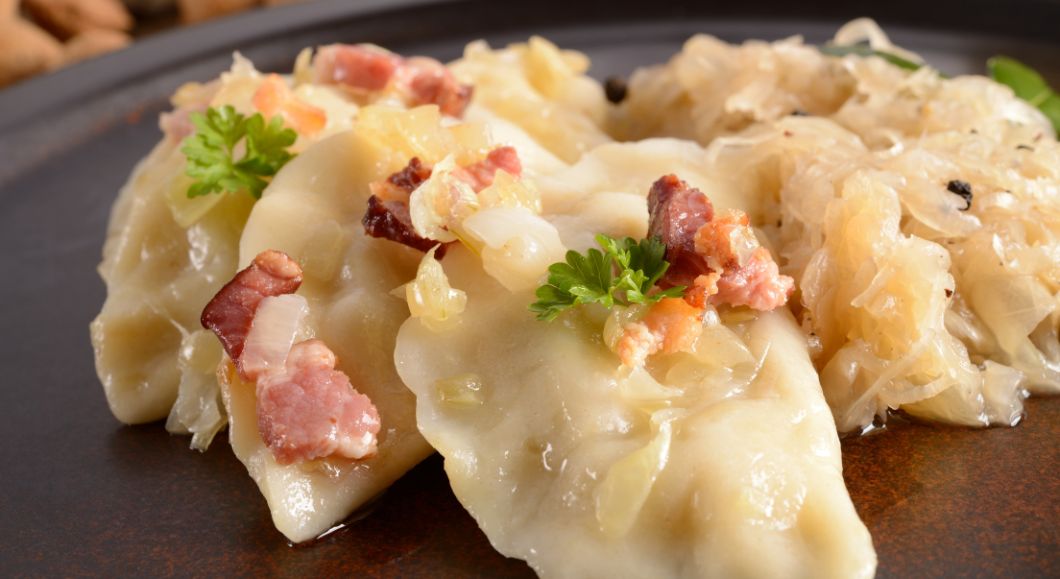
The food is traditional Polish: pierogi in their various forms (ruskie, with meat, with cabbage and mushrooms, fried, boiled), barszcz (beetroot soup), żurek (sour rye soup with sausage and egg), gołąbki (stuffed cabbage rolls), schabowy (fried pork cutlet), kotlet mielony (meat patty), potato pancakes, bigos (hunter’s stew of cabbage and meat), naleśniki (crêpes with sweet or savoury fillings), and the eternal side dish of boiled potatoes with dill. There will be kompot on the menu — a sweet, cold drink made from cooked fruit that is essentially the national non-alcoholic beverage.
Portions are large. Prices are governed partly by government subsidy and partly by the social contract of the milk bar, which is: the food is cheap because that’s the point.
A note on the menu language situation: in the most authentic milk bars, there is no English menu. This is not unfriendly — it’s simply how it is. Bring Google Translate, be willing to point, and ask politely. Nobody will be rude. Alternatively, the more tourist-facing places have English menus, which costs you nothing in quality but a little in atmosphere.
Bar Mleczny Pod Temida — The Old Town Option
Address: ul. Grodzka 43 | (map: corner of Grodzka and Poselska, on the Royal Route)
The only true milk bar still operating within the Old Town walls, Pod Temida has survived precisely because of its location — it sits on Grodzka Street, the Royal Route that leads from the Market Square south to Wawel Castle, on a stretch that’s thick with tourists. This means it’s busier than the out-of-centre options and slightly more expensive (by milk bar standards — the pork cutlet is still under 30 PLN). It also means it has adapted slightly: the staff here cope with foreign visitors better than elsewhere.
The interior is the draw for non-regulars. The space has low-vaulted brick ceilings that feel genuinely medieval — you’re eating a plate of Silesian dumplings in a room that has been some kind of building since the 13th century. The kluski śląskie here (thick, chewy Silesian-style dumplings with a dimple pressed in the centre) served in mushroom sauce are excellent. So is the żurek — the sour rye soup arrives in a generous bowl with sliced sausage and hard-boiled egg, and it costs less than a coffee elsewhere on Grodzka.
Go early for lunch — by noon it fills up. The queue moves quickly.
Milkbar Tomasza — The Tourist-Friendly Entry Point
Address: ul. Tomasza 24 | (map: two minutes’ walk north of the Market Square)
Milkbar Tomasza is the milk bar that most tourists visit first, which makes it both the easiest recommendation and the most contested one. It’s a contemporary take rather than a pure survivor — the interior has been deliberately designed to feel welcoming rather than grimly institutional, with exposed brick, wood tabletops, round pendant lights, and large windows. The menu is bilingual. The staff speak English. There are breakfast options including what the regulars apparently call “the best breakfast in Krakow,” including a Polish version of a full Irish and several omelette variations.
For all of this, it is genuinely a milk bar in spirit: the prices are low, the food is Polish, the portions are generous, and pierogi ruskie cost about what they should cost. The fried pierogi here are particularly good. It’s also the only milk bar in Krakow that regularly offers the choice between fried and boiled dumplings, which is useful for understanding the difference.
The criticism is fair — it’s more polished than authentic, and the crowd is heavier on tourists than locals. But for a first milk bar experience, it works perfectly. And the breakfasts, served until midday, are genuinely excellent.
Bar Mleczny Krakus — The Authentic Local Version
Address: ul. Limanowskiego 16 | (map: Podgórze district, 15-minute walk south of Kazimierz across the Vistula)
If Pod Temida is the convenient choice and Milkbar Tomasza is the tourist-facing choice, Bar Krakus is the real thing. It’s in Podgórze — the neighbourhood across the river from Kazimierz where the Krakow Ghetto was established in 1941, now a quiet, local residential district with very little tourist infrastructure. Getting there requires a commitment (tram, bus, or a pleasant 20-minute walk from the Old Town), but that commitment is what keeps it as it is.
The interior is a model of communist-era functionality: checkered floor, simple wooden tables, the counter with its warming trays, the large yellow-and-black menu on the wall. Workers from the neighbourhood have been eating lunch here for decades. Pensioners come daily. The prices are the lowest of any milk bar convenient to the centre — pierogi ruskie for around 8–10 PLN, soup for under 5 PLN, a main course with sides for 15–20 PLN total.
The staff speak Polish and nothing else, which is entirely consistent with the bar’s identity. Point, smile, use Google Translate. Nobody will be hostile. The food is exactly what it should be: home cooking made by people who learned from their mothers, not from a culinary school. The bigos here — the sauerkraut and meat stew that Poles will tell you their grandmother makes better than anyone else — is excellent.
A side trip: Krakus Mound is less than a kilometre southeast of the bar, a prehistoric earthen mound with panoramic views over the city. It makes for a pleasant post-lunch walk.
Bar Mleczny Centralny — Nowa Huta for the Full Experience
Address: Osiedle Centrum C 1 | (map: Plac Centralny in Nowa Huta, 25-30 minutes by tram from Old Town)
This is the one that milk bar devotees argue is the most authentic in all of Poland. Bar Mleczny Centralny opened in Nowa Huta in the early 1950s as part of the first wave of construction of the communist model city — built at the same time as the apartment blocks and administrative buildings surrounding Plac Centralny, which is now officially Ronald Reagan Central Square. It has barely changed since.
No English menu. No concessions to tourism. The same subsidised government pricing that has kept it open through every economic transformation since the communist era. When an article in 2021 reported that the bar might be struggling financially, regulars and well-wishers flooded back in solidarity — because in Nowa Huta, the milk bar is part of the neighbourhood’s identity in a way that transcends the food.
Getting there: Tram 4 from Poczta Główna in the Old Town, or Tram 22 from Stradom in Kazimierz, both to Plac Centralny im. R. Reagana. The journey takes around 25–30 minutes and the bar is steps from the tram stop. Combining the meal with a walk around Nowa Huta’s socialist-realist architecture makes for one of the more unusual afternoons you can spend in Krakow.
What to Order
If you’re standing at the counter trying to decide, these are the safe and excellent choices at any Krakow milk bar:
Pierogi ruskie — the national default. Dumplings filled with potato, white cheese, and onion. Served boiled or sometimes fried.
Żurek — the sour rye soup. Served with hard-boiled egg and kielbasa sausage, often in a hollowed-out bread roll at the more traditional places. Warm, sour, filling, and entirely unlike anything you’ve tasted before.
Schabowy — fried pork cutlet, like a schnitzel but with its own distinct flavour from the Polish breadcrumb coating. Served with boiled potatoes with dill and some kind of cooked vegetable, usually cabbage or beets.
Barszcz — clear beetroot soup with small mushroom-filled uszka dumplings floating in it. A vivid, slightly sweet, deeply earthy broth.
Kompot — order it. It’s weird the first time (a cold sweet fruit drink with no carbonation), it’s comforting every time after.
Practical Notes
Milk bars are open for lunch, generally from around 10 AM to 4 or 5 PM. They are not dinner venues. Arrive between noon and 1 PM on weekdays for the full atmosphere of working Krakow eating lunch.
Cash is preferred at most places, though some now accept cards. Bring small bills.
The government subsidy that keeps prices low is still in place for registered milk bars. Part of what you’re doing by eating at one is supporting an institution that provides genuinely affordable nutrition to people who need it — students, pensioners, lower-income residents. The food is cheap not just for tourists but for everyone, by design.
At most bars, there is no table service. You order at the counter, carry your food yourself, and return your tray. The efficiency of the system means the queue moves fast even when the place is full.