Krakow is one of those rare cities that was made for walking. The Old Town is almost entirely pedestrianised, compact enough to cross on foot in twenty minutes yet dense enough with history, architecture, and atmosphere to occupy you for days. The streets are cobbled and uneven in the way that medieval streets always are, the buildings lean slightly toward each other across narrow alleys, and around almost every corner there is something that stops you — a courtyard, a fragment of medieval wall, a church whose interior turns out to be extraordinary.
The city survived the Second World War largely intact, which makes it unusual among major Polish cities. What you walk through is not a reconstruction but the genuine article: a medieval and Renaissance urban landscape that has been inhabited continuously for over a thousand years. That continuity is palpable. It gives Krakow a depth of atmosphere that newer cities, however beautiful, simply cannot replicate.
The best way to understand this city is through its neighbourhoods, and the best way to understand its neighbourhoods is on foot. What follows are three walks that together cover Krakow’s essential territory — the Royal Road through the Old Town, the Jewish quarter of Kazimierz, and the former ghetto district of Podgorze — each with its own character, its own history, and its own reasons to take your time.
Walk One: The Royal Road
The Royal Road is Krakow’s spine — the processional route along which Polish kings rode from the city gates to Wawel Castle for their coronations, and along which their bodies were carried in the other direction when they died. It runs from the Florian Gate in the north, through the Main Market Square, south along Grodzka Street, and up the hill to Wawel. It is roughly two kilometres from end to end and passes the greatest concentration of significant buildings anywhere in Poland.
The Florian Gate itself is a good place to start. The 14th-century tower is one of the few surviving fragments of the medieval city walls, connected to the round Barbican — a fortified gatehouse built in 1499 that stands in the green ring of the Planty gardens encircling the Old Town. From the Barbican, Florianska Street leads south into the heart of the city, lined with the kind of tenement houses that once belonged to merchants wealthy enough to build in stone.
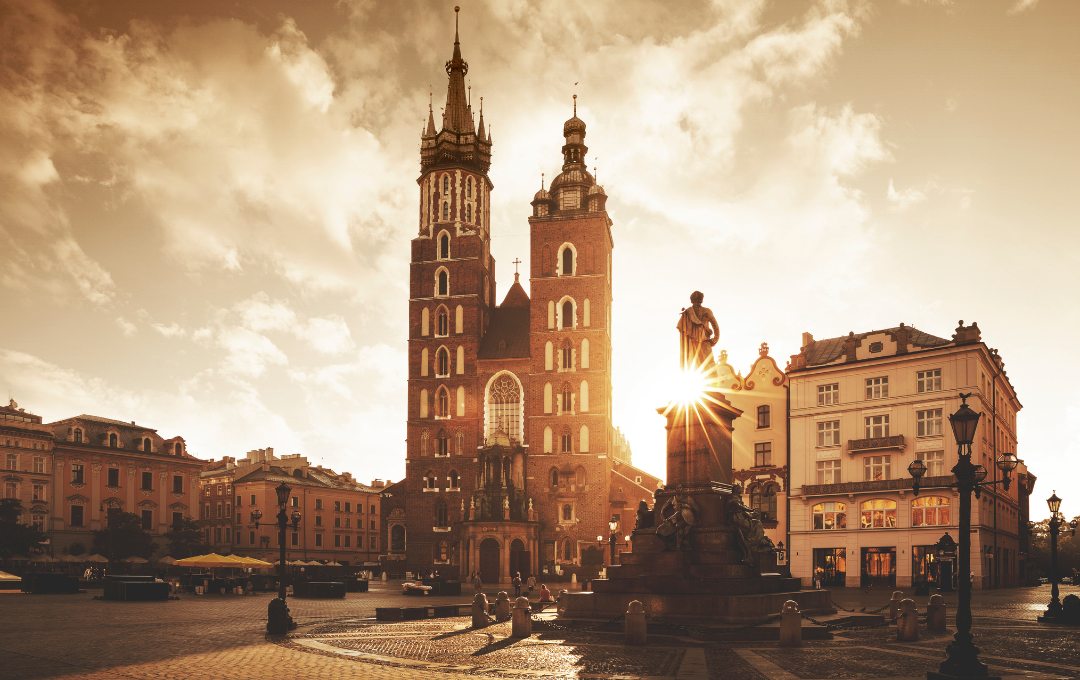
The Main Market Square — Rynek Glowny — is the largest medieval square in Europe and the social centre of Krakow at any hour of the day or night. The Cloth Hall at its centre, a long Renaissance arcade rebuilt in the 16th century after a fire, now houses a market of amber, folk art, and souvenirs on the ground floor and a fine art gallery above. St Mary’s Basilica on the eastern side of the square is a Gothic masterpiece whose interior — the carved and gilded altarpiece by Veit Stoss, the painted nave ceiling in deep blue and gold — is one of the most beautiful in Central Europe. Every hour, on the hour, a trumpeter plays a brief melody from the taller of the two towers, breaking off mid-phrase in commemoration of a medieval watchman killed by an arrow while sounding the alarm during a Tatar raid.
From the square, Grodzka Street carries the route south through a succession of Baroque churches and Renaissance arcaded courtyards toward Wawel Hill. The hill itself — a limestone outcrop rising above the Vistula — holds the Royal Castle and the Cathedral in a complex that was the centre of Polish political and spiritual life for five centuries. The Cathedral crypts contain the tombs of Polish kings, national heroes, and poets; the castle courtyard is one of the finest Renaissance spaces in northern Europe.
The full Royal Road walk takes around two to three hours at a sightseeing pace, longer if you go inside the castle or the cathedral. A detailed interactive guide to the route is available at travelguide.polandtraveltours.com — it covers every significant stop with background that enriches what you’re looking at.
Walk Two: Kazimierz
Kazimierz occupies a position in Krakow that is historically, architecturally, and emotionally distinct from the Old Town. Founded as a separate city in 1335 by King Casimir the Great — who gave it his name — it became from the late 15th century the centre of Jewish life in southern Poland, a community that grew over four centuries into one of the most significant in Europe. By 1939, around 65,000 Jews lived in Krakow, the majority in and around Kazimierz.
Almost all of them were murdered during the German occupation. The community that had existed here for four centuries was destroyed within a few years. What Kazimierz holds today is both the physical fabric of that world — synagogues, cemeteries, the street layout that has barely changed — and the absence at its centre of the people who made it what it was.
The neighbourhood is not a museum, however. Since the 1990s, Kazimierz has become one of Krakow’s most alive and creative districts — its former Jewish streets now lined with independent cafés, bookshops, galleries, and restaurants that bring a different kind of energy to the old buildings. The tension between the weight of history and the vitality of contemporary life is part of what makes Kazimierz unlike anywhere else in Poland.
The walk begins naturally at Szeroka Street — a wide, elongated square that was the heart of the Jewish quarter, lined with synagogues and restaurants. The Old Synagogue at the southern end, dating to the 15th century, is the oldest surviving Jewish religious building in Poland and houses a museum of Jewish history and religious objects. The Remuh Synagogue, still an active place of worship, has a cemetery beside it where tombstones dating to the 16th century survive, some partially buried under centuries of accumulated earth.
From Szeroka Street the walk moves west through the tighter streets of the old quarter — Jozefa Street, Estery Street, the small squares where the daily life of the community once took place — toward the New Square, Plac Nowy, which is the social heart of contemporary Kazimierz. The round building at its centre, once a ritual slaughterhouse, is now surrounded by food stalls that serve zapiekanki — open-faced toasted baguettes that have become Krakow’s signature street food — and the square’s bars and cafés fill with locals and visitors from late afternoon onward.
The Galicia Jewish Museum on Dajwor Street, housed in a former factory building, has a permanent photographic exhibition documenting the traces of Jewish life in the Galicia region that is one of the most thoughtful and affecting pieces of historical documentation you will encounter in any museum in Poland.
Allow three hours for Kazimierz at minimum, more if you want to sit in the square, visit the museum, and eat properly. The neighbourhood rewards unhurried time. A full walking guide to the Kazimierz route with points of interest mapped and explained is at travelguide.polandtraveltours.com.
Walk Three: Podgorze
Podgorze sits on the south bank of the Vistula, directly opposite Kazimierz, and it holds the darkest chapter of Krakow’s history. When the Germans occupied Krakow in 1939, they ordered the city’s Jewish population — by then around 65,000 people — to relocate across the river to Podgorze, which was sealed off with walls in March 1941 to create the Krakow Ghetto. At its most crowded, the ghetto contained over 15,000 people in conditions of deliberate deprivation. Between 1942 and 1943, the population was systematically murdered or deported to the Belzec and Auschwitz-Birkenau extermination camps. The ghetto was liquidated in March 1943.
What remains in Podgorze today are fragments: sections of the original ghetto wall, the surviving buildings of Ghetto Heroes Square, the Eagle Pharmacy on the corner of the square where the Polish pharmacist Tadeusz Pankiewicz — the only non-Jewish resident permitted to remain in the ghetto — documented what he witnessed and provided whatever help he could to the people imprisoned there. His pharmacy is now a museum.
A few streets away, on Lipowa Street, stands the former enamel factory of Oskar Schindler — the German industrialist who employed over a thousand Jewish workers from the Krakow ghetto in his factory, protecting them from deportation and death. After the war, almost all of his workers survived. The factory is now the Museum of Krakow Under Nazi Occupation, one of the most important and well-designed historical museums in Poland. The permanent exhibition covering the German occupation of Krakow from 1939 to 1945 takes a full two to three hours and requires emotional stamina, but it is worth every minute.
The Podgorze walk is quieter and less obviously beautiful than the Royal Road or Kazimierz. There are fewer tourists and fewer cafés. What it offers is something harder to find in the more visited parts of the city: a direct encounter with history in the actual places where it happened, without much in the way of mediation between you and what occurred here. The ghetto wall fragments on Lwowska Street, the pharmacy on the corner of the square, the view from the Krakus Mound over the rooftops of the district — each of these carries a weight that stays with you.
The Podgorze walk takes around two to three hours depending on how long you spend in the Schindler’s Factory museum. A full guide to the route with historical context at each point is available at travelguide.polandtraveltours.com.
Putting it together: walking Krakow over two or three days
The three walks described here can be done independently on separate days, or combined into a longer programme depending on how much time you have. The Royal Road and Kazimierz connect naturally — they are separated by a ten-minute walk and many visitors do both in a single day, with a long lunch in Kazimierz between them. Podgorze is best given its own day, particularly if you plan to spend time in the Schindler’s Factory museum.
A few general notes for walking Krakow. The Old Town is extremely busy in July and August, particularly around the Main Market Square — mornings before 10am are notably calmer and the light is better for photographs. Kazimierz is best from late afternoon onward, when the neighbourhood’s contemporary life is fully awake. Podgorze is quietest and most affecting on weekday mornings.
Wear shoes with grip. The cobblestones throughout the Old Town and Kazimierz are uneven, particularly after rain when they become slippery. The distances involved in all three walks are manageable — none covers more than four kilometres — but the terrain underfoot makes comfortable footwear more important than it might seem on a map.
All three routes are available as interactive digital guides at travelguide.polandtraveltours.com, with maps, historical notes, and practical information for each stop. Whether you use them as preparation before you arrive or navigate with them in hand as you walk, they give the streets of Krakow a context that makes every step more rewarding.