Most visitors to Poland follow a well-worn path: Krakow, Warsaw, Gdansk, perhaps Wroclaw. Bialystok sits far to the east of that circuit, close to the Belarusian border, and most international tourists never make it there. That is, in the most literal sense, their loss — because Bialystok is one of the most genuinely interesting cities in Poland, with a character entirely its own, and it serves as the gateway to some of the most remarkable natural landscapes on the continent.
The city is the capital of the Podlaskie region, an area that has been, throughout its history, a meeting point of cultures, religions, and languages. Catholics and Orthodox Christians, Poles and Belarusians, Jews and Tatars — all left their mark here, and the city’s architecture, its churches, its street layout and its stories reflect that layered past in ways you don’t find anywhere else in the country. Add to this a young, energetic population, excellent food, very few tourists, and prices that feel like a different economic universe compared to Krakow or Warsaw, and Bialystok starts to look less like an oversight and more like a secret.
Branicki Palace and the “Versailles of Poland”
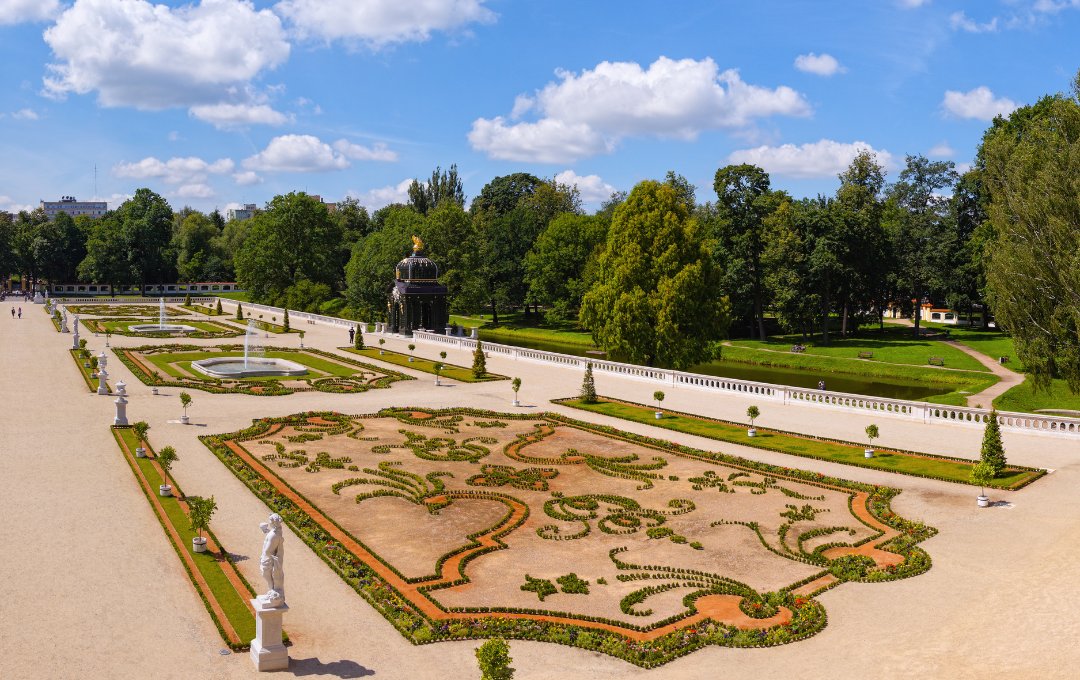
The single most impressive thing in Bialystok is the Branicki Palace, and it announces itself with considerable grandeur on a quiet street near the city centre. The palace was built in the early 18th century by Jan Klemens Branicki, a powerful Polish magnate and military commander who harboured ambitions — never realised — of becoming King of Poland. He spent accordingly. The result was a Baroque complex of palace, formal gardens, pavilions, orangeries, and sculpted terraces that earned it the nickname the Versailles of Poland, a comparison that sounds like local pride but is actually defensible when you see it.
The Germans destroyed the palace during the Second World War. What stands today is a careful post-war reconstruction, and it now houses the Medical University of Bialystok — which means the interior is not open to the general public in the way a conventional palace museum would be. What is open, and what is the real reason to come, are the gardens: a formal Baroque landscape of geometric lawns, topiary, stone vases, fountains, and carefully maintained hedgerows that is the finest example of Baroque garden design in Poland. Entry to the gardens is free. They are at their most beautiful in late spring and early summer, though they retain their formal elegance throughout the growing season.
The palace and its grounds occupy a central position in the city, and an hour spent walking the gardens before heading into the Old Town sets the right tone for a Bialystok visit.
The Old Market Square and Lipowa Street
From the palace gardens, a short walk south brings you to Rynek Kosciuszki — the Old Market Square, laid out in an elongated triangular shape and lined on its western side with a row of townhouses whose facades carry ornate sgraffito decoration. The former Town Hall at the centre of the square now houses the main building of the Podlachian Museum, covering the history and ethnography of the Podlaskie region. The collection is worth an hour, particularly the sections on the multicultural character of the region before the Second World War.
On a warm day the square fills with café tables and has the relaxed, unhurried atmosphere that Bialystok carries more generally — a city that hasn’t been groomed for mass tourism and is better for it. The Cathedral Basilica of the Assumption of the Virgin Mary stands at the eastern end, the oldest Catholic church in the city, its red brick facade a strong presence on the square’s skyline.
From the market square, Lipowa Street — the city’s main boulevard — runs north past the city’s most significant buildings. The Orthodox Church of St Nicholas, midway along the street, is the main Orthodox church of Bialystok and of the Polish Army, a beautifully proportioned neoclassical building dating to the 1840s. Further north, the street passes a statue of Ludwik Zamenhof — of whom more shortly — before arriving at the Church of St Roch, an extraordinary modernist structure that looks from a distance like a ship or lighthouse and was designed in the 1920s as a symbol of Polish independence. Its white tower is one of the most recognisable landmarks on the Bialystok skyline.
The inventor of Esperanto
There is a fact about Bialystok that most visitors don’t know and which produces a genuine double-take: Esperanto — the constructed international language with around two million speakers worldwide — was invented here, by a Bialystok-born doctor named Ludwik Lazarz Zamenhof.
Zamenhof was born in 1859 in a city that was, at the time, a turbulent meeting point of Polish, Russian, Jewish, and German communities who shared a city but largely couldn’t communicate with each other. He grew up watching the misunderstandings and tensions that language barriers created and became convinced that a shared neutral language could reduce conflict between peoples. He spent his adolescence and young adulthood developing Esperanto, publishing the first grammar guide in 1887 under the pseudonym “Doktoro Esperanto” — Dr Hopeful — which gave the language its name.
The Museum of Ludwik Zamenhof on Warszawska Street covers his life and the story of the language he created, with exhibits on the spread of Esperanto across the world and the communities that still use it today. The statue of Zamenhof on Lipowa Street and the square named in his honour in the city centre give a sense of how genuinely proud Bialystok is of this connection. It is an unlikely but entirely true story, and it captures something essential about the city’s multicultural character.
The Memorial Museum Sibir
Opened in 2021, the Memorial Museum Sibir is one of the most significant new museums in Poland and covers a chapter of history that is still relatively unknown in Western Europe. In 1940 and 1941, Soviet forces deported over 300,000 people from the territories they occupied in eastern Poland to Siberia and the steppes of Kazakhstan — Poles, Jews, Ukrainians, Belarusians, and other minorities, arrested in waves and transported east in cattle wagons under conditions of extreme brutality. Many died during the journey. Many more died in the labour camps and special settlements where they were sent.
Bialystok was among the most affected areas, and the museum documents the deportations with considerable depth and care — original documents, personal testimonies, photographs, and objects brought back by those who survived. It is a museum about a specific historical crime, but it is also a museum about the broader experience of displacement, survival, and memory, and it achieves a level of emotional and historical intelligence that compares favourably with the best memorial museums in the country. Allow two hours.
Multicultural heritage and religious architecture
Bialystok’s position at the crossroads of Catholic, Orthodox, Jewish, and Muslim communities for centuries left a physical legacy in its buildings. The variety of religious architecture concentrated in a relatively small area is one of the things that makes the city genuinely distinctive.
Beyond the Orthodox church of St Nicholas and the Catholic Cathedral, there is a mosque in the city centre — a reminder of the Tatar community whose presence in the Podlaskie region dates back to the 14th century, when Tatar cavalry units were invited to settle here by the Polish-Lithuanian Grand Dukes who valued their military skills. The Tatar community maintained their Muslim faith across six centuries, and their presence in the broader Podlaskie region is one of the most unusual historical facts about this part of Europe.
The Jewish heritage of Bialystok is largely absent in physical terms — the community was destroyed during the German occupation and the Great Synagogue was demolished — but traces remain in the street names, in the Zamenhof story, and in the Memorial Museum Sibir, where the Jewish deportees of 1940 are part of the broader account. The Ghetto Uprising monument near the former ghetto area commemorates the Jewish revolt of 1943, one of the largest acts of armed Jewish resistance during the war outside of Warsaw.
Street art and the WidziMisie trail
Bialystok has developed a genuinely impressive street art scene in recent years, concentrated around the side streets off Lipowa and in the Bojary district. The most famous single work is the Girl with a Watering Can by Polish artist Natalia Rak — a monumental mural on a Soviet-era apartment block that has become one of the most recognisable pieces of street art in the country.
For families or anyone who enjoys an organised wander, the WidziMisie Sculpture Trail is a city-wide scavenger hunt involving 24 small bronze bear sculptures hidden around the city centre, each representing a different aspect of Bialystok life — a musician outside the Opera, a student on University Square, a cyclist near Pilsudski Avenue, a football fan near the stadium. The bears were created by local artists and placed around the city as a way of encouraging people to explore beyond the main sights. A map is available from the tourist information office and the trail takes around two hours to complete.
Around Bialystok: three exceptional day trips
The countryside surrounding Bialystok contains some of the most remarkable natural and cultural sites in Poland, and the city makes an excellent base for exploring them.
Bialowieza Forest, around 60 kilometres to the west, is Europe’s last primeval lowland forest — a UNESCO World Heritage Site and biosphere reserve that has never been felled, its ancient trees and extraordinary biodiversity preserved in a landscape that looks today much as the forests of Central Europe looked a thousand years ago. The European bison, hunted to extinction in the wild by the 1920s and reintroduced from captive breeding programmes, now live here in a free-ranging herd of several hundred animals. Entry to the strictly protected core of the forest is only possible with a licensed local guide — tours depart from the village of Bialowieza — and the experience of walking through genuinely ancient woodland with a naturalist who knows every species and sound is unlike anything available elsewhere in this part of Europe.
The town of Tykocin, around 30 kilometres west of Bialystok, is one of those Polish small towns that time has dealt with gently. The Baroque parish church and the town square have a completeness that feels almost theatrical in its preservation. The Great Synagogue, one of the finest Baroque synagogues in Poland and one of very few that survived the war intact, houses a museum of Jewish culture and religious art that is considered among the best of its kind in the country.
The Biebrza Marshes, to the southwest of Bialystok, are the largest wetland area in Central Europe and one of the most important bird habitats in the world. Spring migration — from late March through May — brings thousands of birds to the marshes, and birdwatchers travel from across Europe to witness it. The elk (moose) population is the largest in Poland. Walking the boardwalk trails through the reed beds in early morning, with the sounds of birds in every direction and nobody else in sight, is one of those experiences that stays with you.
Getting to Bialystok
Direct trains from Warsaw run frequently throughout the day and take around an hour and forty minutes on the fastest services — a shorter journey than many visitors expect. The main railway station is a ten-minute walk from the Old Market Square and the city centre. Buses are also frequent from Warsaw and take slightly longer depending on traffic.
Allow at least two days in and around Bialystok to do the city justice and reach at least one of the surrounding natural areas. The city is compact and walkable, most of the major attractions are free or very inexpensive, and the restaurant and café scene along Lipowa Street and around the Old Market Square is genuinely good. Bialystok will not overwhelm you with famous sights. It will give you something better: the feeling of a city that is being visited on its own terms.