Krakow is, by some measure, the best-positioned city in Poland for day trips. Auschwitz-Birkenau is an hour to the west. Wieliczka Salt Mine is 14 kilometres away — you can be underground in 40 minutes. Zakopane and the Tatra Mountains are 100 kilometres south, two hours by bus. Ojców National Park with its castle ruins and limestone gorges is 25 kilometres north. The geography is generous, and the city rewards visitors who treat it as a base rather than just a destination.
The challenge, as with Warsaw, is that Krakow itself deserves several days — and the day trips compete with the city rather than supplementing it. The practical approach for most visitors: plan three full days in Krakow, then choose one or two day trips based on what you most want to see. This guide covers the options honestly.
Auschwitz-Birkenau: The Trip That Changes Everything
Distance: 66 km west | Journey: 1–1.5 hours by bus or tour
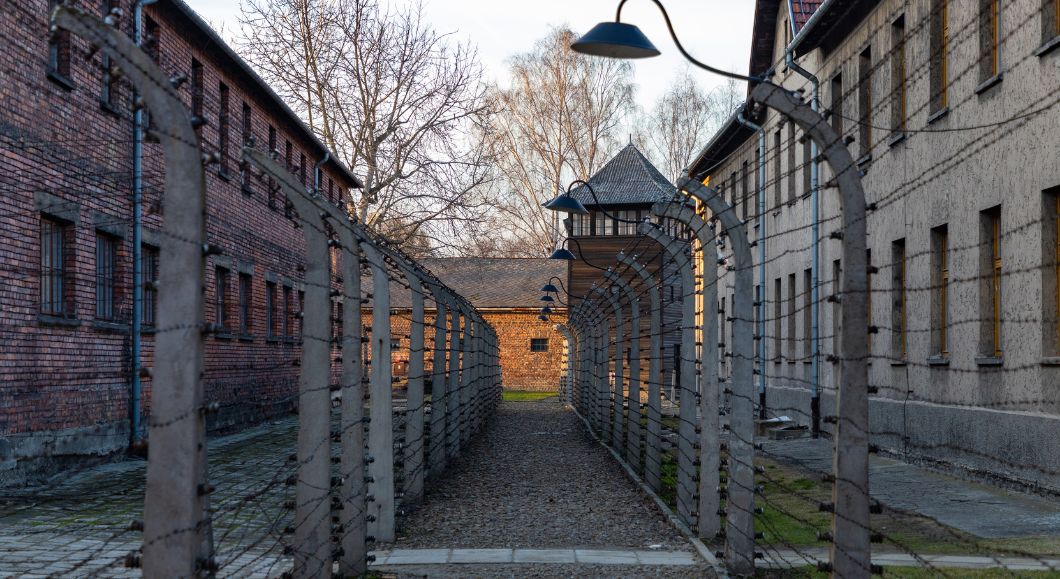
The Auschwitz-Birkenau Memorial and Museum is the most visited site in Poland. Over 2 million people come every year. It needs to be said clearly: this is not tourism in the ordinary sense. It is a visit to the place where 1.1 million people — the overwhelming majority of them Jews — were systematically murdered between 1940 and 1945. The decision to go should be made consciously, not reflexively.
The memorial is divided into two main sites. Auschwitz I is the original camp — brick barracks, the iron “Arbeit Macht Frei” gate above the entrance, the room containing the personal belongings of victims (mountains of shoes, glasses, hair, suitcases). Auschwitz II-Birkenau is three kilometres away and on an entirely different scale: 300 barracks, 170 hectares, the train tracks that ran directly to the selection platform, the ruined crematoria that the SS blew up before retreating. Seeing both camps requires a full day and 3.5–4 hours at minimum for a guided visit.
Guided tours are strongly recommended for first-time visitors. The context provided by a licensed guide is not something an audioguide adequately replaces — the human element matters here. Book in advance: guided tours for specific time slots sell out weeks ahead in summer. Tours operate in English, Polish, and other languages.
Getting there from Krakow: direct buses run from the main bus station, taking around 1.5 hours. Organised tours with transport are available and handle all logistics. The advantage of a tour is that you arrive with a guide and leave with coherence; the advantage of independent travel is flexibility.
Allow time after the visit. Most people need it.
Wieliczka Salt Mine: Underground Poland
Distance: 14 km southeast | Journey: 25–40 minutes
The Wieliczka Salt Mine has been drawing visitors since 1722 — Copernicus, Goethe, and Chopin all made the trip. It was one of the first twelve sites inscribed on the UNESCO World Heritage List in 1978. Salt was extracted here continuously from the 13th century until 1996, generating at peak production roughly a third of all Polish state revenue. The kings of Poland kept their treasury afloat on Wieliczka salt. Much of what Krakow built in its golden age was financed by it.
What visitors see is not a sanitised tourist attraction but the actual mine — 327 metres deep, over 287 kilometres of passages across nine levels, of which the Tourist Route covers 3.5 kilometres through the oldest three. The descent begins down 380 wooden stairs into the shaft. The temperature underground stays at a constant 14–16°C year-round; bring a light layer.
The chambers along the route are extraordinary — carved entirely from rock salt, which in its natural state is grey and black and white, resembling unpolished granite rather than table salt. Large wooden machinery used to haul salt to the surface is preserved in the protected underground atmosphere. Underground lakes appear unexpectedly, their surfaces still and reflective in the torchlight.
But the centrepiece of the visit, and the thing that photographs cannot prepare you for, is the Chapel of St. Kinga — an underground church 101 metres below the surface, 54 metres long, 18 metres wide, 12 metres high, carved entirely from salt by three men over 67 years. The floor is polished salt that shines like marble. Chandeliers made of crystallised salt hang from the ceiling. The walls carry bas-reliefs of biblical scenes including a copy of Leonardo’s Last Supper, all carved in salt. The acoustics are exceptional — the chapel still hosts masses, weddings, and concerts. When the lights dim for the brief multimedia presentation inside, the scale becomes somehow more apparent.
The legend behind the mine involves Princess Kinga of Hungary, who in 1239 married the Polish Duke Bolesław V. As her dowry, she asked not for gold but for salt — the resource her future subjects needed most. She threw her engagement ring into a Hungarian salt mine shaft before leaving. When she arrived in Poland and ordered miners to dig, they found salt — and inside the first lump of rock salt, her ring. She became the patron saint of salt miners. The chapel is dedicated to her.
Practical details: Tickets cost around 140–150 PLN for adults on the Tourist Route. Tours run continuously throughout the day in multiple languages; English tours are frequent. Book online in advance — slots between 10 AM and 2 PM sell out 3–5 days ahead in peak season. The return to the surface is by lift; you don’t have to climb back up. Allow 2.5–3 hours total.
Zakopane: Mountains on Your Doorstep
Distance: 100 km south | Journey: 2 hours by bus, 2.5 hours by train
Everything about the Zakopane day trip from Krakow is covered in more detail in the Zakopane guide, but the summary is simple: this is the most scenic day trip available from Krakow and one of the best introductions to Polish mountain culture for visitors who haven’t encountered the Tatra region before.
The bus from Krakow’s main bus station (MDA) runs frequently — roughly every 30 minutes in summer — and takes around 2 hours depending on traffic. The journey crosses the Malopolska countryside and ends with a descent toward Zakopane that opens the view of the full Tatra range ahead of you.
A day in Zakopane can be structured in several ways depending on your interests. For walkers and hikers, the immediate options from town are the Chochołowska Valley (a long, flat valley walk through limestone scenery), the Kościeliska Valley (similar character, with accessible caves), or the cable car to Kasprowy Wierch at 1,987 metres for ridge views extending into Slovakia. For those who want atmosphere without a serious hike, the Gubałówka funicular (4 minutes to 1,120 metres) gives panoramic views over the entire town and mountain range, and Krupówki Street provides an hour of strolling, smoked cheese, and Góral folk culture. The Tatra National Park entry ticket costs 55 PLN per adult for a weekly pass.
The return bus from Zakopane to Krakow also runs frequently into the evening. A full day gives you 7–8 hours in Zakopane, which is enough for either a substantial mountain walk or a relaxed town visit with one cable car ascent.
Ojców National Park: Hidden Close to Home
Distance: 25 km north | Journey: 30–45 minutes by car or tour
Poland’s smallest national park is one of its most picturesque and one of the most overlooked destinations on the Krakow circuit. Ojców sits in a limestone valley cut by the Pradnik River, flanked by cliff faces and deep forest. The geology here is karst — the same limestone that underlies Krakow — and the landscape is defined by caves, rocky outcrops, and the dramatic Hercules’ Club rock formation, a narrow limestone pillar rising from the valley floor.
The park contains the ruins of two medieval castles. Ojców Castle stands on a promontory above the valley; only the tower and gate survive, but they photograph beautifully against the wooded cliffs. Pieskowa Skała Castle, a few kilometres up the valley, is in much better condition — a Renaissance building on a cliff above the Pradnik with original towers and a loggia courtyard now housing a branch of the Wawel Royal Castle museum. The drive or walk between the two castles, along the valley floor, is one of the most pleasant natural landscapes near Krakow.
Ojców works particularly well for visitors who want natural scenery without the crowds or travel time of Zakopane, or for families with children who want castle ruins and easy walking. Getting there without a car requires a tour or joining a local excursion from Krakow; public transport connections are limited. The park is at its best in spring (wildflowers, green new growth) and autumn (beech and oak colours).
Wadowice: The Town That Made a Pope
Distance: 50 km west | Journey: 1–1.5 hours by bus
Karol Wojtyła — Pope John Paul II — was born in Wadowice in 1920 and spent his childhood here before moving to Krakow as a young man. The town is a pilgrimage destination for Polish Catholics and an interesting cultural visit for anyone curious about the man who led the Catholic Church through the Cold War and played a significant role in the collapse of communism in Eastern Europe.
The house where he was born is now the Wadowice Museum of John Paul II’s Family Home — a well-designed museum covering his childhood, his relationship with the town’s Jewish community (several of his childhood friends were Jewish; the museum handles this history seriously), and his years as priest, bishop, and eventually pope. The exhibitions are modern and multilingual.
The town’s main square is pleasant, the basilica where Wojtyła was baptised stands next to the museum, and the local cream cake — kremówka wadowicka — which Wojtyła is reported to have loved as a child, is sold in every café on the square. Whether or not the papal endorsement is historically accurate, the cakes are excellent.
Getting there: regular buses from Krakow’s main bus station take around 1–1.5 hours. The town is small and walkable once you arrive.
Combining Trips: What Works Together
Auschwitz + Wieliczka in one day is offered by numerous Krakow tour operators and is feasible — Auschwitz in the morning, Wieliczka in the afternoon — but it makes for a very long and emotionally demanding day. The combination works logistically but not emotionally for most visitors. A full day at Auschwitz alone is a more human experience.
Zakopane + thermal baths is the classic Krakow-tour-operator combination: a morning in the mountains, an afternoon at Chochołów or Białka Tatrzańska thermal baths. It works well and suits visitors who want the scenery without a long hike.
Ojców + Pieskowa Skała is a natural pairing since the two sites are in the same valley. Half a day covers both comfortably.
The single most important piece of advice about day trips from Krakow is this: don’t try to do too many. One or two day trips in a four-to-five day visit to Krakow is the right balance. The city itself — the Old Town, Wawel, Kazimierz, the Podgórze ghetto, Nowa Huta — has enough to absorb several days without leaving. The day trips should add to the experience, not replace it.
Practical Notes
All major day trips from Krakow can be organised through local tour operators, who handle transport, tickets, guides, and logistics. The advantage of a tour is efficiency; the advantage of independent travel is pace. For Auschwitz, the only meaningful difference is whether you use the official guided tour at the memorial (strongly recommended regardless of how you get there) or rely on an audioguide.
Book everything in advance for the summer months (June–August). Auschwitz timed entry fills weeks ahead. Wieliczka’s most popular time slots sell out several days in advance. Zakopane is busiest on summer weekends; a weekday visit gives significantly more space on the trails and in the town.