Lower Silesia is castle country. No other region in Poland comes close to the density of fortresses, aristocratic palaces, and medieval ruins concentrated in the landscape between Wroclaw and the Sudeten Mountains. There are over eighty castles within the province alone, with several hundred palaces beside them — a staggering number that makes almost any day trip from Wroclaw an encounter with history on a grand scale.
The reason for this density is the region’s turbulent border history. Silesia passed between Polish, Bohemian, Habsburg, and Prussian control over eight centuries, and every power that held it built, expanded, or fortified something. The result is a landscape layered with medieval origins, Renaissance rebuildings, Baroque additions, 19th-century romantic reconstructions, and — in some cases — Nazi-era interventions that added their own dark chapter to structures already centuries old.
What follows is a guide to the most compelling castles in the region: where they are, what makes each one worth the journey, and how to reach them from Wroclaw.
Ksiaz Castle: the Pearl of Lower Silesia
Ksiaz is the castle that earns Lower Silesia its nickname. The largest castle in Silesia and the third largest in all of Poland after Malbork and Wawel, it sits on a rocky promontory above the forested Pelcznica River valley near Walbrzych, its pink and ochre facades rising in tiers from the tree line in a way that genuinely stops you when you first see it. The building combines Romanesque, Baroque, Renaissance, and neoclassical elements accumulated across seven centuries of construction and reconstruction — the result of having many powerful owners with many different ideas about what a castle should look like.
The most consequential of those owners was the Hochberg family, who held Ksiaz from 1509 until 1941. Over four centuries they transformed a medieval fortress into one of the grandest aristocratic residences in Central Europe, reaching their peak of wealth and influence in the late 19th and early 20th centuries when the family counted among the richest dynasties in Prussia. The most famous resident in Ksiaz’s modern history is Princess Daisy of Pless — born Mary Theresa Olivia Cornwallis-West in Wales, a niece of Winston Churchill, who married into the Hochberg family and lived at Ksiaz from 1891. Her memoirs, written in English, give a vivid account of life in the castle during its final years of aristocratic grandeur.
The Nazis confiscated the castle from the last Hochbergs in 1941, and what followed was one of the more mysterious episodes in the already complicated history of the region. Under the code name Project Riese — German for Giant — forced labourers were put to work digging a vast network of tunnels beneath the castle and the surrounding Owl Mountains. The full purpose of those tunnels has never been definitively established. Documentation was destroyed or hidden as the war ended, and the theories range from a planned underground headquarters for Hitler to facilities for secret weapons research to storage for looted art and treasure. A section of approximately 1.5 kilometres of tunnels is open to visitors today, and the scale of what was carved out of the rock — passages five metres high, wide enough to drive a vehicle through, reinforced with concrete and equipped with the remnants of a narrow-gauge railway — is genuinely staggering. Whatever the intended purpose, the human cost of creating it was enormous: the tunnels were dug by concentration camp prisoners under conditions of extreme brutality.
After the war, the Soviet Army damaged the castle further, and decades of neglect followed before restoration work began in earnest. Today Ksiaz is open to the public as a museum, hotel, and cultural centre, with guided tours covering around 30 of the castle’s 400 rooms and a separate tour of the underground tunnels. The terraced gardens — at their finest between May and October — offer panoramic views over the Waldenburg Highlands that alone justify a visit.
Our guided day trip from Wroclaw combines Ksiaz Castle with the Church of Peace in Swidnica — a UNESCO-listed Baroque timber church of extraordinary interior richness — in a single well-paced day. Details at polandtraveltours.com/en/city-breaks/wroclaw-city-breaks/swidnica-ksiaz.
Czocha and Kliczkow: two castles, two very different characters
In the far west of Lower Silesia, close to the German border and the town of Lesna, Czocha Castle occupies one of the most dramatic positions of any fortress in Poland — a rocky headland jutting into the Lesnianski Reservoir, its dark Gothic towers reflected in the water on still mornings. The view from the lake is the one that appears on every photograph, and it earns the attention.
The origins of Czocha go back to the early 13th century, when it was built as a border stronghold between Silesia and Lusatia. It passed through centuries of ownership — Bohemian kings, Silesian dukes, various German noble families — before falling into ruin in the 18th century. Its current appearance owes everything to a German collector named Ernst Gutschoff, later known as Ernst von Gutschow, who purchased the ruined castle in 1909 and spent the following decades transforming it into a Neo-Gothic fantasy, adding towers, battlements, a drawbridge, and decorative interiors that give the castle its current fairy-tale silhouette. He also stocked it with medieval armour, weapons, tapestries, and furniture collected from across Europe, creating interiors that look and feel genuinely medieval even though much of what you see dates to the early 20th century.
During the Second World War the castle was used for military research. After the war it passed to Polish state administration and spent several decades as a training centre before opening to tourism. Today it operates as a hotel and event venue, with themed rooms available for overnight guests, regular guided tours, and seasonal night tours by lantern that take you through the castle’s ghost legends and darker historical corners. Czocha has also become famous as the setting for live-action role-playing events based on a magical school premise — a Harry Potter-adjacent fantasy scenario that has attracted participants from across Europe and given the castle an unexpected second identity as Poland’s unofficial castle of wizardry.
About an hour’s drive east of Czocha, in the Lower Silesian Forests near Bolesławiec, Kliczkow Castle presents an entirely different character. Where Czocha is dramatic and gothic, Kliczkow is elegant and parkland-romantic — a castle built from the 13th century and expanded through the 19th, now set within an 80-hectare English landscape park of exceptional beauty. The park contains mature chestnut trees, Douglas firs, and Canadian hemlocks of considerable age, and somewhere behind the castle mausoleum there is a horse cemetery created by a 19th-century Prussian prince for his most beloved animals — reportedly the only horse cemetery in Poland, with original tombstones still bearing the horses’ names and dates of death. It is the kind of detail that tells you more about the aristocratic sensibility of that era than any conventional history.
Kliczkow Castle now operates as a luxury hotel, which means that the interiors are not open as a conventional museum. The grounds and exterior are accessible, and the park alone is worth the visit, particularly in autumn when the mixed woodland turns gold and the castle emerges through morning mist in a way that photographers travel considerable distances to capture. Emperor Wilhelm II was a regular guest here between 1877 and 1918 — the castle’s distinguished visitor book being one of those small historical facts that land differently when you’re standing in the courtyard where he once walked.
We combine both castles in a single day trip from Wroclaw that covers Grodziec — a Gothic ruin on top of an extinct volcano — alongside Czocha and Kliczkow. Full details at polandtraveltours.com/en/city-breaks/wroclaw-city-breaks/wroclaw-czocha-castle-kliczkow-castle-tour.
Bolkow Castle, Krzeszow Abbey, and Chelmsko Slaskie
South of Wroclaw, in the foothills of the Sudeten Mountains, a third cluster of historic sites rewards a day’s exploration in a part of Lower Silesia that most visitors never reach.
Bolkow Castle stands on a hill above the small town of the same name, its origins going back to the late 13th century when it was built by the Silesian Piast dukes as a regional stronghold. It changed hands many times over the following centuries — Bohemian kings, Habsburg governors, various German noble families — and was expanded and rebuilt repeatedly before falling into prolonged decline in the 18th and 19th centuries. What stands today is a partial ruin in a state of ongoing restoration: enough survives to give a strong sense of the castle’s original scale and military character, and the tower can be climbed for views over the surrounding Sudeten foothills that rank among the finest in the region. The castle museum inside covers the history of the Piast dynasty in Silesia and the broader story of the region’s medieval period.
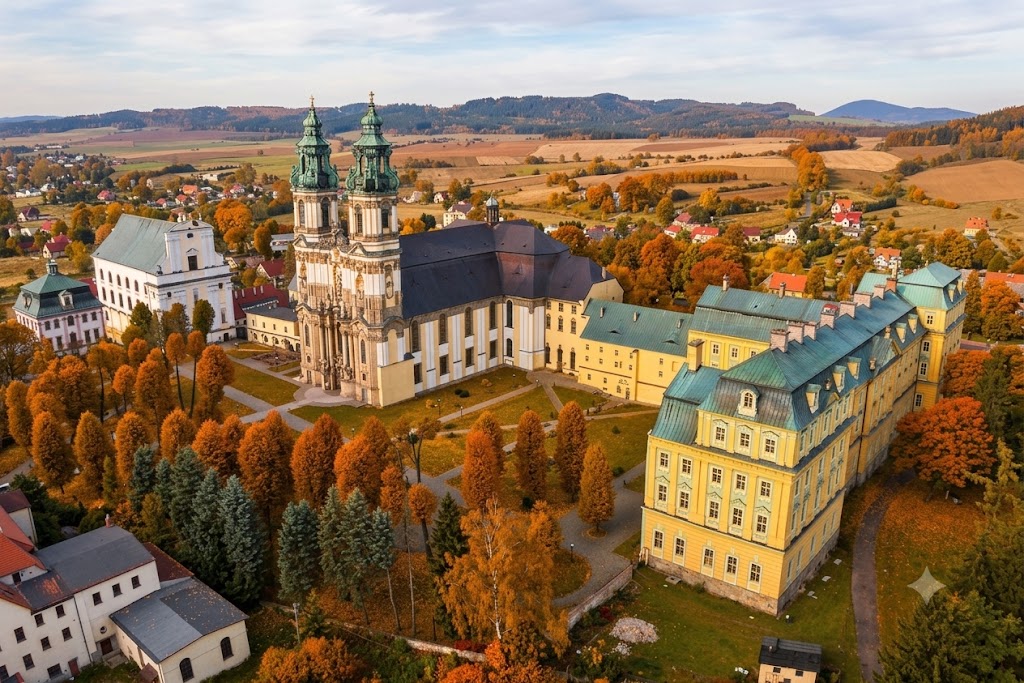
A short drive from Bolkow, the Cistercian Abbey at Krzeszow is one of the most beautiful Baroque complexes in Central Europe — a statement that sounds like the kind of hyperbole that appears on every tourist sign, but in this case is simply accurate. The abbey church, built between 1728 and 1735, has an interior of such extravagance — frescoed ceilings, gilded altars, carved choir stalls, a dome that floods the nave with light — that visitors who stumble upon it without preparation tend to stand in the entrance for a moment unable to quite believe what they’re looking at. The abbey was founded by the Piast Duke Bolko I in 1292 and rebuilt in its current Baroque form under the patronage of the Habsburgs, who used it as a mausoleum for members of the Silesian Piast dynasty. The mausoleum chapel, with its extraordinary sculptural programme, is one of the finest examples of Central European Baroque funerary art anywhere.
Chelmsko Slaskie, a small town nearby, is included on this route for a single but striking reason: its weavers’ houses. A row of half-timbered arcaded houses dating to the late 17th century lines one of the main streets — built for the linen weavers who were the economic foundation of the town in its prosperous period. The architecture is unusual in Polish terms, more reminiscent of towns in Saxony or Bohemia than anything you’d find in central Poland, and it gives a vivid sense of how deeply the culture and economy of this border region was intertwined with the German-speaking world for centuries before 1945.
This combination of Bolkow Castle, Krzeszow Abbey, and Chelmsko Slaskie makes for one of the more varied day trips available from Wroclaw — moving between military history, religious art of the highest order, and vernacular architecture in a compact geographical area. The full details of the guided tour are at polandtraveltours.com/en/city-breaks/wroclaw-city-breaks/wroclaw-day-trip-bolkow-castle-krzeszow-abbey-and-chelmsko-slaskie.
Lower Silesia as a castle destination
The castles described here are four routes into a region that could occupy weeks of exploration without exhausting its possibilities. Grodziec, the Gothic ruin on a basalt volcanic hill near Zlotoryja, has a setting unlike anything else in Poland. The Valley of Palaces and Gardens near Jelenia Gora — a concentration of aristocratic residences in the foothills of the Karkonosze Mountains, many now being restored as hotels — represents one of the most ambitious heritage conservation projects in the country. The Chojnik Castle ruin above the resort town of Szklarska Poreba offers hiking trails and mountain views alongside its medieval history.
All of it is within two hours of Wroclaw. The city makes an excellent base, and the landscape between it and the Sudeten border repays whatever time you’re able to give it. Lower Silesia is not short on things to see. It is short on visitors who know what’s here. That gap, for anyone who finds it, is an opportunity.