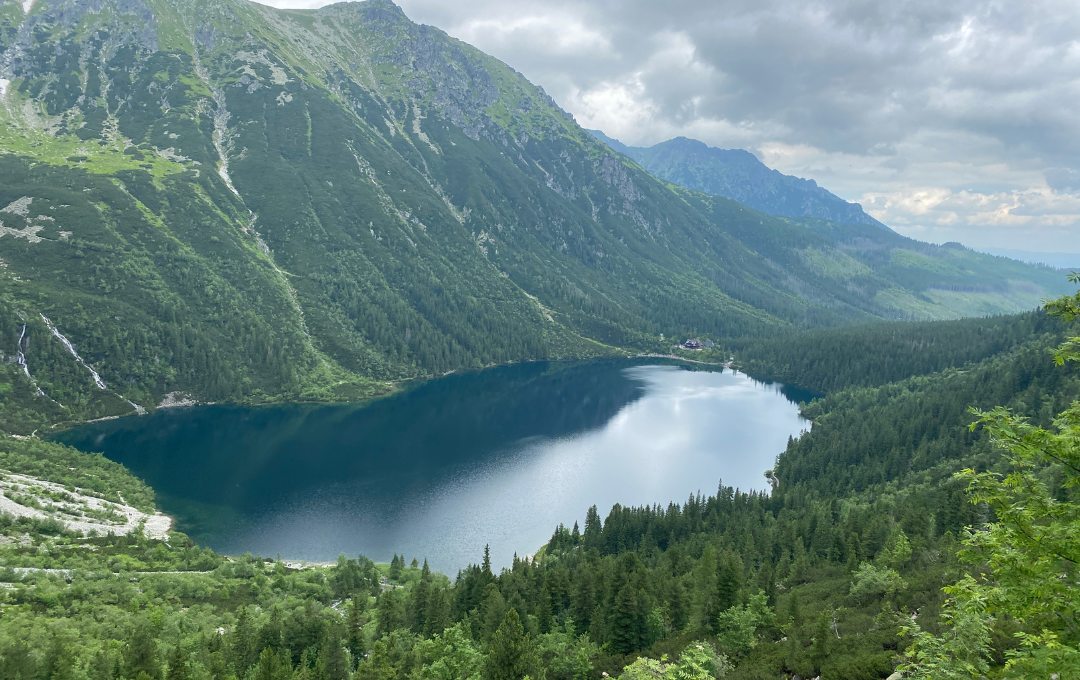
There is a moment, about two hours into the walk from Palenica Bialczanska, when the paved road crests its final rise and the lake appears below you — a deep green oval set into a granite cirque, the peaks of the High Tatras rising on three sides, the surface still and reflective in the morning calm. It is the kind of view that makes two hours of uphill walking feel like a very reasonable price to pay.
Morskie Oko — the Eye of the Sea — is the most famous lake in Poland and the destination of the most popular mountain hike in the country. Every summer, hundreds of thousands of people make the walk from the car park at Palenica Bialczanska through the Bialka Valley to the lake and back. The trail is well-marked, the route straightforward, and the reward at the end entirely justifies the effort. Getting there, however, requires some planning — particularly around parking, transport, and timing — and the difference between a well-planned Morskie Oko visit and a frustrating one comes down almost entirely to the decisions you make before you leave.
The basics: what the hike actually involves
The trail from Palenica Bialczanska to Morskie Oko is 9 kilometres one way, with an elevation gain of approximately 400 metres, following a paved road for its entire length. The walk takes approximately 2 to 2.5 hours in each direction at a comfortable pace, making the total return journey around 18 kilometres.
Those numbers tell the essential story. This is not a technical or dangerous hike — there are no exposed ridges, no scrambling, no route-finding decisions to make. The paved surface means ordinary walking shoes or trainers are adequate in summer and autumn, though proper hiking boots are recommended for winter visits when the road becomes icy. The gradient is steady and moderate throughout, steepening slightly in the final section before the lake, but manageable for most levels of fitness including older walkers and older children.
Along the route you will find toilets, benches, shelters, and small food huts, which makes the walk comfortable even for families. The entire route is within Tatra National Park, and an entrance fee is charged at the ticket checkpoint at Palenica Bialczanska — the fee goes directly toward trail maintenance and conservation work.
What the hike is not is quiet or solitary, particularly in the summer months. This is Poland’s most popular mountain trail and it shows. On peak summer weekends the road can feel like a busy footpath, with walkers in both directions sharing the space with occasional service vehicles. The experience of the lake itself is worth it regardless, but managing your expectations about the walk there — and choosing your timing carefully — makes a meaningful difference.
Getting to Palenica Bialczanska
Palenica Bialczanska is approximately 25 kilometres from central Zakopane, and there are several ways to reach it depending on where you’re starting from and whether you have a car.
By minibus from Zakopane: Minibuses marked “Morskie Oko” run from ul. Jagielłońska in Zakopane from early morning and the journey takes approximately 30 minutes. This is the most common option for visitors staying in Zakopane, and the minibuses are frequent during the main season. The fare is modest — around 15 PLN each way. One important note: make sure to stop at Palenica Bialczanska, not Lysa Polana — the two are sometimes used interchangeably by locals but they are different points, and Palenica Bialczanska is where the trail begins.
By car: Arriving by car is straightforward — the roads are well-maintained and clearly signposted — but parking at Palenica is limited and fills up quickly, especially during peak season. Since 2024, Tatra National Park requires advance online booking for parking spaces at the Morskie Oko car parks — you cannot simply drive up and park without a reservation. Booking is done through the official TPN website. If the Palenica car park is full, Lysa Polana on the Slovak side is sometimes used as an overflow, adding a short extra walk to the trailhead.
From Krakow directly: The full Morskie Oko experience as a day trip from Krakow is a long but entirely feasible day. The total travel time from Krakow to Palenica Bialczanska and back is approximately 2.5 to 3 hours each way by bus, changing at Zakopane. This means leaving Krakow early — no later than 7am — to arrive at the trailhead with enough time for the full hike and return before the last connections back. The logistics are manageable but require attention, particularly around return transport from Zakopane to Krakow in the evening.
For those who prefer not to manage the logistics independently, our Tatra Mountains tour from Krakow handles the full day — hotel pick-up in Krakow, transport to the trailhead, the hike itself, and the return journey — which removes the logistical pressure and lets you focus entirely on the walk.
The trail from Palenica Bialczanska: what to expect step by step
From the ticket checkpoint and car park at Palenica Bialczanska, the trail follows a single paved road heading south into the Bialka Valley. The path is impossible to miss and there are no junctions requiring navigation decisions — you simply follow the road upward.
The first section runs through mixed forest with the Bialka stream audible to the right. After approximately 30 to 40 minutes of walking, you reach the Wodogrzmoty Mickiewicza — the Mickiewicz Waterfalls, a series of cascades on the Roztoka stream where the water thunders over rocky ledges in a narrow gorge. This is the most dramatic natural feature along the trail below the lake itself, and it is worth stopping properly rather than walking past. There are viewing points from the road and a lower path that takes you closer to the water.
Beyond the waterfalls the road continues upward through increasingly open terrain. The forest thins and the valley walls begin to close in. Around the halfway point you reach Wlosienica, a flat clearing where a mountain hut offers refreshments — tea, soup, grilled oscypek. This is a natural stopping point in both directions, and on busy days the benches outside the hut are full.
The final section from Wlosienica to the lake is the steepest part of the trail — a rise of around 150 metres over the last kilometre and a half, the road cutting through the rocky Zleb Zandarmerii gully before emerging above the treeline. The lake appears without much warning. One moment you are on a road through rock and scrub; the next you are standing at the water’s edge looking across Morskie Oko to the walls of the Tatras.
At the lake
The lake itself sits at 1,395 metres above sea level and covers around 35 hectares, making it the largest lake in the Polish Tatras. The surrounding peaks — Mieguszowieckie Szczyty, Rysy, Mnich — rise sharply from the water on three sides, their reflections visible on calm mornings. The colour of the water shifts between deep green and blue-grey depending on the light and the season, and in early morning before the day-trippers arrive it has a stillness that photographs only partially capture.
The PTTK mountain hut at the lake — Schronisko PTTK nad Morskim Okiem — serves traditional Polish mountain food and is one of the more atmospheric mountain restaurants in the Tatras, largely because the setting is so disproportionately dramatic. Hot soup and tea after the uphill walk taste considerably better than they would anywhere else. The hut dates to the early 20th century and has been serving walkers here for over a hundred years.
A well-marked path circles the entire lake in around 45 minutes — a flat, easy walk that shows you the lake from multiple angles and takes you to the wilder southeastern shore where the crowds thin and the views of the Mieguszowieckie peaks are at their most impressive.
Going further: Czarny Staw pod Rysami
For visitors with the energy and time, a marked trail climbs steeply from the far end of Morskie Oko to Czarny Staw pod Rysami — the Black Lake — sitting at 1,583 metres in a higher cirque above. The climb takes approximately 30 minutes on a rocky path that requires more effort than anything on the main trail — hands on rock in places, steeper gradient throughout. The reward is a second, darker, wilder lake in a more enclosed granite bowl, with almost no one there compared to the crowds below.
From Czarny Staw, experienced and properly equipped hikers can continue on to Rysy — at 2,499 metres the highest point in Poland — in around 2.5 to 3 additional hours of serious mountain climbing. This extension is not for casual day-trippers: the terrain is exposed, requires route-finding ability, and should only be attempted in good weather with appropriate equipment and experience. The Morskie Oko circuit with Czarny Staw is a more realistic goal for most visitors and makes for a very full and satisfying day.
Practical information: tickets, fees, and parking
Tatra National Park charges an entrance fee at Palenica Bialczanska. Current rates are available on the official TPN website — tpn.gov.pl — where you can also book parking spaces in advance. Parking booking is mandatory since 2024 and spaces sell out well ahead of summer weekends. Book your parking at the same time you book your accommodation in Zakopane.
The park gate at Palenica Bialczanska opens at 3am and closes at 8pm in summer, with last entry to the trail at 3pm to ensure all hikers can complete the walk and return before dark. These hours vary by season — check the TPN website before planning your visit, particularly in spring and autumn when hours are shorter.
There are toilets at Palenica Bialczanska, at the Wodogrzmoty Mickiewicza waterfalls, at Wlosienica, and at the PTTK hut at the lake. All are free of charge.
When to go and what to bring
The trail is open year-round, but the experience varies enormously by season. Summer — July and August — is the most popular period and also the busiest. Arriving early in the morning is the best way to secure a parking spot and beat the main crowds. Aim to be at the trailhead by 7am on summer weekends. The lake in the early morning, before the main wave of visitors arrives around 10am, has a quality that the midday version does not.
September is arguably the finest month for the hike. The summer crowds thin significantly after the Polish school holidays end in late August, the weather remains generally stable, and the first hints of autumn colour appear in the valley forest. The light is better for photography and the lake feels considerably more peaceful.
Winter visits are possible and genuinely beautiful — the road becomes a snowy track, the waterfalls partially freeze, and the lake in a January morning calm has an atmosphere unlike anything the summer version offers. Winter hiking requires microspikes or crampons for the icy road surface, appropriate layering for temperatures that can drop well below freezing, and a reasonable level of fitness and winter walking experience.
For summer and autumn visits, bring comfortable walking shoes with a reasonable grip, a waterproof layer regardless of the morning forecast (Tatra weather changes quickly and afternoon thunderstorms are common in summer), sun protection, water, and food. The hut at the lake serves good food but the prices are mountain-hut prices and having your own lunch allows you to eat wherever the view is best.
Morskie Oko rewards the effort you put into planning the visit. Arrive early, allow a full day, go as far as Czarny Staw if the legs are willing, and sit at the lake long enough to let the mountains do what they do best — which is make everything else feel, temporarily, very far away.