Before you go to Wawel, it helps to know what it actually meant. This isn’t just a castle — it’s the place where Poland’s kings were crowned and buried for six centuries, where the Crown Jewels were kept, where the national parliament met in grand Renaissance halls. When the capital moved to Warsaw in 1596, Wawel lost its political function, but not its symbolic weight. When Nazi Germany occupied Poland during World War II, Governor-General Hans Frank chose Wawel as his personal residence — a deliberate act of cultural humiliation. And when the tapestries commissioned by King Sigismund Augustus were evacuated to Canada in 1939 to keep them out of German hands, Poles waited 22 years for them to come home.
Understanding that weight changes how you walk through the place. You’re not just looking at old rooms. You’re standing inside the most contested building in Poland’s history.
Wawel Hill: The Complex as a Whole
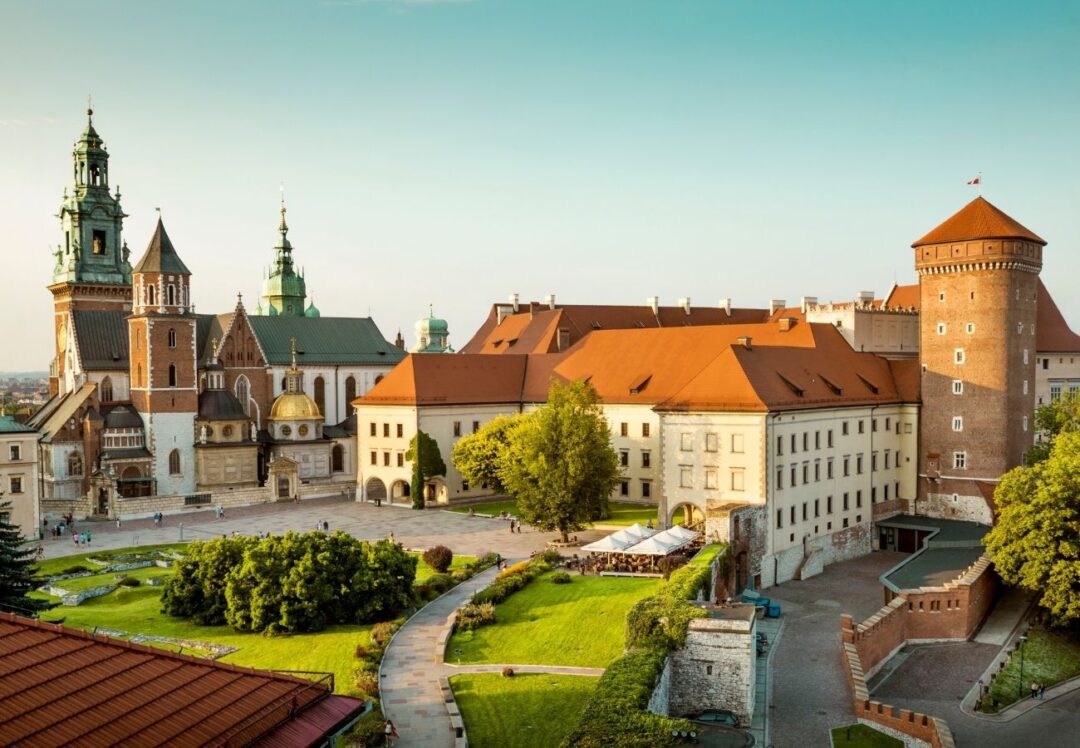
Wawel isn’t a single building — it’s a walled hilltop complex rising above the Vistula River at the southern edge of Krakow’s Old Town. The hill itself has been occupied since the Paleolithic period. By the 11th century, Polish monarchs had built a Gothic castle here. In the 16th century, under the Jagiellonian dynasty, it was transformed into the Renaissance palace you see today — a process overseen by Italian architects who brought the latest style from Florence to the banks of the Vistula.
The complex includes the Royal Castle, Wawel Cathedral, the Castle Courtyard, a labyrinth of underground chambers, and the Dragon’s Den at the base of the hill. You could spend a single focused hour here or a full day — the exhibitions are extensive, each ticketed separately, and they reward proper time.
Getting There
Wawel Hill sits at the southern end of Krakow’s Old Town and is walkable from the Main Market Square in 10–15 minutes. The most atmospheric approach is via Kanonicza Street — one of the oldest streets in Poland, running straight from the Market Square to the castle’s Herbowa Gate, past the house where Karol Wojtyla (later Pope John Paul II) lived before becoming archbishop. The walk up to the gate involves a steep cobbled ramp, so wear sensible shoes.
By tram, lines 6, 8, 10, 13, and 18 stop at the Wawel stop. From the stop it’s a short walk up to the hill. There’s also a stop at Stradom, about five minutes away on foot.
Tickets: What to Know Before You Buy
This is where many visitors run into trouble, so read carefully. Wawel operates on a timed-entry system with daily visitor limits for each exhibition. Tickets are sold separately for different sections of the castle, and during summer (June–August) the most popular exhibitions — particularly the State Rooms — sell out early, sometimes days in advance.
The official ticket website is bilety.wawel.krakow.pl. Book online rather than queuing at the ticket office, especially on weekends or in peak season. Tickets are valid only on the day of purchase, and the entry time printed on the ticket must be respected.
Key ticket prices (regular / reduced):
- State Rooms: around 35 PLN / 28 PLN
- Royal Private Apartments: around 35 PLN / 28 PLN
- Crown Treasury and Armoury: around 35 PLN / 28 PLN
- Castle Underground (The Lost Wawel): around 25 PLN / 20 PLN
The cathedral is managed separately and sells its own tickets independently of the castle. The Dragon’s Den at the foot of the hill has its own small entry fee and is only open from late spring through early autumn.
On Mondays, selected exhibitions are free for individual visitors — but free tickets must be collected at the ticket office and are limited. They typically run out before 10:00 AM. If you want to avoid queues, a paid weekday visit on Wednesday or Thursday is often a better option.
The castle is closed on the following public holidays: January 1st, Holy Saturday, Easter Sunday, Easter Monday, November 1st, November 11th, December 24th and 25th.
The State Rooms: The Crown Jewel of the Visit
If you only have time for one exhibition, make it the State Rooms on the castle’s second floor. These are the official ceremonial chambers of the Royal Castle — where the Polish parliament met, where ambassadors were received, where royal weddings were held. They contain the most important artistic collection in the building and one of the finest Renaissance interiors in Central Europe.
The centrepiece is the tapestry collection of King Sigismund Augustus. Commissioned in Brussels between roughly 1550 and 1560, these are the most valuable objects in the entire castle. Around 140 survive today — enormous textile works woven from cotton, silk, silver, and gold threads, depicting biblical scenes, animals in landscapes, and the coats of arms of Poland and Lithuania. They’re the only elements of the original castle interior that have survived intact across nearly five centuries of war, looting, and partition. When you stand in front of them, you’re looking at something that was hanging on these same walls before Shakespeare was born.
The Audience Hall — also called the Hall Under the Heads — is where the lower house of the Polish parliament held its sessions. Look up at the ceiling: 30 carved wooden heads from 1540 look down at you from the coffered panels. The original ceiling had 194 heads; the rest were lost over the centuries. One of them, according to Wawel legend, once spoke aloud during a royal session, calling on the king to judge justly — after which, the story goes, the offending head was gagged with a band, which you can still see if you look closely.
The Senators’ Hall is the largest room in the castle. Royal weddings took place here. So did coronation parliament sessions. The walls are hung with the great biblical tapestries — the Flood series — and the leather wall coverings (cordovan) give the room a warmth and darkness that reproductions never quite capture.
The Crown Treasury and Armoury
Located in the castle’s Gothic cellars, the Crown Treasury holds what remains of the Polish Crown Jewels after centuries of looting. The centrepiece is the Szczerbiec — the coronation sword of Polish kings, dating to the 13th century and the only piece of the original royal regalia to survive. It was used in coronation ceremonies for centuries and its survival through partition, occupation, and world war is something close to miraculous.
Also on display in the Treasury: the hat and ceremonial sword given to King Jan III Sobieski by the Pope after his victory at Vienna in 1683 — a direct connection to the story told at Wilanow Palace.
The adjoining Armoury displays Winged Hussar armour, medieval weapons, cannons, and military objects. It’s usually less crowded than the State Rooms and well worth the extra time — the hussar armour in particular is extraordinary to see up close.
The Castle Underground: The Lost Wawel
Beneath the courtyard lie the archaeological remains of earlier structures that preceded the Renaissance castle — including the rotunda of St. Felix and Adauct, one of the oldest churches in Poland, dating to the late 10th century. The exhibition called “The Lost Wawel” follows the layered history of the hill from its earliest occupation through the medieval period.
It’s a different kind of visit from the upper floors — quieter, more archaeological, more suited to visitors with a genuine interest in how the site evolved. The underground sections are genuinely old, not reconstructions, and the scale of what lies beneath the visible castle is impressive.
Wawel Cathedral: Not Included in Castle Tickets
The Cathedral sits separately on Wawel Hill and requires its own ticket, sold at the Cathedral ticket office rather than the castle. This is a point of confusion for many visitors — if you’ve bought a castle ticket online, it does not include the Cathedral.
Wawel Cathedral is the burial place of Polish kings and national heroes. Beneath its floor lie the royal crypts — the tombs of Casimir the Great, Jan III Sobieski, Stefan Batory, and many others. The crypt of St. Leonard, the oldest surviving part of the Cathedral complex, dates to the 11th century. The Sigismund Chapel, added in 1533, is considered the finest example of Renaissance architecture north of the Alps.
The Cathedral is also where Karol Wojtyla said his first mass as a bishop. His papal cross stands near the entrance. Allow 45 minutes to an hour for the Cathedral and crypts.
The Dragon’s Den
At the base of Wawel Hill, beneath the castle walls on the river side, is the limestone cave associated with the legend of the Wawel Dragon — the monster that terrorised Krakow until a clever shoemaker named Skuba defeated it by stuffing a lamb’s skin with sulphur. The dragon, according to the story, drank so greedily from the Vistula trying to quench its burning throat that it burst.
Outside the cave entrance stands a metal dragon sculpture that breathes real fire every few minutes. Children love it. Adults take photos of it too, without admitting to each other that it’s quite good. The cave itself is a short walk-through of actual limestone chambers. It’s only open from late spring through early autumn, and the entry fee is a few zlotys. Worth it if you’re visiting with children.
Practical Tips for Your Visit
Book online in advance, especially for the State Rooms and Royal Apartments in summer. Arriving at the ticket office and finding the 10:00 AM slot sold out is a disappointment that’s entirely avoidable.
Large backpacks, umbrellas, and suitcases are not permitted inside the exhibitions. There are lockers and a cloakroom in the Arcaded Courtyard — use them before joining any queue for the indoor sections.
Plan for at least 3–4 hours if you want to see the State Rooms, Crown Treasury, and Cathedral. A thorough visit including the underground sections will take 5–6 hours. The hill and courtyard are free to walk at any time, so arriving early and exploring the exterior before your timed ticket is a good way to structure the day.
Autumn and spring offer the best conditions — lower crowds, pleasant weather for the courtyard and gardens, and the full range of exhibitions open. Summer is busy but the river views from the hill at dusk are hard to argue with.
The approach from Kanonicza Street is more interesting than coming up from the river side. If you walk it slowly and look at the plaques on the buildings, you’ll understand why this street has been called one of the most beautiful medieval streets in Poland.