There’s a detail about Kazimierz that most visitors don’t know before they arrive, and it changes how you see the place. By the 1930s, Krakow had 120 registered synagogues and prayer houses. The Jewish community made up roughly a quarter of the city’s population. Before the war, Kazimierz — already technically part of Krakow for over a century — was still the spiritual and cultural centre of that community, the place where the old synagogues stood and where Orthodox families remained close to the buildings that structured their weeks.
In 1941, the Germans forced all Jewish residents out of Kazimierz into a walled ghetto in the Podgorze district across the river. Two years later, on March 13, 1943, the ghetto was liquidated. Most of its 17,000 inhabitants were murdered in the camps. Today, around 200 Jewish people live in Krakow.
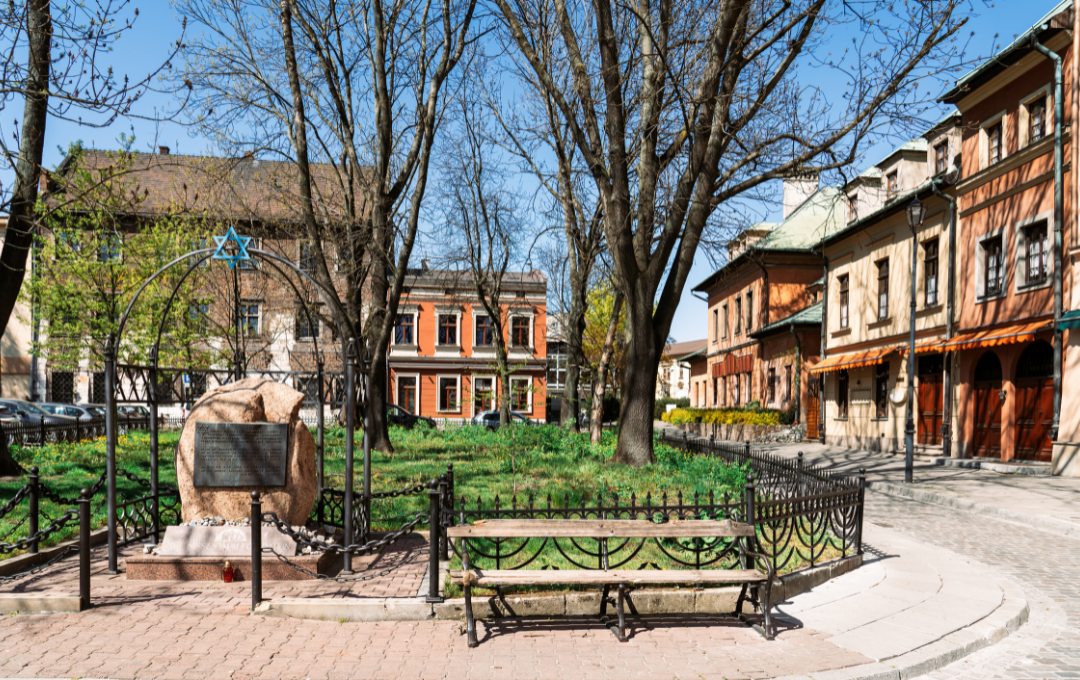
Kazimierz is now one of the liveliest neighbourhoods in Poland. It’s full of cafés, bars, street art, independent bookshops and restaurants. The cobbled streets are beautiful. On summer nights Plac Nowy is packed with young Poles sitting on the kerb eating zapiekanka. The Jewish Culture Festival every June draws tens of thousands of visitors. And in the middle of all that life — right there on Szeroka Street, open every Friday for Shabbat services — is the Remuh Synagogue, the smallest and oldest active synagogue in Poland. The contrast between past and present is Kazimierz. You can hold both things at once, and you should.
Getting There
Kazimierz is about 1.5 kilometres south of the Main Market Square — a 15–20 minute walk if you know the route, which catches some people out. The most direct path is to head south down Stradom Street from the base of Wawel Hill, which brings you straight into the district. From the Market Square you can also head along Starowiślna or Krakowska streets, both of which lead you there.
By tram, lines 7, 13, or 24 stop close to the district. The stop at Miodowa or sw. Wawrzyńca puts you right at the heart of the Jewish quarter section. If you’re coming from the train station, a tram to Kazimierz takes about 15 minutes.
Most people arrive on foot from the Old Town and Wawel, making Kazimierz the natural afternoon half of a morning spent at the castle.
Szeroka Street: Start Here
Szeroka Street — its name translates to “Broad Street,” though it’s really more of an elongated square than a street — is the historic heart of the Jewish quarter. In the 16th century, when Kazimierz was at the peak of its significance as the most important centre of Jewish learning in the world, Szeroka was where community life was concentrated. Today it’s lined with restaurants on one side and historic synagogues on the other, with restored storefronts at the top end that evoke what the street once looked like.
Stand at the southern end and look up the length of it. The Old Synagogue is to your left. The entrance to the Remuh Synagogue and cemetery is halfway up on the right. In the evenings, several of the restaurants host live klezmer music — traditional Jewish instrumental music that sounds like it’s been playing on this street for five hundred years, because in some sense it has.
The Old Synagogue
The oldest surviving synagogue building in Poland, the Old Synagogue dates to the 15th century — possibly as early as 1407, though the exact founding date is debated. Originally built in the Gothic style, it was rebuilt after a fire in the early 16th century by the Italian architect Mateo Gucci in Renaissance style, giving it the fortress-like solidity you see today.
The building now functions as a branch of the Museum of Krakow, with an exhibition covering the history and traditions of Krakow’s Jewish community. The exhibits include ceremonial objects, photographs, and documentation of community life before the war. Entrance is ticketed and reasonably priced. It’s worth spending 45 minutes here to understand the depth of what was lost before you continue walking through the neighbourhood.
Remuh Synagogue and Cemetery
Fifty metres up Szeroka Street from the Old Synagogue, through an unassuming gateway at number 40, is the most significant Jewish site in Krakow and arguably one of the most important in all of Central Europe.
The Remuh Synagogue was built in the 1550s by Israel Isserles, a wealthy banker, for his son Rabbi Moses Isserles — known by the Hebrew acronym Remuh. Moses Isserles was one of the greatest Jewish scholars of the 16th century, whose legal commentaries on the Shulchan Aruch are still studied and followed in Ashkenazic Jewish practice today. His tomb in the adjacent cemetery bears the inscription: “From Moses [the prophet] to Moses [Isserles], there was no such Moses.” It’s a measure of how revered he remains that the chair in the synagogue where he used to pray is still left unoccupied during services.
The cemetery behind the synagogue is one of the oldest surviving Jewish cemeteries in Europe, dating to the mid-16th century. The Nazis destroyed most of it — tearing down walls and using tombstones as paving material — but Rabbi Isserles’s grave was among the few that survived intact. There’s a story, whether legend or fact nobody can say for certain, that the German soldier who tried to destroy it was struck by lightning before he could. The grave still draws Jewish pilgrims from around the world, particularly on the holiday of Lag BaOmer.
The fragments of tombstones that couldn’t be saved or properly restored were embedded into the wall along Szeroka Street, creating what’s known as the Wall of Tears. It runs along the entire length of the cemetery’s street-side wall. If you walk slowly past it and look at the pieces — carved Hebrew lettering, decorative motifs, dates — you begin to understand what 711 surviving gravestones out of a community that once filled this entire neighbourhood actually means.
The Remuh Synagogue is still an active house of worship. Shabbat services are held here every Friday. Entering requires modest dress and a small admission fee. It is the only synagogue in Krakow still used for regular prayer.
The Galicia Jewish Museum
On Dajwor Street, a five-minute walk from Szeroka, is one of the finest museums in Poland. The Galicia Jewish Museum focuses not on destruction, but on what existed before and what has survived — it approaches the history of Jewish life in the region through the lens of contemporary photography, asking what remains rather than what was lost.
The permanent exhibition is called “Traces of Memory” and it consists of large-format photographs of Jewish heritage sites across Galicia — synagogues, cemeteries, buildings — paired with contextual text that explains what they were and what happened to them. It’s quietly devastating and intellectually serious, and far more affecting than a conventional documentary exhibition would be. The museum also runs temporary shows, lectures, and events throughout the year. If you have time for one museum in Kazimierz beyond the Old Synagogue, this is it.
The Tempel Synagogue
On Miodowa Street, a few minutes’ walk west from Szeroka, the Tempel Synagogue is the grandest and most ornate of Kazimierz’s surviving synagogues. Built between 1860 and 1862 in a mix of Neo-Renaissance and Moorish styles, it’s a Reform synagogue whose interior is strikingly different from the Orthodox buildings on Szeroka — more decorated, more theatrical, with stunning stained-glass windows and golden stucco work.
During the war the Nazis stored ammunition here, which damaged the interior. After extensive restoration it reopened and now frequently hosts concerts and cultural events alongside occasional religious services. Check the schedule before your visit — an evening concert in this space, with the light coming through the windows at dusk, is genuinely memorable.
Isaac Synagogue and the Legend Behind It
On Kupa Street, the Isaac Synagogue was founded in 1638 by a merchant named Isaac Jakubowicz, reportedly the wealthiest Jew in Kazimierz at the time. The story behind its funding is one of those tales that gets better every time it’s told. According to the legend, Isaac dreamed of a treasure hidden under a bridge in Prague. He travelled there, but a soldier told him that he too had a dream — of a treasure buried in the stove of a man named Isaac, in Krakow. Isaac rushed home, dismantled his stove, found the gold, and built this synagogue with it.
Whether the legend is true is beside the point. The synagogue is real, the stucco ceilings are beautiful, and fragments of original 17th and 18th century wall paintings were discovered during restoration work and are still visible. The acoustics are remarkable — it’s used occasionally for concerts.
Plac Nowy: The Heart of Modern Kazimierz
While the eastern section of Kazimierz is defined by the synagogues and Jewish heritage sites, the western part belongs to Plac Nowy — a market square that is the beating heart of the neighbourhood’s contemporary life. During the day there’s an open-air market where you can buy antiques, communist-era memorabilia, vintage clothing, and general oddities. In the evenings the square fills with people eating zapiekanka from the circular kiosk at its centre — a Polish baguette topped with mushrooms and cheese that has been Plac Nowy’s signature street food for decades.
The streets radiating off Plac Nowy — especially Józefa and Meiselsa — are where you’ll find the independent cafés, second-hand bookshops, and small galleries that give Kazimierz its particular character. This is where the bohemian Krakow that locals are proud of actually lives, and it’s worth giving yourself an afternoon to wander without a plan.
Crossing the River: Podgorze and the Ghetto
No visit to Kazimierz is complete without crossing the Bernatek footbridge over the Vistula to the Podgorze district, where the Krakow Ghetto was established in 1941. The contrast is immediate. Kazimierz is café culture and street art; Podgorze is quieter, heavier, more residential.
Ghetto Heroes Square — the main square of the former ghetto — is marked by 68 empty metal chairs, a memorial to the Jews of Krakow who were deported and murdered. The chairs stand on the cobblestones where belongings were abandoned during deportations. You can’t see them without stopping.
The pharmacy “Under the Eagle” on the corner of the square was run by a Polish pharmacist named Tadeusz Pankiewicz — the only non-Jew permitted to remain inside the ghetto. He used the pharmacy as a place to gather information, provide medicines, and help ghetto residents in any way he could. The building is now a museum. Oskar Schindler’s enamel factory, which tells the full story of the German occupation of Krakow, is a few minutes’ walk from here.
Practical Tips
Kazimierz is walkable in a focused half-day, but rewards a longer visit. Most synagogues and museums are open Tuesday through Sunday; hours vary by season. The Remuh Synagogue charges a small entry fee and requires modest dress — a headcovering for men is provided at the entrance.
The Jewish Culture Festival, held annually in late June and early July since 1988, transforms the entire neighbourhood with concerts, lectures, film screenings, workshops, and events that celebrate living Jewish culture rather than just memorialising the lost one. If your trip overlaps with it, rearrange your plans accordingly.
For restaurants, the Kazimierz food guide covers the district in depth — but in brief, the streets around Józefa offer the best independent options, and Szeroka’s restaurants are atmospheric if touristic. The zapiekanka at Plac Nowy requires no research. You’ll find it.