There’s a story Poles love to tell about King Jan III Sobieski. In September 1683, his army of Winged Hussars stood on a hill above Vienna, outnumbered three to one by the Ottoman forces besieging the city below. Sobieski looked at the enemy’s position and reportedly said: “This man is badly encamped, he knows nothing of war and we will surely defeat him.” A few hours later, he led the largest cavalry charge in history, broke the Ottoman siege, and saved Europe. The Pope called him the Defender of Faith. The defeated Ottomans called him the Lion of Lechistan. He went home to Poland and built himself a palace.
That palace is Wilanow. And if you’re spending any time in Warsaw, it’s worth every minute of the 30-minute bus ride to get there.
Why Wilanow Is Different From Other Royal Palaces
Most European palaces were built to intimidate. Versailles, Schonbrunn, Caserta — they’re all statements of absolute power, designed to make you feel small. Wilanow is different. Yes, it’s grand. Yes, it has the gilded interiors, the formal gardens, the Baroque ornamentation. But there’s something almost human about it — a place where a real king actually lived with his wife and children, went hunting in the mornings, and spent his evenings writing tender letters to his French wife Marysienka.
Sobieski acquired the village of Milanow in 1677, and the name itself tells you something. “Wilanow” comes from the Italian phrase villa nuova — new villa. He didn’t want a fortress-palace. He wanted an Italian villa in the Polish countryside. His architect Agostino Locci started small — a modest single-storey residence — but after Sobieski’s triumph at Vienna, ambitions grew. By the time of the king’s death in 1696, the building had expanded into a full Baroque palace combining Italian villa design, French formal geometry, and distinctly Polish aristocratic sensibility.
It’s also one of the very few historic buildings in Warsaw that survived World War II essentially intact. While the rest of the city was systematically destroyed, Wilanow came through the war largely unscathed. Walking through its rooms, you’re not looking at a reconstruction. You’re looking at the real thing.
Getting to Wilanow
Wilanow Palace is located roughly 10 kilometres south of Warsaw city centre, in the Wilanow district at the far end of the Royal Route that begins at the Old Town. It’s not walking distance from anywhere central, but getting there is easy.
The simplest public transport option is bus 116 or 180, both of which run from central Warsaw (the 116 stops near the Old Town, the 180 connects from several central points). The ride takes around 30-45 minutes depending on traffic and where you board. A standard Warsaw city bus ticket costs 4.40 PLN for a single journey or 5 PLN for a 75-minute ticket that lets you transfer.
If you’d rather not deal with buses, an Uber or Bolt from the city centre typically costs 25–40 PLN and takes 20–30 minutes without traffic. There’s also a paid car park approximately 300 metres from the palace entrance if you’re driving.
Practical Information: Hours, Tickets and What to Know
The palace is open every day except Tuesday, from 10:00 AM to 4:00 PM, with last entry at 3:00 PM. The park and palace courtyard are open daily from 9:00 AM — so if you arrive early, you can walk the grounds before the palace itself opens.
Note that from mid-December to late January the palace interior closes for a winter break, though the park remains open. In recent years a seasonal light installation called the Royal Garden of Light has operated in the evenings during this period — worth checking if you’re visiting in winter.
Ticket prices: Palace admission is 35 PLN regular, 28 PLN reduced (students, seniors). Entry to the park and gardens is a separate ticket. Sunday admission to the palace is free, though this makes it significantly busier — if you prefer a quieter visit, a weekday morning is ideal. Tickets are limited to a set number per time slot, so booking online in advance is recommended for weekends.
The museum has an official app you can use as a digital guide — scan QR codes on information plaques throughout the rooms to get context on the interiors, artworks, and historical significance of each space.
What You’ll See Inside
The palace interior is organised as a museum with several distinct sections. Most visitors enter through the grand courtyard before moving into the royal apartments, and the best way to approach it is chronologically — following the history of the building and its different owners.
The Royal Apartments are the core of the palace — the rooms where Sobieski and his wife Marysienka actually lived. Their separate bedrooms are open to visitors, which gives you an unusually intimate view of royal domestic life. The king’s bedroom is modest by palace standards, which fits everything we know about Sobieski — a soldier-king who preferred his horses and his library to court ceremony.
The White Hall served as the palace’s main reception room. It’s the most formally spectacular space, with elaborate stucco decoration and a ceiling that catches morning light beautifully. Even visitors who aren’t particularly interested in Baroque interiors tend to stop here.
The King’s Library is a smaller, quieter room that reveals a different side of Sobieski. He was genuinely scholarly — fluent in Latin, German, and Turkish, interested in astronomy and mathematics. The constellation Scutum Sobiescianum (Sobieski’s Shield) was named after him by the astronomer Johannes Hevelius, whose laboratory Sobieski had funded after it was destroyed in a fire. The library feels like the room where he was most himself.
The upper floor galleries include a permanent exhibition on the Potocki family, who owned the palace in the 19th century after Sobieski’s line died out, and were responsible for opening it to the public in 1805 — making it one of the first public museums in Poland.
Sobieski’s armour and personal belongings are displayed among the collections. There’s something genuinely moving about standing in front of armour worn by someone whose story you know this well before you arrive.
The Gardens: The Real Reason Many People Come
If the palace interior is excellent, the gardens are extraordinary. Wilanow has three distinct garden styles layered over each other, reflecting the different owners who shaped the estate across three centuries.
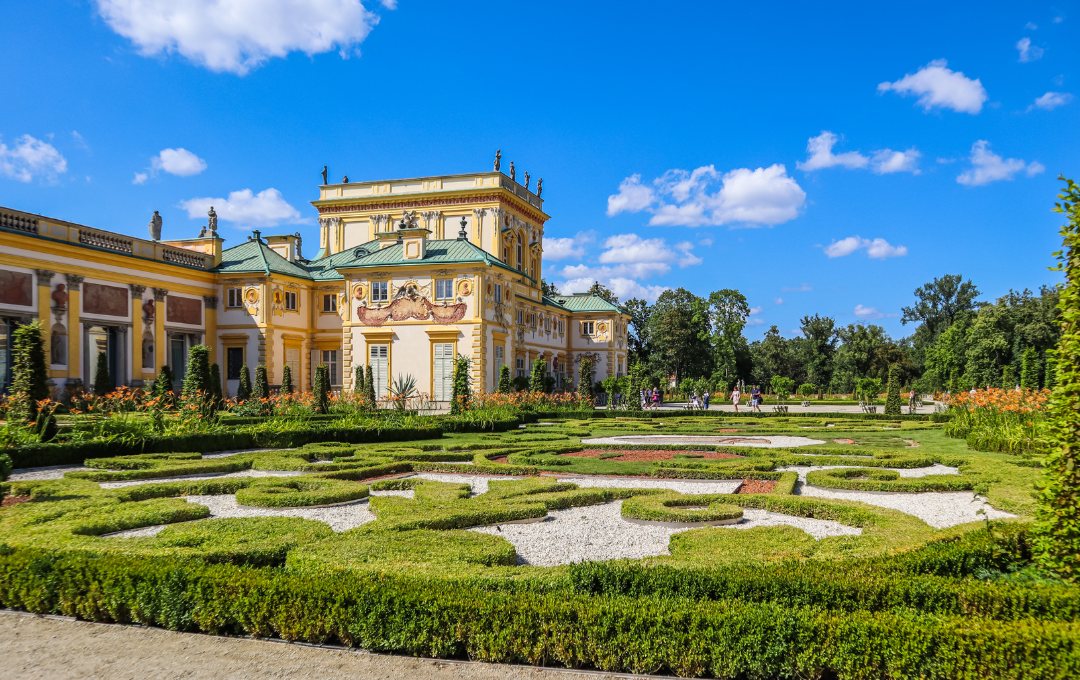
The formal Baroque garden directly behind the palace was laid out in the French geometric style — symmetrical flowerbeds, clipped hedges, stone ornaments — visible from the palace’s rear facade in one long, symmetrical sweep. In summer, the rose garden in this section blooms spectacularly and hosts the Summer Royal Concerts, an outdoor classical music series that draws Varsovians every year.
Further back, the garden transitions into an English landscape park — romantic, naturalistic, with a lake and paths that wind through mature trees. This section was designed in the late 18th century by the architect Szymon Bogumil Zug for owner Izabela Lubomirska, who had a taste for the picturesque over the formal.
The combination of both styles in one continuous space, with the yellow Baroque facade of the palace at one end, is one of the most beautiful things in Warsaw. On a sunny autumn afternoon, when the trees have turned, it’s exceptional.
The Poster Museum: An Unexpected Highlight
Most visitors don’t know about this before they arrive, which is part of why it’s worth mentioning. On the palace grounds, in what was once the horse dressage arena, is the world’s first poster museum — established in 1968 and now holding a collection of over 54,000 posters.
Polish poster art is genuinely famous in design circles. The Polish School of Posters, which emerged in the 1950s and 60s, produced some of the most striking graphic design of the 20th century — circus posters, film posters, opera posters, political posters — and this museum holds the definitive collection. The temporary exhibitions change regularly, but if you’re visiting and have any interest in graphic design, it’s worth the extra 30 minutes.
Tips for Getting the Most From Your Visit
Allocate at least 3 hours to do both the palace and gardens justice. If you want to include the Poster Museum, give yourself 4 hours.
The palace interior is genuinely worth having a guide for — the rooms are dense with history, symbolism, and context that you’ll miss without someone to explain it. The official app helps, but a live guide brings the story of Sobieski to life in a way that transforms what you’re looking at.
Visit on a weekday if possible. Sundays are free but crowded. A weekday morning is when the palace is quietest, and the gardens feel entirely different with few other people in them.
If you’re visiting between May and September, consider timing your trip to coincide with one of the Summer Royal Concerts in the rose garden. They’re held on Sunday afternoons and don’t require an additional ticket beyond the park entry. It’s the kind of thing you’ll remember from a Warsaw trip.
Adding Wilanow to a Wider Warsaw Experience
Wilanow sits at the end of Warsaw’s Royal Route — the historic axis that runs from the Old Town south through Nowy Swiat and Lazienki Park before reaching the palace. The most satisfying way to structure a full day in Warsaw is to walk or cycle the Royal Route, stopping at Lazienki Park in the late morning, and arriving at Wilanow in the afternoon.
Whether you come with a guide or on your own, give Wilanow the afternoon it deserves. The Lion of Lechistan built it to last.