Stutthof sits 36 kilometres east of Gdansk, at the end of a quiet road through pine forest, a few kilometres from the Baltic coast. The surrounding villages are summer resorts. People come here in July and August for the beach, for sailing, for the clean northern air. And in the middle of all of that, enclosed behind a fence on the edge of the village of Sztutowo, is the place the world still knows by its German name: Stutthof.
It was the first Nazi concentration camp established beyond Germany’s pre-war borders, opened in September 1939 just days after the invasion of Poland began. Over the course of the war, around 115,000 people were imprisoned here. At least 65,000 of them died.
Visiting Stutthof is not an easy experience, and it is not meant to be. What follows is a guide to help you prepare — practically and emotionally — for what you will encounter there.
What Stutthof was
When the German forces occupied the Danzig region in the opening days of the Second World War, they needed somewhere to imprison the local Polish and Jewish population they immediately targeted — intellectuals, teachers, priests, civic leaders, anyone considered a potential source of resistance. Stutthof was established as that place, initially under local SS and police authority rather than the central concentration camp system.
It expanded steadily. In January 1942 it was formally incorporated into the national SS concentration camp network, redesignated as a concentration camp and brought under the direct administration of SS headquarters in Berlin. With that redesignation came the full machinery of the Nazi camp system: forced labour, systematic starvation, medical experimentation, and eventually, in 1944, a gas chamber.
The prisoner population changed as the war progressed. The first inmates were predominantly Poles — civilians, resistance members, Polish Jews from Danzig and the surrounding region. Later came Lithuanian and Latvian civilians and resistance fighters, Soviet prisoners of war, Polish civilians deported during the Warsaw Uprising of 1944, and increasingly from 1944, Jewish women from across occupied Europe — from the Baltic states, Hungary, Poland — evacuated from other camps as Soviet forces advanced westward.
When the camp was redesignated as an extermination camp in its final phase, prisoners arriving by transport were divided on the platform: those judged able to work were assigned to forced labour, while the weak, elderly, ill, and those unable to work were sent directly to the gas chamber.
The conditions throughout the camp’s operation were, by any measure, among the harshest in the entire concentration camp system. The principal causes of death were physical exhaustion from slave labour, disease, malnutrition, exposure to the harsh northern climate, and direct violence from guards. Typhus epidemics swept the camp in the winter of 1942 and again in 1944. SS doctors killed prisoners through lethal injections. The gas chamber, operational from the summer of 1944, was used primarily for those deemed unable to continue working.
As Soviet forces closed in during January 1945, the SS began evacuating the camp. Over 10,000 prisoners in several convoys were forced onto death marches heading westward or toward eastern Prussia. Thousands died in the brutal winter conditions — those who could not keep up were shot where they fell. A separate group of prisoners, mostly Jewish women, were evacuated by sea; many drowned or were killed when their ships came under attack. The camp was liberated by Soviet forces on May 9, 1945 — the last of the major concentration camps to be freed.
What the museum contains
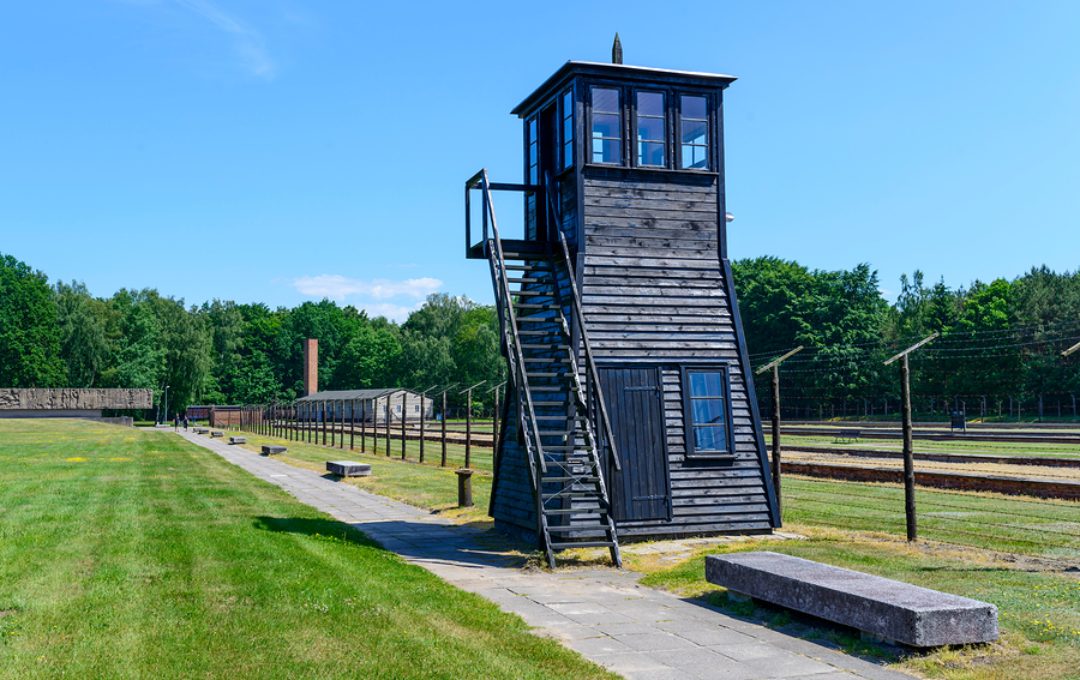
The Stutthof Museum today covers approximately 20 percent of the original camp’s area. What remains is a combination of preserved original structures, rebuilt elements, and open ground where barracks once stood.
The entrance to the site is through the original gate, still marked with the SS motto Arbeit Macht Frei — “Work Sets You Free” — which survivors and witnesses nicknamed the “Death Gate.” Walking through it is the moment the visit becomes fully real for most people.
Inside the fenced area, the preserved prisoner barracks give the most direct sense of the conditions people lived and died in: the wooden bunks stacked three high, the narrow passages between them, the complete absence of anything that might constitute privacy or comfort. The barracks are cold in winter and suffocating in summer, and neither condition is entirely out of place.
The gas chamber and the crematorium — both original structures — stand at the back of the camp. They are small, which surprises many visitors. The scale of death here was achieved not through industrial efficiency on the scale of Auschwitz-Birkenau, but through sustained, deliberate brutality across six years of operation.
The main museum building contains permanent exhibitions covering the camp’s history from its establishment in 1939 through liberation. The exhibitions include original documents, prisoner photographs and registration records, personal objects, and testimony from survivors. Films are screened on the hour between 10am and 4pm. The material is difficult. It is also necessary.
There is a memorial area at the site, and a symbolic cemetery. Many of those who died at Stutthof were buried in mass graves; others were cremated. The memorial is a place where visitors often spend time quietly before leaving.
Practical information
The museum is open every day of the year, including weekends and public holidays. From May to September, opening hours are 8am to 6pm. From October to April, the museum closes earlier — check the official website at stutthof.org before visiting, as winter hours vary. Admission to the museum is free of charge, though donations are welcomed and help fund the site’s ongoing preservation work.
An audio guide is available in several languages including English, and is worth taking — the site is large enough that without guidance it can be difficult to understand the significance and history of what you’re looking at. Guided tours with English-speaking museum staff can be arranged in advance through the museum, and are recommended for those who want a fuller understanding of the history. Allow at least two hours for a thorough visit; many people find they need longer.
The site is primarily outdoors, which means weather matters significantly. In the colder months, dress warmly — the flat, open ground between structures offers little shelter from the wind off the Baltic. Comfortable shoes are necessary; the ground is uneven in places.
The museum advises that the site is not appropriate for children under 13. The exhibitions contain images and documentation of extreme violence and suffering. Parents should consider this carefully before bringing younger children.
Getting there from Gdansk
The most straightforward way to reach Stutthof from Gdansk is by bus. Line 870 departs from the Brama Wyzynna stop in central Gdansk and runs roughly every hour during the main season, with the journey taking around an hour. The stop to alight at is marked Sztutowo Muzeum — you will see the museum entrance from the road. Bus tickets cost approximately 10 to 14 PLN each way. Outside peak summer season, weekend services are less frequent; check the timetable before travelling.
By car, the drive from Gdansk takes around 45 to 55 minutes depending on traffic. There is parking at the site. The route east along the Vistula Spit offers some of the most striking landscape in northern Poland — the narrow strip of land between the Vistula Lagoon and the Baltic Sea, with water on both sides — and it is a genuinely beautiful drive, which itself feels like a strange contrast to the destination.
Organised tours from Gdansk are available, combining transport and a guide for a half-day visit. If you are travelling without a car and find the bus schedule restrictive, or if you want the added context of an English-speaking guide throughout, this is the most practical option. We run guided visits to Stutthof from Gdansk that include transport and a museum guide — a meaningful and respectful way to make the most of the visit.
How to approach the visit
Stutthof receives over 100,000 visitors a year, yet it remains far less known internationally than Auschwitz-Birkenau, which absorbs the vast majority of Holocaust-related tourism to Poland. That relative obscurity is worth reflecting on. The scale of what happened here — around 115,000 prisoners passed through Stutthof, and more than half died there — deserves full recognition. It is not a footnote to the larger history; it is part of the same systematic destruction of human life.
Visiting a site like this is a personal experience and people respond to it differently. Some find the museum exhibitions the most affecting part; others are most struck by standing in the barracks or at the gas chamber. Some visitors need to sit quietly for a time before leaving. None of this is unusual.
What tends to be universally true is that having some knowledge of the history before you arrive makes the visit more meaningful. Reading even a short account of Stutthof’s history — the kinds of people who were imprisoned here, the specific phases of the camp’s operation, the stories of individual survivors — gives the objects, the buildings, and the documentation in the museum a human weight they might otherwise lack.