Most people who visit Poland head south. Krakow, the Tatra mountains, Auschwitz — the southern itinerary has been well mapped for decades. Meanwhile, a thousand kilometres of Baltic coastline stretches across the entire northern edge of the country, dotted with cities, spa towns, fishing ports, and beaches that most international visitors never reach. That is, quietly, their loss.
Poland’s Baltic coast runs from Szczecin in the far northwest — practically on the German border — to the Tricity of Gdansk, Sopot, and Gdynia in the east, with a string of resorts, headlands, and small ports in between. The sea here is calm and shallow by ocean standards, the beaches are wide and sandy, and the cities that line the coast carry a history as layered and complicated as anywhere in Europe. Coming north is worth the journey.
Szczecin — the underrated western gateway
Szczecin sits at the far western end of the Polish coast, separated from Germany by the Oder River and so close to Berlin that many visitors arrive from there rather than from Warsaw or Krakow. It is, as one travel writer put it, massively underrated and virtually tourist-free — which is either a warning or an invitation depending on what kind of traveller you are.
The city was almost entirely destroyed in the Second World War and rebuilt on its medieval street plan, giving it an unusual combination of historic layout and largely modern architecture. What survived — or was carefully restored — is striking. The Ducal Castle, seat of the Pomeranian Griffin dynasty for three centuries, dominates the old town from a hill above the river. The Philharmonic Hall, a dramatic contemporary building in glass and steel that opened in 2014, won the European Union Prize for Contemporary Architecture and is one of the most remarkable new buildings in Poland. The contrast between the two — medieval power and 21st-century ambition — captures something true about Szczecin’s character.
The Chrobry Embankment along the Oder is the place for an evening walk, the old harbour waterfront lined with monumental early 20th-century buildings. There’s a lightness to the city that comes partly from its location — water everywhere, long flat skies — and partly from its relative obscurity. Nobody is rushing you here.
Swinoujscie and the western island coast
East of Szczecin, the coast becomes a landscape of islands, lagoons, and straits — a geography unique on the entire Baltic. Swinoujscie is perhaps the most unusual city on the Polish coast, spread across several dozen islands and accessible by ferry between its own districts. Its lighthouse, standing over 68 metres tall, is the highest on the Baltic Sea, and the view from the top across the sea and the port is genuinely spectacular.
Swinoujscie is also a working spa resort with a long tradition of health tourism — its microclimate, sea air, and therapeutic waters have been attracting visitors since the 19th century. The beach here is wide, the pace is slow, and ferry connections to Sweden and Germany make it a natural crossing point for travellers moving between countries.
Miedzyzdroje and Wolin National Park
Between Swinoujscie and Kolobrzeg lies one of the most overlooked natural areas in Poland. Wolin National Park, centred on the island of Wolin, protects a landscape of cliffs, forests, dunes, and lagoons that feels dramatically different from the flat sandy coast elsewhere. The cliffs near Miedzyzdroje drop directly to the sea, offering some of the most dramatic coastal walking in the country.
Miedzyzdroje itself is a classic Polish spa town — elegant pre-war villas, a promenade along the sea, a pier, and a rhythm of life that still runs on the old resort model. The Polish Film Festival brings the film industry here each summer, which gives the town an annual moment of glamour it wears comfortably.
Kolobrzeg — the Pearl of the Baltic
Halfway along the coast, Kolobrzeg holds the unofficial title of the Baltic’s most popular spa resort, and it earns it. Around twenty kilometres of equipped sandy beach, more than thirty sanatoria offering treatments for rheumatic, cardiovascular, and metabolic conditions, and a town centre built around the idea of wellness in the broadest sense — sea air, salt springs, peat baths, long walks on the beach.
The Gothic Cathedral Basilica in the old town is the architectural centrepiece, and the harbour area has a charm that survives the resort infrastructure well. August is the peak month — the microclimate here is at its warmest and the beach at its liveliest — but the shoulder seasons of May and September offer the spa culture without the summer crowds.
Hel Peninsula — the most unusual piece of land in Poland
Before reaching the Tricity, the coast produces one of its most peculiar geographical features: the Hel Peninsula, a narrow sand spit barely 200 metres wide in places, curving 35 kilometres out into the Bay of Gdansk like a finger pointing eastward. The train line runs its entire length, passing through fishing villages that become progressively more remote and windswept as you approach the tip.
The town of Hel at the end of the peninsula has a working harbour, a seal sanctuary, and a fortification museum in bunkers that once defended the bay. In summer the beaches on the lagoon side are warm and sheltered; on the sea side, the wind is almost always present. It is the kind of place that rewards those who make the extra effort to reach it.
Gdansk — the city where modern Poland began
Gdansk is the crown of the Baltic coast, and no description of northern Poland is complete without it. The city is over a thousand years old, has been Hanseatic trading hub, Free City, and the site of the first shots of the Second World War, and it is where the Solidarity movement that ultimately ended Communist rule in Poland — and set off a chain reaction across Eastern Europe — was born in 1980.
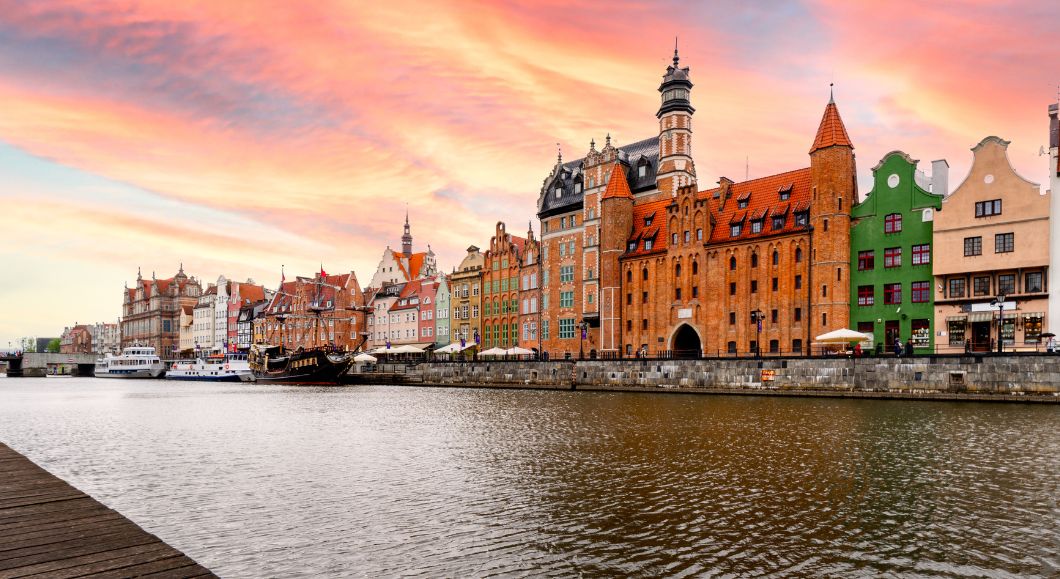
The Long Market, lined with tall Gothic and Baroque merchant houses in shades of gold and terracotta, is one of the most beautiful urban spaces in Poland. The Neptune Fountain at its centre has stood here since 1633. The Artus Court, where merchants and nobles once gathered, is now a museum. The Royal Route leads from the Golden Gate through the heart of the old town to the Green Gate on the river.
But Gdansk is not only its postcard image. The European Solidarity Centre, built on the site of the Lenin Shipyard where Solidarity was founded, is one of the most important historical museums in Europe — its permanent exhibition on the movement, the people who built it, and its global consequences is genuinely affecting and takes a full morning to do justice to. The Museum of the Second World War, opened in 2017 after years of political controversy, is considered among the finest history museums on the continent.
The Motlawa riverfront — the old harbour quay lined with cranes, granaries, and amber shops — is where the city’s commercial life once centred and where its café life clusters today. Amber, the fossilised tree resin that washes up on Baltic beaches and has been traded here for centuries, is everywhere: in shop windows, in market stalls, worn by locals and tourists alike. Gdansk is the amber capital of the world, a fact that remains surprising even after you’ve been here.
We offer guided tours of Gdansk that take in the old town, the Solidarity story, and the riverside — the kind of visit that gives you the context to understand what you’re looking at rather than simply admiring the facades.
Sopot — Poland’s summer capital
Sopot sits between Gdansk and Gdynia, connected to both by the fast SKM commuter rail line, and it occupies a unique position in Polish life: simultaneously a serious spa resort with a 200-year history and the country’s most fashionable seaside destination. The Poles call it the summer capital, and in July and August it earns the name.
The pier — Molo w Sopocie — is the defining landmark. At just over 511 metres, it is Europe’s longest wooden pier, stretching from the foot of Monte Cassino Street out into the Bay of Gdansk. Walking its length on a summer evening, with the lights of Gdansk visible to the south and Gdynia to the north, is one of those simple pleasures that stays with you.
Monte Cassino Street itself is the social centre — lined with restaurants, bars, boutiques and the occasional street performer, closed to traffic and busy from mid-morning to late at night in summer. At its far end from the pier stands the Crooked House, a genuinely strange building whose walls and windows curve and undulate as if melting, which has somehow become one of the most photographed buildings on the entire coast.
The Grand Hotel, a Belle Époque palace facing the sea, has hosted everyone from kings to rock stars since it opened in 1927 and remains the most atmospheric place on the coast to have a coffee or a glass of something cold. The beach below it is wide, well-maintained, and, in peak summer, extremely busy — arrive early or head slightly north of the main stretch for more space.
Our Sopot day trip covers the pier, Monte Cassino, and the beach — a natural pairing with a day in Gdansk for anyone spending time in the north.
Gdynia — modern, maritime, and underappreciated
The youngest city on the coast, Gdynia was essentially built from scratch in the 1920s as Poland’s major commercial port after the country regained independence. Its architecture reflects that moment: clean Modernist lines, wide boulevards, buildings that still look forward-looking a century later. It holds an energetic, youthful spirit that is different in character from either Gdansk’s history-saturated old town or Sopot’s resort ease.
The harbour is the place to start. The ORP Blyskawica — a Second World War destroyer that defended London during the Blitz and is now a floating museum — and the Dar Pomorza sailing ship sit moored at the quay, open to visitors. The Gdynia Aquarium, also in the port area, is one of the best on the Baltic coast. The cliff walks at Kepa Redlowska to the south offer some of the finest coastal views in the Tricity and a welcome escape from the urban centre.
Together, Gdansk, Sopot, and Gdynia form the Tricity — three cities within 30 kilometres of each other, connected by commuter rail every few minutes, each with a completely distinct character. It is one of the most rewarding urban combinations anywhere in northern Europe, and spending three days across all three gives you a fuller picture of Baltic Poland than any single city could.
The coast is long, and every stretch of it has something to offer. But if you can only choose one section to explore, the Tricity is where to start — and Gdansk and Sopot are where we can take you.