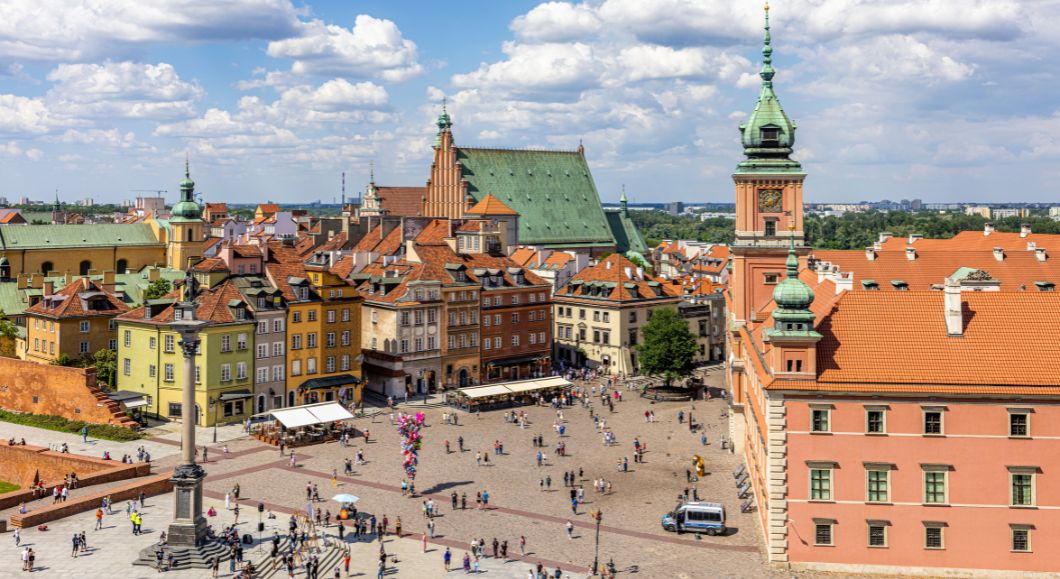
May is the month when Gdansk starts to look like the city it spends the rest of the year being. The light comes back — properly, Baltic-scale light, with 16 hours of daylight by the end of the month, sunrise before 5 AM, sunset past 8:30 PM. The outdoor terraces open. The parks come into bloom. The Motlawa riverfront loses the grey stillness of winter and fills again with people, boats, and the particular energy of a port city remembering itself.
The summer crowds haven’t arrived yet. July and August bring the peak season — booked hotels, queues at the most popular sights, St. Dominic’s Fair filling the city’s streets with 700 stalls and several hundred thousand visitors. May has none of that. You can walk through the Long Market on a weekday morning with the cobblestones largely to yourself. Museums don’t require advance booking. Restaurants have tables. This combination of good weather and manageable crowds makes May one of the most rewarding months to visit.
The Weather in May: What to Realistically Expect
Gdansk sits on the Baltic coast, which moderates the temperature but introduces a reliable wind. May averages daytime highs of around 15–17°C, though it can reach 20–25°C on good days — and, less frequently, drop back toward 10°C in early May. The Baltic weather is genuinely variable: a warm, sunny week can be followed by a grey, cool one. The historical records include a snowfall in Gdansk in May 2017 and temperatures near 30°C in May of other years.
The practical approach: pack for 10–20°C range. Layers work better than committing to either summer or shoulder-season wardrobes. A light waterproof jacket handles the rain (roughly a 22% chance on any given day) without weighing down your bag. Comfortable walking shoes are essential regardless of weather — the Old Town’s cobblestones are uneven and the city rewards walking.
Early May (first two weeks) tends to be cooler and more variable. Late May increasingly feels like the beginning of summer, with longer warm spells and the outdoor café culture fully established. If you have choice, the last two weeks of May are generally the more reliable.
A note on Polish public holidays: May 1st (Labour Day) and May 3rd (Constitution Day) are national holidays. This creates a long weekend — sometimes called the “May Long Weekend” — that brings domestic tourists to Gdansk in significant numbers. Expect higher prices and busier accommodation around these dates. Booking in advance for the first week of May is advisable.
What’s Open, What’s Happening
By May, the full tourist infrastructure is operational. Every museum, boat trip, amber shop, and restaurant is open. The Museum of the Second World War, the European Solidarity Centre, the National Maritime Museum, and the Amber Museum all run their full schedules.
The Gdansk Shakespeare Theatre — a remarkable building designed to replicate the structure of Elizabethan playhouses, with an open-air section and a retractable roof — runs its programme throughout the year. The famous annual Shakespeare Festival takes place in August, but the theatre itself hosts performances year-round. May is a good time to check the schedule and book tickets for a production in a venue that genuinely has no equivalent in Poland.
Organ concerts at Oliwa Cathedral run from May through September. The instrument in this Cistercian church is one of the finest in Central Europe — the cathedral itself is extraordinarily long, the longest Cistercian church in the world, with a nave that creates acoustic conditions that make the organ sound unlike anything in a conventional church building. Concerts run on selected days; check the cathedral website for current schedule. Oliwa is 20 minutes from the Old Town by tram and can be combined with a walk through Oliwa Park.
Oliwa Park in bloom is the specific May experience that draws local visitors from across the Tricity. The park’s famous rose garden does not peak until June, but May brings the lilac alleys into full bloom — long avenues of lilac bushes in purple and white that fill the surrounding air and make the park one of the most atmospheric places in the city. Go in the morning on a warm day. Bring no particular agenda.
Boat trips on the Motlawa River start their season in spring. Short river cruises passing the Crane and the waterfront granaries, longer trips to Westerplatte, and day excursions to the Hel Peninsula all become available through May. Westerplatte — where the first shots of World War II were fired on 1 September 1939 — can be reached by boat (45 minutes, departures from the Green Gate) or by local bus. The boat approach is more atmospheric.
The Old Town in May: Walking the Essential Routes
The Old Town of Gdansk is compact enough to walk comprehensively in a day but complex enough to reward several days of exploration. In May, the light and temperature make extended walking not just possible but pleasant.
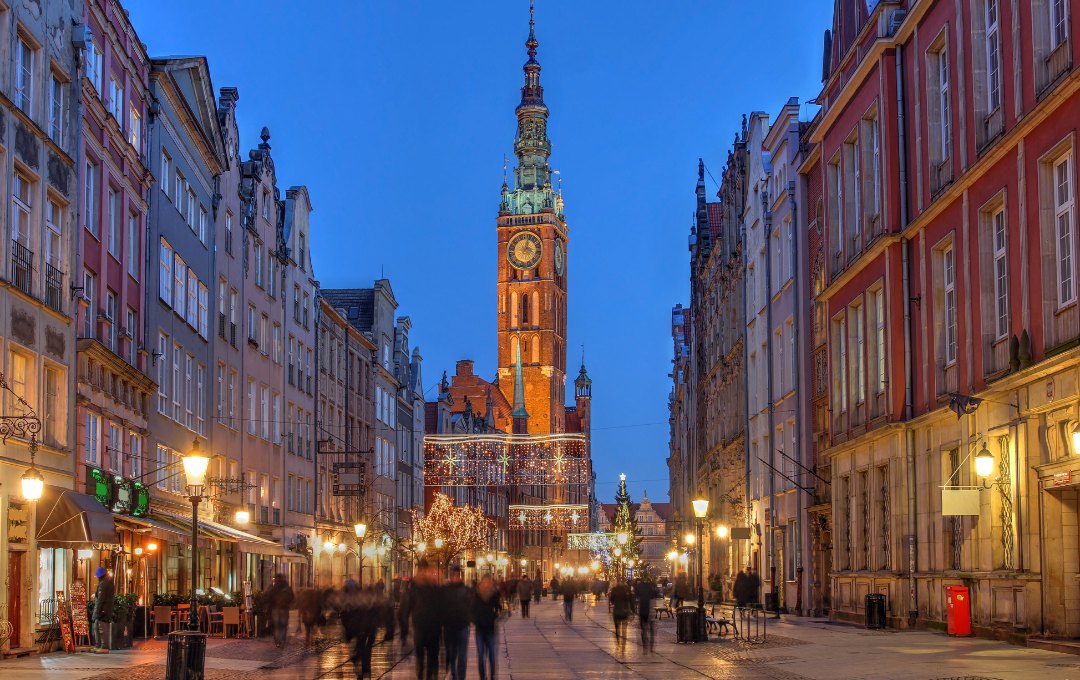
The Long Market (Długi Targ) and Long Lane (Długa) form the spine of the Old Town — the Royal Route along which Polish kings traditionally processed through the city. The Neptune Fountain at the centre of the Long Market is the city’s most photographed object; the Green Gate at the river end and the Golden Gate at the landward end frame the axis. Walk it in both directions at different times of day.
The Crane (Żuraw), the medieval double-tower gate that served simultaneously as a harbour crane and a city gate, is the most distinctive building in Gdansk and one of the most photographed from the Granary Island side of the Motlawa. The medieval treadmill mechanism inside is operational; the view from the tower in May, before the summer haze settles in, is particularly clear.
Mariacka Street, connecting St. Mary’s Basilica to the riverfront, is lined with the amber shops and Gothic house porches that give Gdansk much of its postcard character. In May, the sellers set up their outdoor stalls in the porches without the crowds that make navigation difficult in August.
St. Mary’s Basilica — the largest brick church in the world — deserves extended time. The interior scale is extraordinary: the white Gothic vaulting soars to 30 metres and the light through the windows fills the space differently across the day. Climb the tower (approximately 400 steps) for views across the rooftops of the Old Town and, on clear days, across the bay toward the Hel Peninsula. May’s longer days mean good light for the view until late evening.
Beyond the Old Town
The Museum of the Second World War is the most important museum in Gdansk and one of the finest history museums in Europe. It occupies a striking wedge-shaped building that tilts at an angle toward the city — architecturally provocative and programmatically serious. The permanent exhibition covers World War II from a genuinely global perspective: not only the Eastern Front and the Polish experience, but the Pacific War, the Holocaust, civilian populations across all theatres, the rise of fascism and totalitarianism. It is a large museum; allow 3–4 hours minimum. The building sits close to the main train station and is easily combined with arrival or departure.
The European Solidarity Centre occupies a building designed to evoke the rusted steel of the shipyards it stands adjacent to. The museum documents the Solidarity movement that began in Gdansk’s Lenin Shipyard in 1980 — the first mass independent trade union in the Soviet bloc, whose eighteen months of legal existence before martial law ended it planted the seeds that eventually led to the collapse of communism in Poland and across the Eastern Bloc. The Gate 2 of the Lenin Shipyard is immediately outside the museum; the original agreements signed by Lech Wałęsa and the government in August 1980 are on permanent display inside. This is one of the most significant documentary exhibitions in Poland.
The Sopot day trip is 25 minutes by commuter rail from Gdansk. The beach resort town of the Tricity has a different quality in May: the famous wooden pier (the longest in the Baltic, 511 metres) can be walked without the summer crowds, the sea temperature is still too cold for swimming but not too cold for walking the shoreline, and the Art Nouveau architecture of the central streets looks particularly fine in the light of a long spring evening. The train runs frequently and the fare costs a few PLN.
Practical Notes for May
Accommodation: Book in advance for the first week of May due to the Polish public holidays. For the rest of May, last-minute availability is generally reasonable, though the Old Town’s better hotels fill quickly at weekends.
Getting around: The Old Town is walkable in its entirety. The commuter rail (SKM) connects the Old Town to Oliwa (Oliwa Cathedral and Park), Sopot, and Gdynia in the Tricity efficiently and cheaply. Bolt and Uber operate in Gdansk; taxis are straightforward. Westerplatte is most easily reached by boat in season or by bus 106 from the main bus terminal.
Dress: See the weather section above. The Baltic wind makes it feel cooler than the air temperature suggests, particularly on the waterfront. A wind-resistant layer matters more than a heavy jacket.
Amber: If you are going to buy amber anywhere in Poland, Gdansk is the correct place to do so. The city sits on the Amber Coast and has been the centre of amber trade since the medieval period. The shops on Mariacka Street vary considerably in quality and authenticity; reputable shops will provide a certificate of authenticity, and genuinely Baltic amber is heavier and warmer to the touch than most plastic imitations. May is a better time to buy than August — the sellers have more time for questions and the prices are not inflated by peak season pressure.
The honest summary: May offers Gdansk at its most walkable, most accessible, and most genuinely pleasant — without the compromises of the peak summer crowds. The light is extraordinary, the parks are in bloom, the city’s history is no less present or moving for being visited in spring rather than summer, and the waterfront in the long Baltic evenings has a quality that makes it difficult to leave. It is a good month to be here.