Wroclaw’s geography is unusually generous for day tripping. To the south, the Sudeten Mountains begin within an hour’s drive. The densest concentration of castles and palaces in Europe lies scattered across Lower Silesia in every direction. The Czech Republic is 100 kilometres away. Two UNESCO World Heritage Sites — the Churches of Peace — sit 60–75 kilometres southwest. The rock labyrinths of Adršpach are across the Czech border. Moszna Castle, one of the most extraordinary buildings in Poland, is 60 kilometres east.
Most of what follows takes between one and two hours to reach from Wroclaw by car. Public transport connections exist for some destinations but not all — a car gives significantly more flexibility for the Lower Silesian castle circuit, the mountains, and the Czech border destinations. Organised day tours from Wroclaw are available for the most popular sites and handle logistics efficiently.
Ksiaz Castle and the Church of Peace in Swidnica
Distance: 70 km south | Journey: about 1 hour 20 minutes by car
This is the most popular single day trip from Wroclaw, and with good reason — it combines two of the most significant monuments in Lower Silesia into a single route that fits comfortably in half a day.
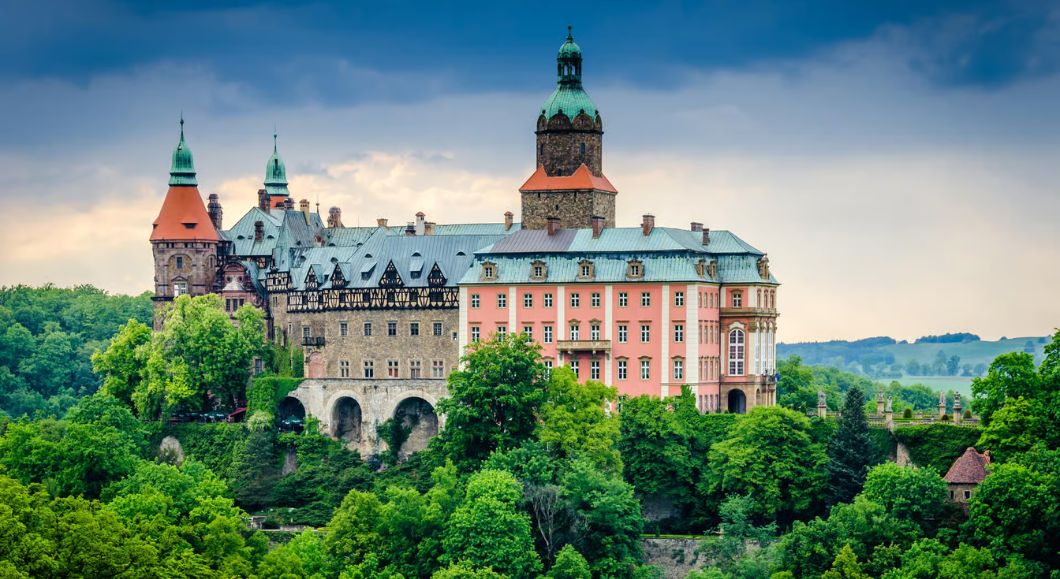
Ksiaz Castle is the third largest castle in Poland and the most dramatic in Lower Silesia: a baroque palace above the gorge of the Pelcznica River, surrounded by dense forest, its pink-tinged facades visible for some distance through the trees. The Hochberg family owned it for over four centuries, transforming a medieval fortress into an eclectic palace that hosted German emperors, the Russian Tsar, and Winston Churchill. In 1944 the Nazis seized it and began carving a network of tunnels — Project Riese — deep in the bedrock beneath. Nobody knows what the tunnels were for; the documents were destroyed. Descending by the original Nazi-era elevators into the cold, concrete passages is one of the more unsettling experiences available as a day trip from any Polish city. The castle interior — baroque salons, grand ballroom, Flemish tapestries — requires 2.5–3 hours to explore properly.
The Church of Peace in Swidnica, 30 minutes further by car, is one of the strangest and most beautiful buildings in Europe. After the Thirty Years’ War, the Habsburg Emperor allowed Protestant communities in Silesia to build churches — but with strict conditions: outside town walls, no towers, no stone, no mortar, built within a year. The result in Swidnica is the largest timber-framed church in the world, capable of holding 7,500 worshippers, its interior covered in trompe l’oeil ceiling paintings, galleries stacked four levels high, every surface occupied by Baroque decoration. It is a UNESCO World Heritage Site. The companion church in Jawor (30 km from Swidnica) is smaller but equally extraordinary; combining both in one day from Wroclaw is possible with an early start.
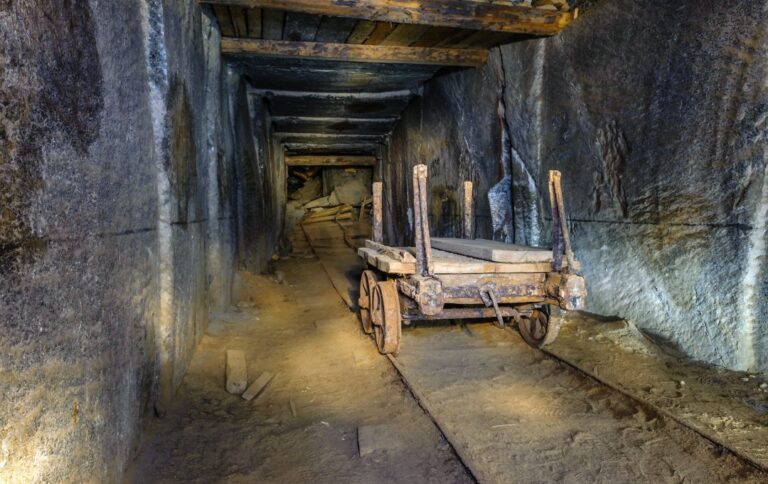
Discover Poland’s underground wonder on a seamless day trip from Wrocław to Kraków and the UNESCO-listed…
Read More →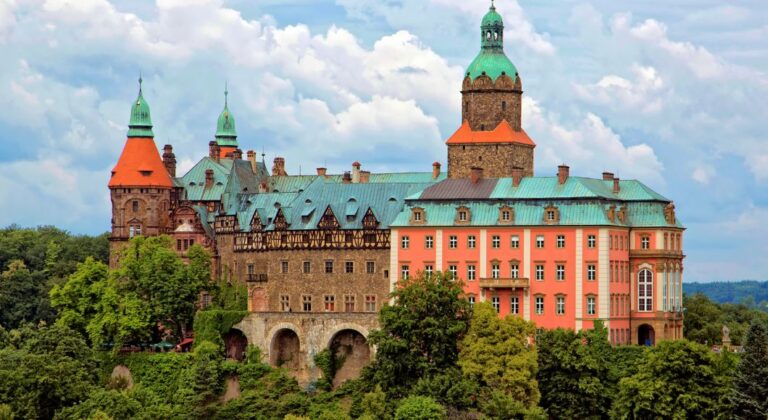
Discover the rich heritage of Lower Silesia on a private 6-hour excursion from Wrocław. Visit the…
Read More →Getting there: By car, direct. No reliable public transport for this combination. Organised tours from Wroclaw covering Ksiaz and the Church of Peace run regularly and are worth considering — guides add significant context to both sites.
Adršpach Rock Town (Czech Republic)
Distance: 100 km southwest | Journey: about 1 hour 45 minutes by car
Just across the Polish-Czech border in the Broumov region, the Adršpach Rock Town is a sandstone labyrinth of towers, gorges, and passages that looks like something from a fantasy novel — which explains why it was used as a filming location for The Chronicles of Narnia. The main trail is 3.5 kilometres, takes 2–3 hours at a comfortable pace, involves wooden walkways through narrow passages, steep staircases, and an underground boat ride across a lake. The tallest formation, the Lovers (Milenci), reaches 81.4 metres.
The experience is covered in detail in the separate Adršpach guide on this site. The short version: arrive early (the site opens at 8 AM), book entry tickets online in advance at adrspasskeskaly.cz (slots sell out on summer weekends), and wear footwear with good grip. The adjacent Teplice Rocks can be combined via the Wolf Gorge trail for a full day.
Getting there: By car from Wroclaw, crossing into the Czech Republic near Kudowa-Zdrój. The journey is straightforward; Google Maps handles it without complications. Parking at the entrance fills quickly from mid-morning in summer.
Mount Ślęża — The Silesian Sacred Mountain
Distance: 45 km south | Journey: about 50 minutes by car or train
Ślęża is an isolated basalt peak rising 718 metres from the Silesian plain — a mountain you can see from Wroclaw on clear days, standing alone without the surrounding ranges that usually give mountains their context. The Slavic Bobrzanie tribe considered it sacred; the pre-Christian stone sculptures found on its slopes and in the surrounding area suggest a religious significance that predates written history. There is a church at the summit, ancient granite bear sculptures along the trail, and — if the cloud cooperates — a view across the Silesian plain that extends on clear days back toward Wroclaw.
The hike from Sobótka at the base takes around 1.5 hours each way; the trail is well-marked and within reach of reasonably fit walkers. The mountain is the closest hiking destination to Wroclaw that feels genuinely like a mountain rather than a forest walk.
Getting there: By train to Sobótka (around 1 hour) or by car in under an hour. Sobótka has bus connections. The green trail from Sobótka leads directly to the summit.
Moszna Castle
Distance: 60 km east | Journey: about 1 hour by car
If you are building a castle designed to appear in someone’s imagination rather than in history, Moszna Castle is what you produce. The building has 365 rooms and 99 towers — the towers added in stages between 1900 and 1914 until the skyline became a fantasy of turrets, spires, and crenellations. The original part of the castle dates from the 17th century; the neo-Gothic and neo-Baroque extensions from the 19th and early 20th century are responsible for the spectacular silhouette. It is often called “the Polish Hogwarts,” which understates it.
Today Moszna operates as a hotel and sanatorium; guided tours of the castle interior are available to non-residents. The grounds include a 200-hectare park with ancient trees, a pond, and outbuildings that contribute to the sense of an estate designed at considerable expense with minimal restraint.
Getting there: By car only — public transport connections are very limited. A car trip east from Wroclaw through the Opole countryside is pleasant.
Karkonosze Mountains and Karpacz
Distance: 130 km southwest | Journey: about 2 hours by car
The Karkonosze (Giant Mountains) form the natural border between Poland and the Czech Republic southwest of Wroclaw and contain the highest peaks in the Sudeten range — Śnieżka at 1,603 metres is the highest point in both Poland and the Czech Sudetes. Karpacz, the main resort town on the Polish side, is the starting point for trails that include the route to Śnieżka (approximately 4–5 hours return from Karpacz, rewarding but demanding), shorter valley walks suitable for families, and access to Karkonosze National Park.
The other reason to come to Karpacz is the Wang Stave Church — a Norwegian wooden church from the 12th century, dismantled, transported piece by piece to Silesia in 1842 by the Prussian King Friedrich Wilhelm IV, and reassembled on a hillside above Karpacz where it has stood ever since. It is one of the more improbable architectural objects in Poland: a genuine Viking-age Norwegian stave church, 1,000 kilometres from its origin, with views of the highest mountain in Lower Silesia.
Getting there: By car approximately 2 hours. From June 2025, train connections to Karpacz have resumed via Jelenia Góra, making the journey by public transport feasible but slower. Allow a full day.
Kłodzko Valley and the Table Mountains (Góry Stołowe)
Distance: 95 km southwest | Journey: about 1.5 hours by car
The Kłodzko Valley (Kotlina Kłodzka) is a heavily forested basin in the southern Sudetes with a concentration of spa towns, baroque monasteries, natural rock formations, and fortifications. The Table Mountains National Park (Góry Stołowe), just west of Kłodzko, contains the most distinctive landscape in the Sudetes: flat sandstone plateaus eroded into labyrinths of narrow passages, natural rock amphitheatres, and wind-sculpted formations. The Błędne Skały (“Lost Rocks”) labyrinth and Szczeliniec Wielki plateau are the main attractions, each requiring a few hours of walking.
The fortified town of Kłodzko itself has a medieval fortress (one of the largest in Central Europe) built on a rocky outcrop above the Nysa River, with underground passages open to visitors. The Benedictine abbey at Bardo and the spa town of Polanica-Zdrój are worth combining on the same trip if you have a full day.
Getting there: By car. Train connections to Kłodzko from Wroclaw exist and take about 1.5 hours. For the Table Mountains and surrounding attractions, a car is more practical.
Prague (Czech Republic)
Distance: 270 km southwest | Journey: about 3 hours by car or bus
Prague sits at the outer limit of a comfortable day trip from Wroclaw — technically possible, but a full day of travel and sightseeing leaves little time and significant fatigue. The bus from Wroclaw runs regularly and costs around 20–25 euros one way; the journey takes approximately 4 hours. By car the drive is around 3 hours under normal conditions.
The honest advice: if you are going to Prague, stay at least one night. The city repays extended time and does not benefit from being rushed. But if Wroclaw is your base and you have a specific reason to visit Prague for the day — a concert, a museum, a meeting — the connection is workable.
Getting there: Flixbus and several Polish carriers run direct coaches from Wroclaw to Prague multiple times daily.
Dresden (Germany)
Distance: 220 km northwest | Journey: about 2 hours 15 minutes by car
Dresden is closer to Wroclaw than Prague and considerably less visited as a day trip, which makes it a more relaxed experience. The Baroque Old Town — largely reconstructed after the Allied bombing of February 1945, which killed between 22,000 and 25,000 people — contains the Zwinger palace complex, the Semperoper opera house, and the rebuilt Frauenkirche. The Gemäldegalerie Alte Meister (Old Masters Picture Gallery) in the Zwinger holds one of the finest collections of old master paintings in Germany, including Raphael’s Sistine Madonna.
Dresden also provides a specific kind of historical perspective for visitors to Poland: the bombing and destruction of Dresden is the German experience of wartime destruction, one that invites comparison with what happened to Warsaw, Wroclaw, and Gdansk on the other side of the conflict.
Getting there: By car approximately 2 hours 15 minutes on the A4 motorway via Görlitz. Train connections also exist, taking around 2.5 hours via Görlitz or Zgorzelec.
Practical Notes
Car vs. public transport: A car unlocks the full day trip menu from Wroclaw. Without one, Ślęża (train to Sobótka), Kłodzko (train), and Karpacz (train from June 2025) are the most accessible nature destinations. Ksiaz, Moszna, Adršpach, and the Churches of Peace are all significantly more difficult without a vehicle.
Organised tours: Multiple Wroclaw-based operators run guided day trips to the most popular destinations, handling transport and providing historical context. For Ksiaz and the Church of Peace, the WWII tunnel sites, and Moszna, a guide adds considerably to the experience.
Combining destinations: The Ksiaz + Church of Peace combination is the classic half-day route. Adršpach pairs naturally with a morning at the nearby Teplice Rocks or with a scenic drive through the Broumov region. The Kłodzko Valley and the Table Mountains are best combined as adjacent areas — different in character but close enough to visit on the same day.