Poland is a large country — larger than most visitors expect when they start planning their first trip. The distance from Gdańsk on the Baltic coast to Krakow at the foot of the Tatra Mountains is approximately 640 kilometres, comparable to the distance from London to Edinburgh or from Paris to Barcelona. Between these two cities, roughly in the middle, sits Warsaw — the capital, the largest city, and the point where the country’s roads, railways, and air routes converge.
This north-to-south route through Poland’s three most visited cities is the classic Polish itinerary for a reason. It covers the full spectrum of what makes the country remarkable: a Baltic port city with a Hanseatic old town and the birthplace of Solidarity; a capital rebuilt from rubble and now one of the most dynamic cities in Central Europe; and a medieval royal city that has been continuously inhabited for over a thousand years and sits within reach of UNESCO World Heritage sites and the highest mountains in the Carpathians. Each city is distinct. Each requires at least two nights to see properly. Together, they tell the story of Poland more completely than any single destination can.
Gdańsk: Where Poland Meets the Sea
Gdańsk is where to start. Flying into Gdańsk Lech Wałęsa Airport — named after the electrician who co-founded Solidarity at the adjacent shipyard — and arriving in the city by late morning gives you most of your first day in one of the most visually striking old towns in northern Europe.
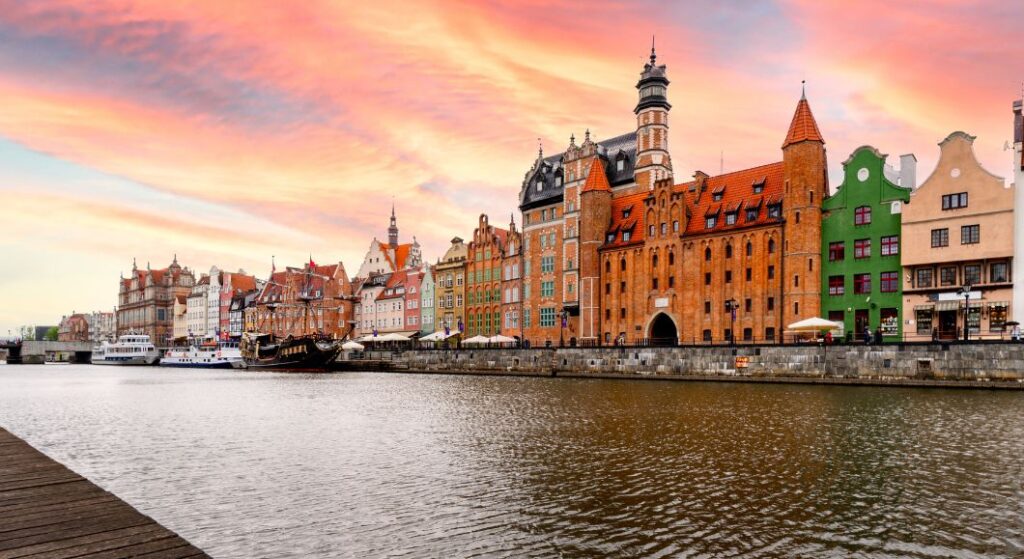
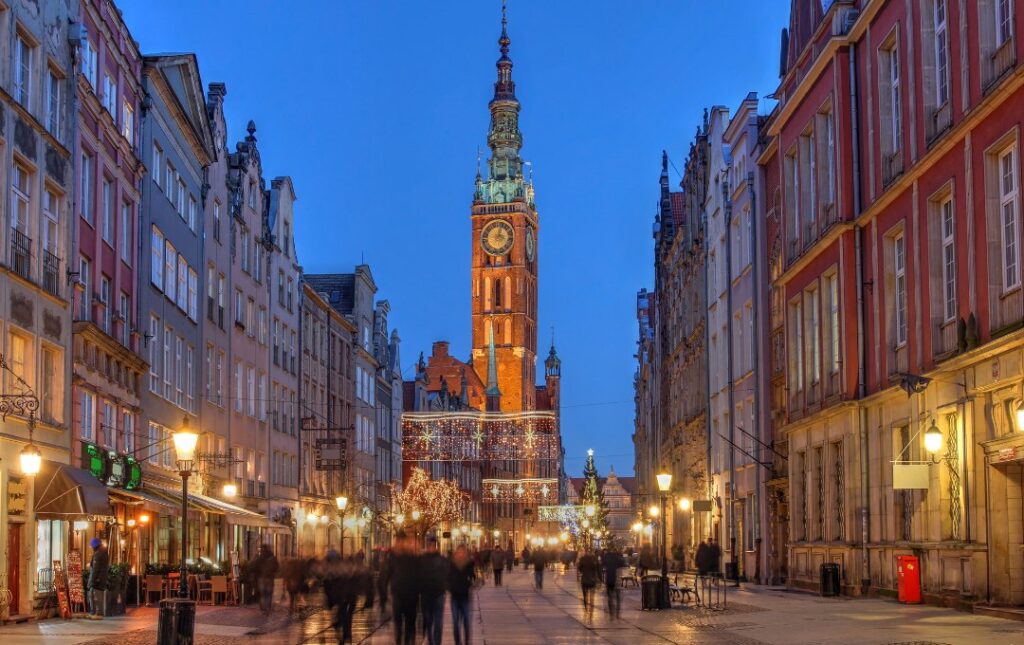
The Long Market (Długi Targ) and Long Street (Długa) form the spine of the Gdańsk Old Town — a sequence of Dutch Mannerist and Renaissance facades in amber, terracotta, and green that were rebuilt after wartime destruction with extraordinary faithfulness to their pre-war appearance. The Gothic Crane (Żuraw) on the Motława riverfront — a double-tower mechanism that was the largest medieval port crane in Europe — is the defining image of the city. The Green Gate and the Golden Gate frame the Royal Way at either end.
Two days in Gdańsk is the minimum for doing the city justice. The Museum of the Second World War — opened in 2017 on the site where the war began, when German warships opened fire at 4:47 AM on September 1, 1939 — is one of the finest war museums in Europe and requires a full day on its own. The European Solidarity Centre, built on the site of the Lenin Shipyard where Solidarity was founded in August 1980, documents the trade union movement that began the end of Soviet-aligned rule in Central Europe. Together, these two museums give Gdańsk a historical density unusual even in a country where history is everywhere.
The beach at Sopot — 20 minutes by commuter rail, 511 metres of wooden pier, 4.5 kilometres of Baltic sand — adds a coastal dimension available nowhere else on this itinerary. A half-day in Sopot fits naturally into the Gdańsk stay.
The day trip to Malbork Castle — one hour south by train, the largest castle in the world by land area, built by the Teutonic Knights in the 13th century — is one of the best single-day excursions available in Poland. The Teutonic Order’s brick Gothic on a scale that has no parallel in Central Europe; the castle complex covers 21 hectares.
Explore Gdańsk tours and excursions: Poland Travel Tours — Gdańsk
Recommended time: 2–3 nights. Train to Warsaw: approximately 3 hours by express PKP Intercity.
Warsaw: The City That Refused to Stay Dead
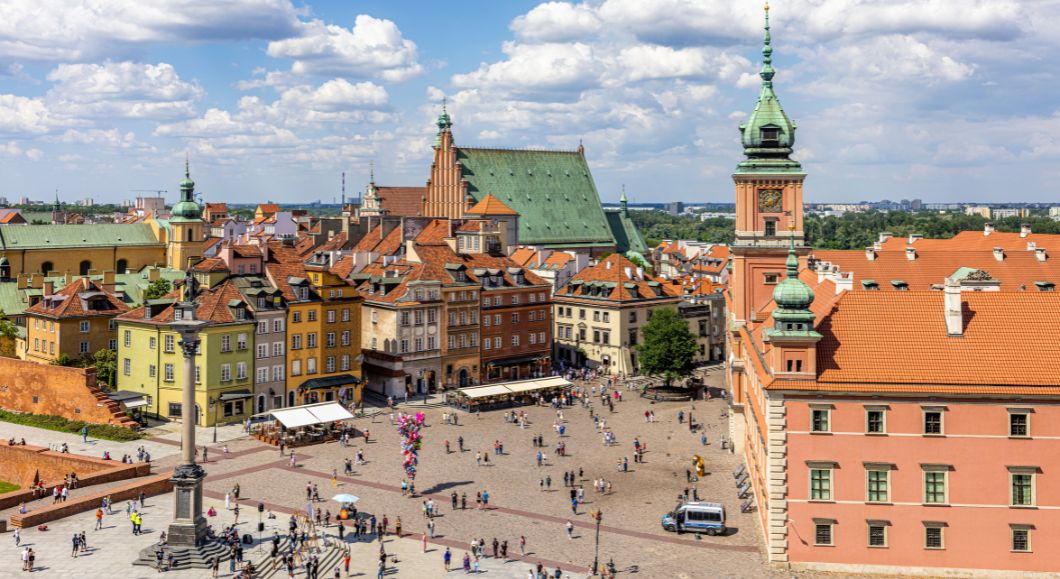
The train from Gdańsk arrives at Warsaw Central Station, directly below the Varso Tower — at 310 metres, the tallest building in the European Union — and within sight of the Palace of Culture and Science, the Stalinist Gothic skyscraper that Stalin gifted to the Polish people in 1955 and that Warsaw has been ambivalent about ever since. The juxtaposition of these two buildings, seen from the station exit, is one of the more concise summaries of Warsaw’s 20th and 21st centuries available in a single glance.
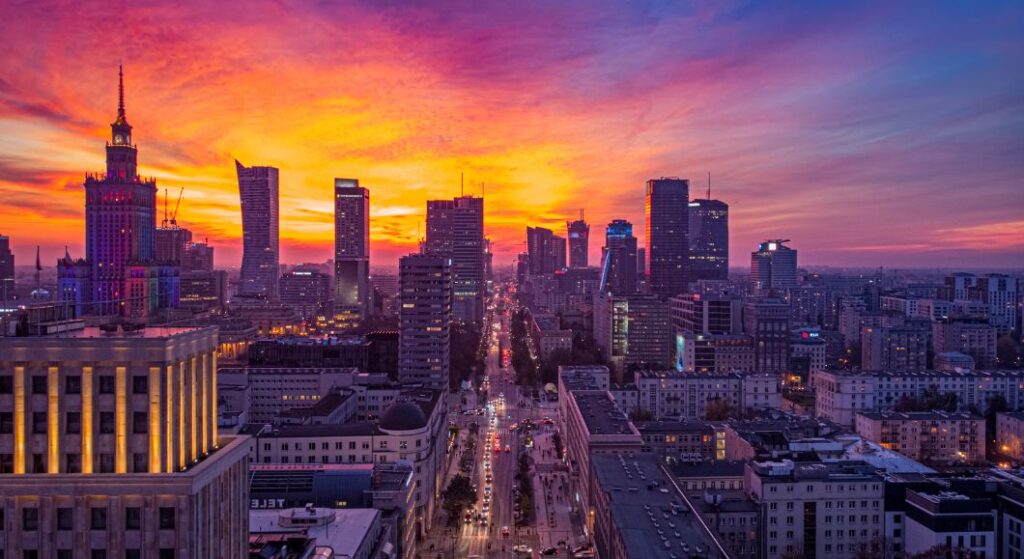
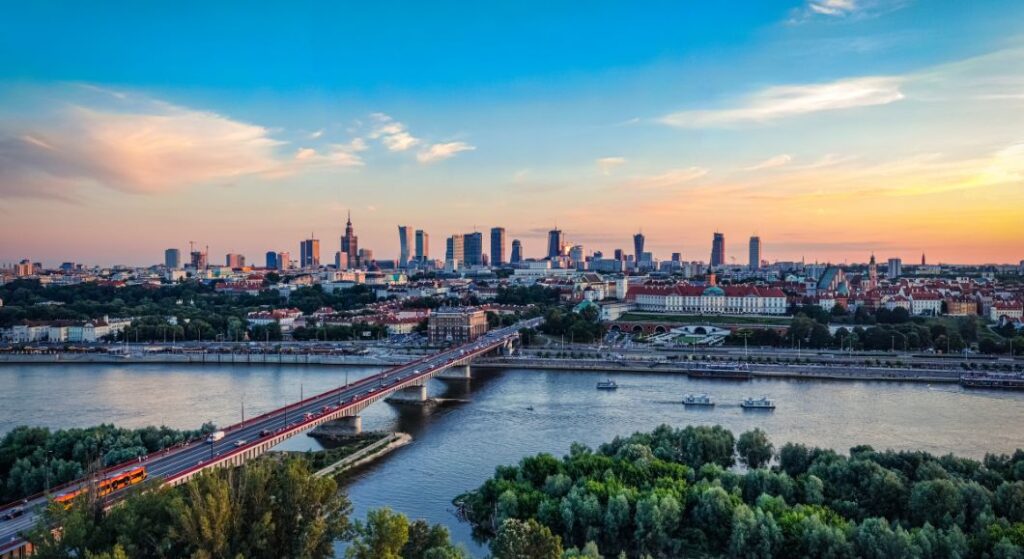
Warsaw was 85% destroyed by the end of the Second World War. The Germans systematically demolished it building by building using specialist Vernichtungskommandos — demolition units whose sole purpose was the physical erasure of the city — following the suppression of the Warsaw Uprising in October 1944. What exists today is a city rebuilt from rubble by its own inhabitants, which gives Warsaw an energy and a relationship with its history that no other city in Poland has. It is simultaneously one of the youngest cities in Europe and one of its oldest.
The Old Town — rebuilt between 1945 and 1963 with such fidelity to the original that UNESCO inscribed it on the World Heritage List in 1980 specifically citing the reconstruction — provides the historical backdrop. The Royal Castle (dynamited by the Germans in 1944, rebuilt between 1971 and 1984 using private donations from Polish citizens and the diaspora) houses the eighteen Canaletto paintings that were used as architectural blueprints for the Old Town’s reconstruction. The Copernicus Science Centre on the Vistula riverbank is the best interactive science museum in Central Europe. The POLIN Museum of the History of Polish Jews is essential for understanding what Warsaw was before the war — when Jews constituted approximately 30% of the city’s population — and what was lost.
Warsaw’s skyline, food scene, and after-dark life have transformed dramatically in the last decade. The city is now genuinely cosmopolitan — with Michelin-listed restaurants, a thriving craft beer scene, and a contemporary arts landscape that extends well beyond the museums.
Explore Warsaw tours and excursions: Poland Travel Tours — Warsaw
Recommended time: 2–3 nights. Train to Krakow: approximately 2.5 hours by express.
Krakow: The Royal City at the Edge of the Mountains
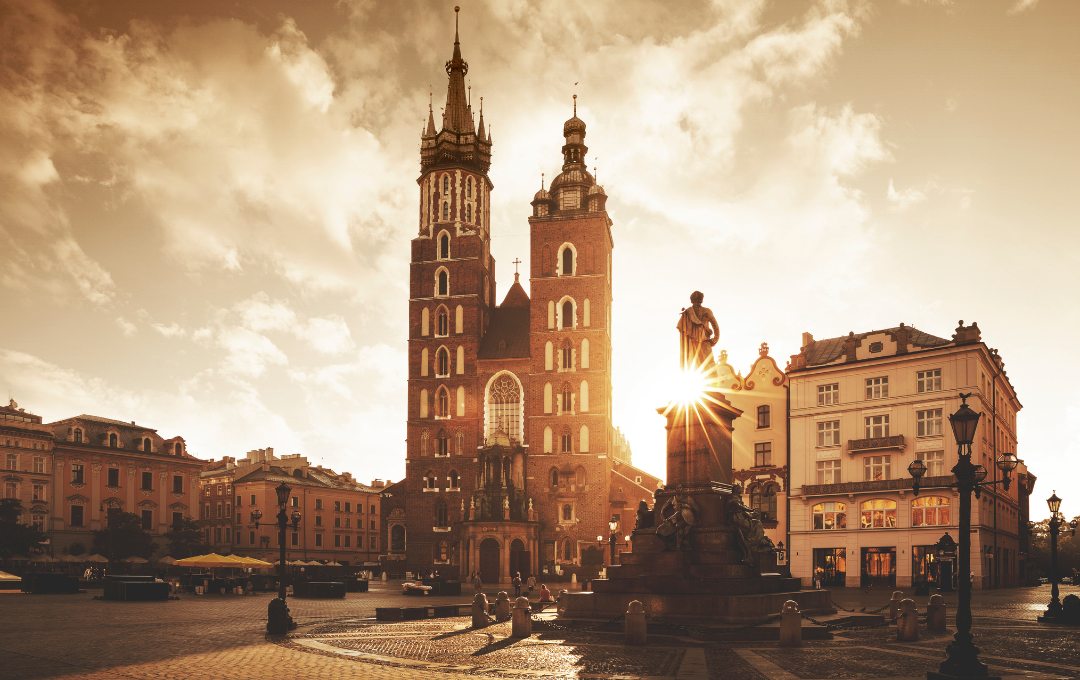
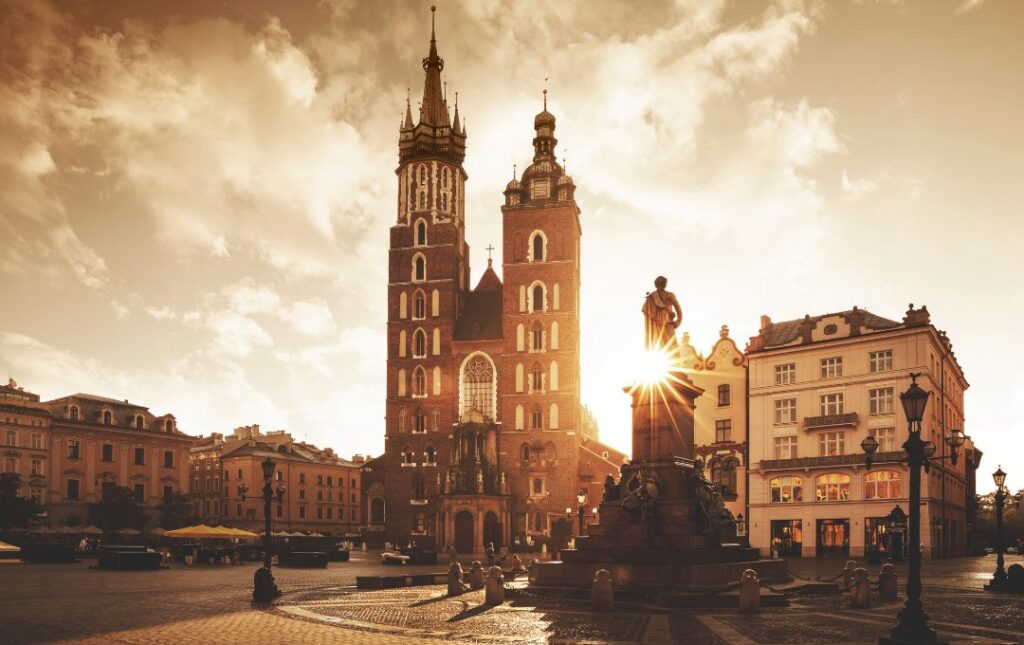
The train from Warsaw arrives at Krakow Główny railway station, adjacent to the Planty — the ring of gardens built on the site of the medieval city walls — and five minutes’ walk from the Rynek Główny. Unlike Warsaw, Krakow was not destroyed in the war. The Germans used it as the administrative capital of occupied Poland — Hans Frank governed from Wawel Castle — and retreated without the systematic destruction they carried out elsewhere. The architecture you walk through in Krakow’s Old Town is substantially the original fabric: Gothic churches, Renaissance townhouses, Baroque facades, a medieval market square that has been in continuous use for seven centuries.
The Rynek Główny is one of the largest medieval market squares in Europe, surrounded by buildings whose histories span from the 13th to the 20th century. St. Mary’s Basilica at the square’s corner has a trumpeter who plays the hejnał from the tower every hour, in a tradition that has continued since the medieval period. The Cloth Hall in the centre of the square houses a gallery of 19th-century Polish painting upstairs and souvenir stalls below. The Town Hall Tower is the only surviving element of the original town hall, demolished in 1820.
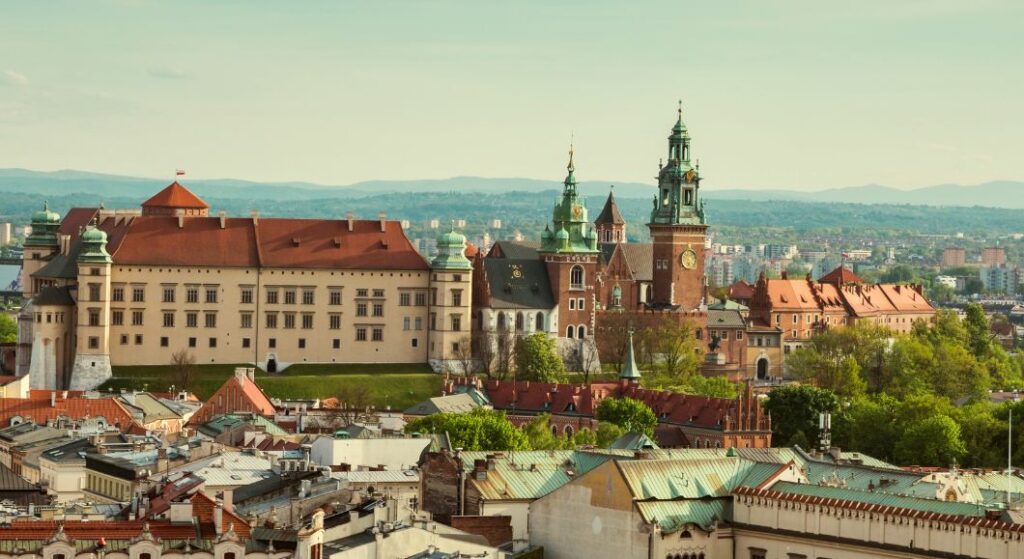
Ten minutes south is Wawel — the castle and cathedral complex on a limestone hill above the Vistula, the seat of Polish kings for five centuries. The Royal Chambers, the Crown Treasury (housing the Szczerbiec coronation sword, used at every Polish coronation from 1320 to 1764), and the Wawel Cathedral with its royal tombs together make Wawel the most historically significant complex in Poland. Book timed entry tickets well in advance.
Five minutes south of Wawel begins Kazimierz — the former Jewish quarter, one of the most atmospheric neighbourhoods in Poland. More than 60 synagogues and prayer houses operated here before the war; seven survive. The Old Synagogue, the Remuh Synagogue and Cemetery, and the Tempel Synagogue are the principal sites. In the evening, the restaurants, cafés, and bars of Kazimierz make it the best neighbourhood in Krakow for dinner and an evening walk.
Krakow’s greatest advantage over Warsaw and Gdańsk as a base is the quality and range of its day trips. Within 90 minutes: the Wieliczka Salt Mine (UNESCO, 300 kilometres of underground corridors, the Chapel of St. Kinga carved entirely from salt), Auschwitz-Birkenau (the most important Holocaust memorial site in the world; requires a full day and should not be combined with other activities), and Zakopane with the Tatra Mountains and the thermal baths of the Podhale region.
Explore Krakow tours and excursions: Poland Travel Tours — Krakow
Recommended time: 3–4 nights.
How to Travel Between the Cities
The three cities are connected by PKP Intercity express trains — the fastest and most comfortable way to cover the route.
Gdańsk to Warsaw: Express trains (EIP/EIC) take approximately 2 hours 50 minutes to 3 hours 20 minutes. Trains run frequently throughout the day from Gdańsk Główny to Warszawa Centralna. Book in advance for the best prices and guaranteed seating.
Warsaw to Krakow: Express trains take approximately 2 hours 15 minutes to 2 hours 45 minutes — one of the best value inter-city rail journeys in Central Europe for the combination of speed and comfort. Multiple departures daily from Warszawa Centralna to Kraków Główny.
The full north-to-south route can also be done by car, but the train is faster between cities and eliminates parking logistics in three urban centres. Flying between cities is available but unnecessary given the rail times and the distance lost getting to and from airports.
How Long Do You Need?
The minimum for all three cities is 7 nights — two nights each in Gdańsk and Warsaw, three in Krakow. This covers the essential sites in each city with one day trip from Krakow (either Wieliczka or Auschwitz, not both).
10 nights is comfortable: three nights in Gdańsk (with Malbork and a Sopot afternoon), three in Warsaw (with a full day for POLIN and the Copernicus Science Centre), and four in Krakow (allowing Auschwitz as a full day, Wieliczka or Zakopane as a second day trip, and genuine time in Kazimierz and Wawel without rushing).
Two weeks allows the route to breathe: additional days in each city for the experiences that reward slower engagement, and the possibility of stopping in Toruń between Gdańsk and Warsaw (the best-preserved Gothic old town in Poland, birthplace of Copernicus, 2 hours from Gdańsk and 2.5 hours from Warsaw by train), or in Lublin between Warsaw and Krakow (one of Poland’s most historically significant and least visited cities, 2 hours from Warsaw).
Practical Notes
Best time: May–June and September–October offer the best combination of weather, crowd levels, and full access to all sites. July–August is peak season — all attractions are fully operational but Gdańsk and Krakow in particular are busy.
Booking: For Krakow, book Wawel Castle and Schindler’s Factory Museum tickets as soon as dates are confirmed — both sell out weeks in advance in summer. The Auschwitz guided tour similarly requires advance booking. POLIN Museum in Warsaw is less pressured but benefits from pre-booking in summer.
Currency: Poland uses the Polish złoty (PLN), not the euro. ATMs are widely available in all three cities; cards are accepted almost everywhere, but small cash amounts are useful at markets and for tips.
SEO Title: Poland from North to South: Gdańsk, Warsaw & Krakow – Complete Travel Guide
SEO Description: The ultimate Poland north to south itinerary — Gdańsk on the Baltic, Warsaw rebuilt from rubble, and Krakow at the foot of the Tatras. How long to spend in each, how to travel between them, and the best tours and excursions.