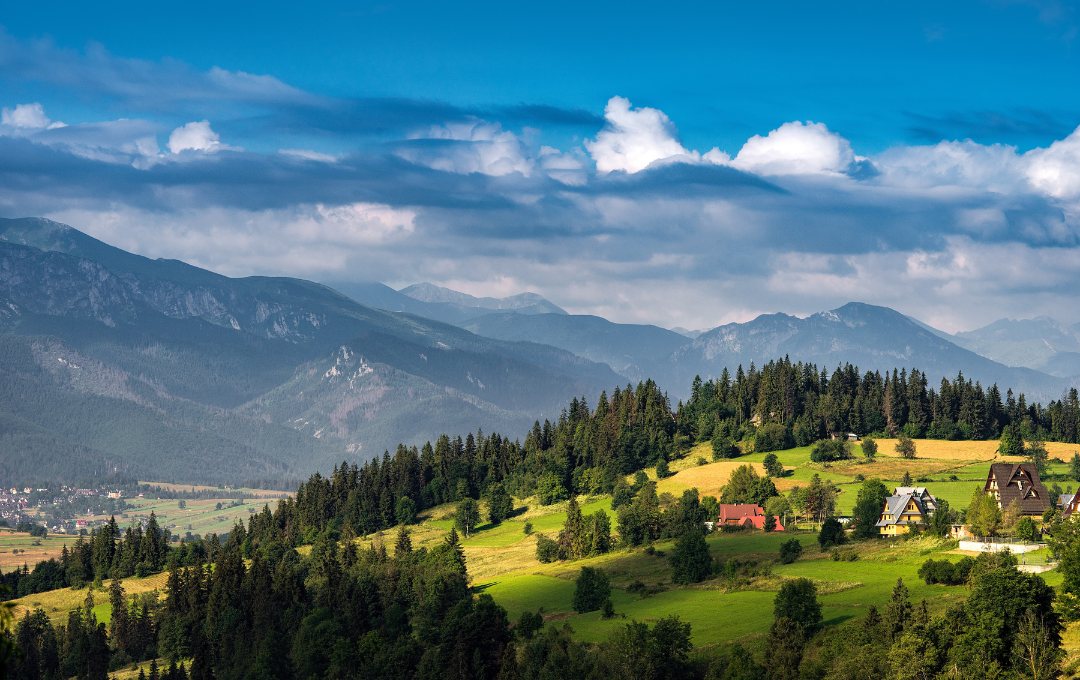
An hour and a half south of Krakow, the flat Malopolska countryside begins to change. The horizon lifts. The fields give way to forest, the forest to something larger, and then — coming around a bend in the road — the Tatra Mountains appear. Not hills. Not the gentle ridges of the Beskids further north. Real mountains, with granite peaks and snow on the upper slopes for much of the year, rising sharply from the valley floor with an abruptness that surprises almost every first-time visitor.
At the foot of those mountains sits Zakopane: Poland’s mountain capital, winter sports centre, highland culture heartland, and one of the most visited destinations in the entire country. Around three and a half million people come here every year. And for visitors based in Krakow, it is the most natural and rewarding day trip available — close enough to reach comfortably, different enough in character to feel like a genuine departure.
Why Zakopane is worth your time
Zakopane is not a medieval town with a market square and cathedral. It developed primarily in the 19th century, when Polish intellectuals, artists, and romantics discovered the Tatra highlands and made them fashionable. What they found was a pre-existing highland culture — the Gorals, or Polish mountaineers — with its own distinct architecture, music, food, dialect, and way of life that had developed in relative isolation over centuries.
That culture is still very much present. The wooden architecture of the Zakopane Style — designed by the architect Stanislaw Witkiewicz in the late 19th century to formalise the vernacular building traditions of the highlands — is visible throughout the town in the older villas, churches, and guesthouses. The Tatra Museum on Krupowki Street, the main pedestrian thoroughfare, covers the natural and cultural history of the region and is a good orientation before heading into the mountains.
Krupowki itself deserves a mention as one of the more chaotic and lively streets in Polish tourism — full of stalls selling smoked cheese, restaurants with folk music, souvenir shops of wildly varying quality, and a constant stream of visitors. It is not peaceful, but it is genuinely alive, and the food options here are better than the setting might suggest.
The thing most visitors come for: Morskie Oko
If you only have one day and one mountain experience in the Tatras, make it Morskie Oko. The name translates as Eye of the Sea — a glacial lake sitting in a dramatic natural cirque at 1,395 metres above sea level, surrounded by granite walls and the peaks of the High Tatras. It is the largest and most famous lake in the Polish mountains, and the trail to it is the most popular mountain walk in Poland. That popularity is for good reason: the scenery is genuinely spectacular, and the walk is manageable for most visitors.
The trailhead is at Palenica Bialczanska, around 25 kilometres from Zakopane town centre. From there, the route to the lake follows a well-maintained asphalt road climbing steadily through the forest for about 9 kilometres. The walk takes roughly two hours at a comfortable pace. If you’d prefer not to walk the full distance, traditional horse-drawn carriages operate from the trailhead and will take you most of the way up for a fee — a slower but characterful alternative.
From the lake shore, the view across the water to the surrounding peaks is the one that appears on every Tatra poster, and it earns its reputation. For those with more energy, a steeper trail climbs from the far side of the lake to Czarny Staw pod Rysami — the Black Lake, the deepest in the Tatras at 76 metres — in around 30 minutes of harder climbing. From there, experienced and well-equipped hikers can continue to Rysy, at 2,499 metres the highest peak in Poland. Most day visitors are content with Morskie Oko itself.
One important practical note: arrive early. The car park at Palenica Bialczanska fills before 9am on summer weekends and the shuttle buses from Zakopane also become very crowded. This is one of those places where starting at 7am and finishing by early afternoon is a genuinely better experience than arriving mid-morning with the main crowds.
Gubalowka: the easy mountain view
For visitors who want the panorama without the hike, Gubalowka is the answer. A funicular railway runs from the northern edge of Zakopane town centre to the top of Gubalowka ridge at 1,120 metres above sea level — a journey of a few minutes that delivers you to one of the finest views of the entire Tatra range. The three peaks of the Giewont massif dominate the view to the south, a silhouette so familiar to Poles that it has become a symbol of the mountains.
At the top, there is the usual assortment of food stalls, souvenir stands, and a summer alpine slide, all of which can be cheerfully ignored in favour of simply sitting with the view. A marked walking path continues west along the ridge toward Butorowy Wierch, gradually leaving the crowds behind and delivering longer views of the Western Tatras. Allow an hour for the ridge walk each way.
The cable car to Kasprowy Wierch, deeper in the national park, reaches a significantly higher elevation — the summit sits at 1,987 metres on the border with Slovakia — and delivers a more dramatic alpine experience. Queues for the cable car are substantial in summer, particularly on weekends, and advance booking online is strongly recommended.
What to eat and where
Highland cuisine deserves its own moment. Zakopane is one of the few places in Poland where the local food culture is genuinely distinct from the national norm, shaped by the Goral tradition and the products available in the mountain environment.
Oscypek is the defining ingredient: a smoked sheep’s milk cheese pressed into a characteristic spindle shape, sold at stalls throughout Zakopane and at mountain huts along the trails. Grilled oscypek served with cranberry jam is one of those combinations that sounds odd and tastes completely right. It is protected as a regional product under EU law and can only be produced in specific highland areas using traditional methods — what you buy in Zakopane is the real thing in a way that cheese sold elsewhere in Poland often is not.
Beyond oscypek, look for bigos (hunter’s stew), placek po zbojnicku — a potato pancake topped with goulash that is deeply satisfying after a day in the mountains — and grilled trout from the mountain streams. Kwasnica, a sour sauerkraut soup sometimes made with mutton stock, is the traditional warming dish of the highlands and particularly good in colder weather. The wooden restaurants along Krupowki and in the side streets nearby are the right places to eat: the tourist-facing stalls do a decent trade but the restaurants with proper kitchens serve food worth sitting down for.
Thermal baths: the unexpected bonus
Around 25 kilometres from Zakopane, the thermal baths of the wider Tatra region offer something completely different from the mountain hiking. The Chocholowskie Thermal Baths, the largest in Poland, use naturally heated mineral water pumped from underground springs and offer a combination of outdoor and indoor pools, saunas, and water attractions in a valley setting with mountain views. After a day of walking, sitting in warm mineral water looking up at the Tatras is a particular pleasure.
The Termy Zakopanskie within the town itself offer a more compact alternative closer to the centre. Both are year-round facilities, and in winter — when the outdoor pools steam in the cold air against a backdrop of snow — they become one of the more memorable experiences available in southern Poland.
Getting to Zakopane from Krakow and how to make the most of one day
The bus is the most convenient option for independent travellers. Direct buses run from Krakow bus station throughout the day and take around two hours, depositing you close to the centre of Zakopane. The train is slower — around three and a half hours — due to a route that is not direct, and most visitors choose the bus for good reason.
By car, the drive takes roughly an hour and a half in normal traffic, though summer weekends bring significant congestion on the approach road to Zakopane and the parking situation in town can be difficult.
The honest challenge of doing Zakopane independently in a day is time and distance. Morskie Oko alone requires most of a morning if you’re walking the full route. Gubalowka takes another couple of hours. Adding food, the town itself, and the return journey to Krakow leaves little room for anything to go wrong.
The alternative is a guided day trip from Krakow, which handles transport and timing and gives you the kind of context that turns a day in the mountains into something that stays with you. Our Zakopane tour from Krakow covers the highlights in a well-paced day — Morskie Oko, Gubalowka, time in the town, and the food — without the logistical stress of navigating the mountain transport on your own.
When to go
Every season in Zakopane has something to offer, and the honest answer is that there is no bad time to visit. Summer — July and August — brings the best hiking conditions and the warmest temperatures but also the largest crowds; Morskie Oko in particular can feel uncomfortably busy on peak days. September and early October are arguably the finest months: the crowds thin, the autumn colours arrive in the valleys, and the weather remains good for walking.
Winter transforms Zakopane into Poland’s ski capital. The slopes of Kasprowy Wierch offer the best high-altitude skiing in the country, and the town itself takes on a different character — the wooden buildings lit in the evenings, horse-drawn sleighs operating on some routes, the thermal baths operating at full appeal against the cold. Christmas and the February school holidays bring the largest winter crowds.
Spring — particularly May, when the crocuses bloom in the highland meadows and the lower trails clear of snow — is the most underrated season. The Chocholowska Valley crocuses in particular are a sight worth planning a trip around.
Whatever time of year you come, the mountains are there. And they are more impressive than the photographs.