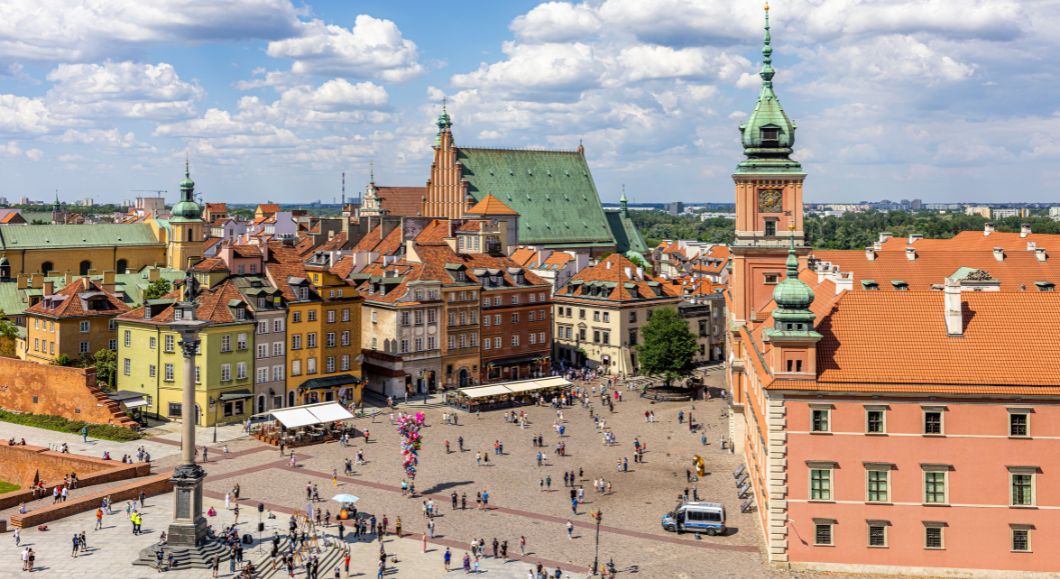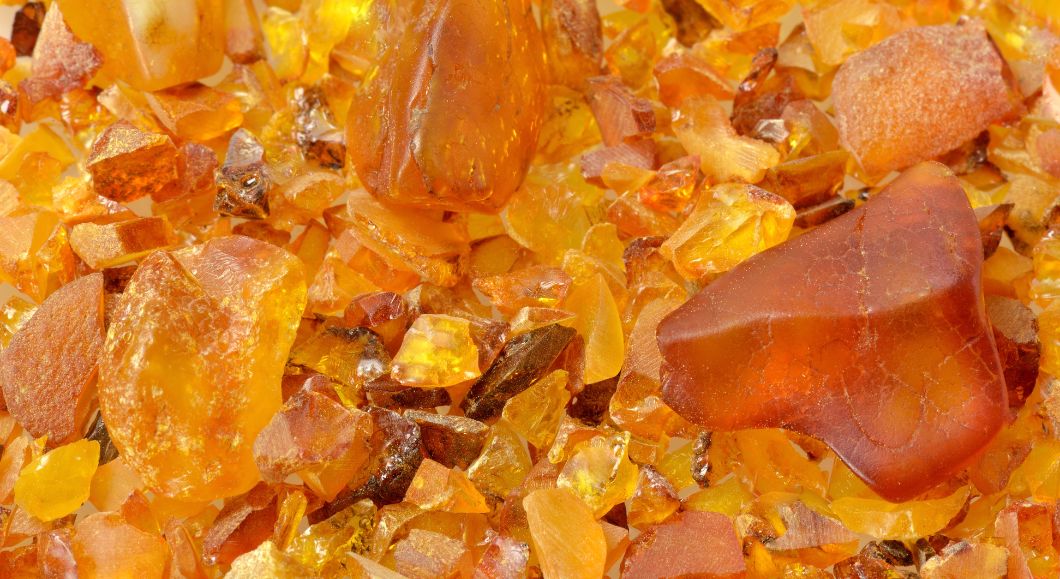
There is a moment, somewhere along the waterfront in Gdansk, when you look up and realise that almost every shop window contains amber. Pendants, rings, bracelets, loose stones, decorative boxes, chess sets, miniature sculptures — all in that distinctive spectrum of colour from pale champagne through deep honey to near-black, some pieces cloudy and opaque, others transparent enough to see the light passing through. A few contain something dark and suspended at the centre: a bubble of ancient air, a fragment of plant matter, or — the most prized of all — an insect frozen in resin perhaps forty million years ago.
Amber has been traded on the Baltic coast for at least four thousand years. It washes up on beaches after storms, is dug from coastal deposits, and has been carried along trade routes from northern Europe to the Mediterranean since the Bronze Age. The Romans called the Baltic the Mare Suebicum — the Amber Sea. For much of human history, Baltic amber was as valuable as gold and far more exotic. The material you can buy in a Gdansk market stall today is the same substance that was sent south to Rome, to Egypt, to the courts of ancient China.
Understanding a little of this history — and knowing the practical basics of what amber actually is and how to tell the real thing from imitation — makes the experience of shopping for it considerably more satisfying.
What amber actually is
Amber is not a mineral or a crystal. It is fossilised tree resin — the sticky substance that certain trees secreted millions of years ago, which over geological time hardened, polymerised, and became the material we know today. Baltic amber specifically comes from a now-extinct conifer species, Pinus succinifera, which grew in forests across what is now northern Europe somewhere between 34 and 48 million years ago. The resin dripped from the trees, trapping whatever happened to be nearby at the time — insects, spiders, plant fragments, feathers, drops of water — before hardening and eventually washing into the sea or becoming embedded in sediment.
Baltic amber is distinguished from other amber deposits around the world by its particularly high succinic acid content — typically between three and eight percent — which gives it specific chemical properties and has historically made it the most valued type. The Polish and Latin terms for Baltic amber, bursztyn and succinum, both derive from this succinic acid content. When you rub Baltic amber briskly, it produces a faint, distinctive piney scent — one of the traditional field tests for authenticity.
The colour range of Baltic amber is extraordinary. The most common is yellow in its many shades, but amber also occurs in white (sometimes called “royal white”), green, blue, black, and the rarest natural colour, deep cherry red. The cloudy or opaque quality of some amber comes from microscopic air bubbles trapped within the resin as it formed; transparent amber hardened more slowly and allowed those bubbles to dissipate.
Four thousand years of trade
The oldest known amber trade routes date to around 1800 BCE, connecting the Baltic coast — primarily the shores of what are now Poland, Lithuania, and the Kaliningrad region of Russia — to the Mediterranean world. Archaeologists have found Baltic amber in Bronze Age graves in Greece, in Mycenaean shaft tombs, and in Egyptian tombs from the same period. The material traveled thousands of kilometres by foot and river before the first roads were built.
The Romans formalised this into what historians call the Amber Road — a network of trade routes running from the Baltic coast south through the Germanic territories, across the Alps, and down to Rome. The emperor Nero reportedly sent a Roman knight to the Baltic coast specifically to acquire large quantities of amber for a single gladiatorial spectacle. The Roman writer Pliny the Elder noted with evident fascination that amber figurines fetched higher prices in Rome than living human slaves.
Gdansk — then known as Danzig — became the centre of the Baltic amber trade by the medieval period, and the Teutonic Knights, who controlled the region from the 13th century, established a monopoly on amber collection and trade so strict that anyone found with uncertified amber was subject to execution. The knights maintained their control until the city passed to Polish sovereignty in the 15th century, at which point the amber trade became one of the foundations of Gdansk’s extraordinary commercial wealth.
The amber workshops and craftsmen of Gdansk developed into a sophisticated industry over the following centuries, producing work of exceptional quality for European courts and aristocracy. The most famous single object in the history of amber — the Amber Room, created in the early 18th century for the Prussian king Frederick I and later given to Peter the Great of Russia — was a room-sized installation of amber panels, gilded wood, and mirrors considered one of the wonders of the world. It was looted by German forces during the Second World War and has never been recovered. Its whereabouts remain one of the great unsolved mysteries of European art history.
Where to buy amber in Gdansk
The Long Market and the surrounding streets of Gdansk’s old town contain the highest concentration of amber shops anywhere in Poland, and the quality and prices vary enormously. The general principle that applies to luxury goods everywhere applies here: the more prestigious the shop, the more reliable the provenance and quality, and the higher the price. That trade-off is yours to make.
Amber Street — Ulica Mariacka — is the most famous amber shopping destination in Poland. The street runs from the Church of St Mary toward the Motlawa river, lined with Gothic tenement houses whose stone porches spill over with amber displays. It has been associated with the amber trade for centuries and remains the most atmospheric place to browse, particularly in the morning before the tour groups arrive. The traders here are a mix of established jewellers and individual craftspeople; quality ranges from excellent to mediocre, and bargaining is not the norm but polite conversation about what you’re looking at is welcomed.
The Amber Museum in the Amber Palace near the Great Mill is the right place to visit before you buy anything serious. It covers the history of amber, explains the geological formation of Baltic amber in detail, and displays an outstanding collection of amber inclusions — pieces containing insects, plant matter, and other organic material trapped in the resin. Seeing what exceptional amber looks like, and understanding what makes certain pieces scientifically and aesthetically significant, calibrates your eye for everything you look at afterward.
For higher-end purchases — jewellery from established designers who work amber into contemporary settings — the designer studios around the old town waterfront are worth seeking out. Polish amber jewellery design has become genuinely creative over the past twenty years, moving well beyond the traditional pendant-on-a-silver-chain format into pieces that treat amber as a serious design material alongside gold, oxidised silver, and unconventional shapes.
The covered market at the end of Ulica Mariacka and the stalls along the Motlawa waterfront offer lower price points and a wider range of decorative objects — amber-framed mirrors, ornamental boxes, loose stones sold by weight. These are reasonable places to buy small gifts and souvenirs, but require more attention to what you’re actually buying.
How to tell real amber from imitation
This is the question most visitors ask, and it deserves a straight answer. Imitation amber — primarily made from plastics, glass, or cheaper resins such as copal — is common in tourist markets everywhere, including Gdansk. Most reputable jewellers in established shops will not sell you fake amber, but the lower end of the market is less reliable.
The most accessible test you can do without equipment is the saltwater test. Real Baltic amber floats in a saturated saltwater solution (approximately two tablespoons of salt dissolved in a glass of water); most plastics and glass imitations sink. This is obviously not something you can do in a shop, but it works well if you’ve already bought something and want to verify it at home.
The rubbing test is possible in a shop: rub the piece briskly against a cloth or your palm for fifteen to twenty seconds and then smell it. Genuine Baltic amber produces a faint, distinctive resinous scent — slightly piney, slightly medicinal. Plastic imitations either produce no smell or a sharp chemical odour.
Under ultraviolet light, genuine Baltic amber fluoresces with a distinctive blue-green glow. Many reputable amber shops carry a UV torch and will use it on pieces if you ask. Copal, a younger and cheaper resin sometimes sold as amber, fluoresces differently — typically a weaker, more yellow-white glow.
Pieces that are suspiciously cheap, perfectly uniform in colour, or contain suspiciously perfect-looking inclusions (insects centred precisely in a transparent stone, for instance) warrant extra scrutiny. Natural amber inclusions are usually visible at odd angles, partially obscured, or positioned in ways that suggest genuine random entrapment rather than deliberate placement.
A note on amber inclusions
If you are drawn to amber containing organic inclusions — the pieces with insects, plant fragments, or air bubbles visible inside — it’s worth knowing that the market for these ranges from the scientifically significant to the outright fraudulent. Genuine prehistoric insect inclusions in Baltic amber do exist and are sold legitimately, but they command serious prices commensurate with their rarity. Very cheap pieces claiming to contain well-preserved whole insects should be viewed sceptically; injecting inclusions into reconstituted amber or copal is a known practice.
The legitimate end of this market is extraordinary. A single mosquito in a piece of Baltic amber — the real thing, forty million years old — is a genuinely remarkable object, a direct physical connection to a world that existed before humans. If you have any serious interest in natural history, spending time in the Amber Museum looking at the inclusion collection is one of the more quietly mind-expanding experiences available in northern Poland.
Amber as a piece of Poland to take home
Of all the things you might buy in Poland, amber is the one most directly tied to place. It comes from this specific coastline, formed in forests that stood here tens of millions of years ago, washed by this particular sea, traded through this particular city for four thousand years. A well-made piece of amber jewellery bought from a craftsperson in Gdansk is not a generic souvenir — it is a material connection to one of the longest continuous trade traditions in European history.
That’s worth knowing before you buy. And it’s worth knowing before you walk past the window without stopping.