The plan was straightforward. Krakow had long been a problem for the communist authorities — an intellectual, bourgeois city with a powerful Catholic Church, a royal castle, medieval traditions, and citizens who voted less than 12% in favour of communist rule after World War II. The solution, ordered by Stalin, was to build an entirely new city next to it: a workers’ paradise of steel mills and monumental boulevards that would dilute the old Krakow with an influx of proletarian consciousness and flood the region with compliant industrial workers. They called it Nowa Huta — the New Steel Mill.
It didn’t go as planned. Within a decade, the workers who’d been brought in from rural Poland to build the communist dream were rioting in the streets over a wooden cross. Within three decades, the steelworks that gave the city its name was one of the strongest strongholds of the Solidarity movement. The Lenin statue was torn down in 1989 to the applause of Nowa Huta’s residents. The main square was renamed Ronald Reagan Central Square in 2004. The streets that were once called Lenin Avenue and Cuban Revolution Street now bear the names of Pope John Paul II and Solidarity.
The city built to destroy old Krakow is now one of the most fascinating tourist attractions in Poland.
Getting There
Nowa Huta sits about 8 kilometres east of Krakow’s Old Town and is connected to the city centre by tram. The ride from the central tram stops takes around 25–30 minutes and costs a standard Krakow tram fare (around 4–6 PLN depending on the ticket type). Take tram line 4 or 22 heading east and get off at the Plac Centralny im. Ronalda Reagana stop — you’ll emerge directly at the heart of the district.
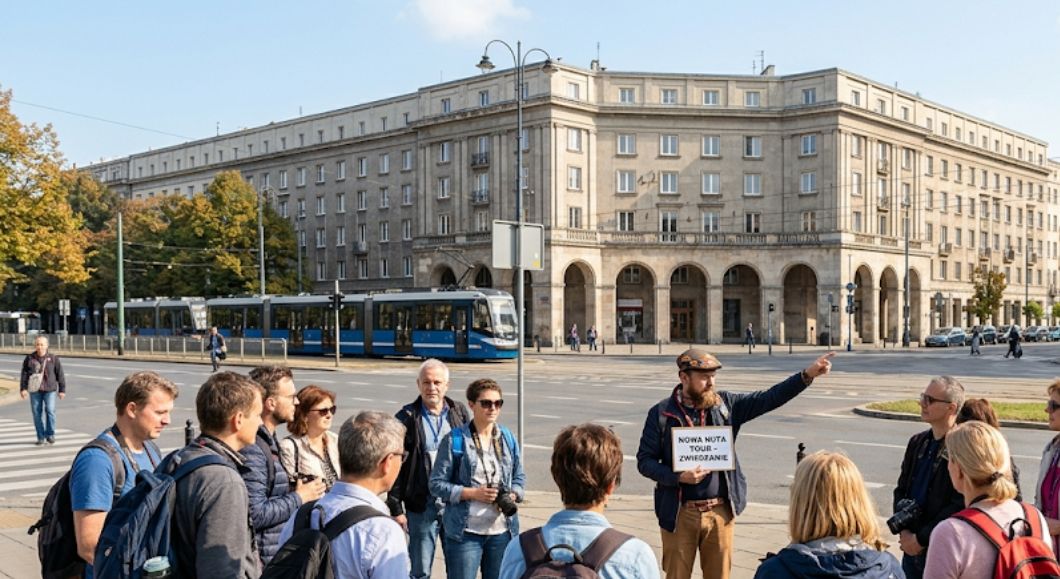
You can also join one of Krakow’s communist-era tours, many of which involve vintage Soviet Ladas or Trabants — uncomfortable, loud, and genuinely atmospheric in a way that a tram can’t match. For a first visit where context matters, a guided tour is worth it. For a second visit where you know the story and want to walk at your own pace, the tram is fine.
Plac Centralny: Start Here
Step off the tram and you’re standing in one of the most extraordinary urban spaces in Central Europe. Plac Centralny — officially Ronald Reagan Central Square since 2004, though locals still mostly call it Plac Centralny — is a vast pentagonal square from which five wide, tree-lined boulevards radiate outward like the points of a red star. The geometry is deliberate: this is city planning as ideology, every sight line and proportion calculated to convey the power and order of the socialist state.
The buildings surrounding the square are in the Socialist Realist style — the Soviet-mandated aesthetic of the early 1950s that borrowed from Renaissance and classical forms to create something monumental, symmetrical, and slightly oppressive. The proportions are too large for human comfort. The ornamental details were planned but never fully completed — the communist system ran out of enthusiasm and resources by the mid-1950s, when Stalin died and Socialist Realism was quietly abandoned across the Eastern Bloc.
Stand in the middle of the square and look north along what was once Lenin Avenue — now Aleja Solidarnosci. The Lenin statue that towered here from 1973 to 1989 is gone, replaced by a monument to the Solidarity trade union. The ideological reversal is almost theatrical.
The Steelworks: The Reason It All Exists
Two kilometres north of Plac Centralny, at the end of the main boulevard, stand the gates of the Tadeusz Sendzimir Steelworks — still operating today, owned since 2005 by the Mittal Steel Company. Originally named the Vladimir Lenin Steelworks, it opened in 1954, employed up to 38,000 workers at its peak, and was the largest steel plant in Poland. The demand for steel, historians note, was relatively modest. The steelworks existed primarily to create a working class where none had been.
The administration buildings at the entrance — known locally as the “Doges’ Palace” or the “Vatican” because their Socialist Realist grandeur seems to reference Venice and Rome simultaneously — are the most architecturally striking industrial buildings you’ll ever see. They’re open for guided tours, and if you can get inside, the original 1950s interiors — the honeycomb ceilings, the grand spiral staircases, the meeting rooms frozen in amber — are genuinely worth the effort.
The irony of the steelworks’ political history is considerable. By the early 1980s, 29,000 of its 38,000 workers were members of Solidarity. The factory built to produce a compliant proletariat produced instead some of the most active opponents of the communist system in Poland. The 30-foot steel cross hanging in the Lord’s Ark Church was secretly fabricated here by Solidarity workers, under the noses of communist management.
The Cross and the Church: Resistance in Concrete
The most extraordinary story in Nowa Huta — and there are many — is the story of the church.
The city was designed without one. This was not an oversight. Nowa Huta was explicitly planned as an atheist city, a place where religion would be irrelevant to the workers of the future. The Cistercian monastery in the village of Mogila, incorporated into Nowa Huta’s territory, remained the only church for the entire district for years.
In 1957, following the partial liberalisation of the “Gomulka thaw,” residents were given permission to erect a wooden cross marking the site of a future church. People gathered for outdoor masses. Then the authorities changed their minds: the plot had been reassigned to build a school under the “1000 schools for the millennium” programme. Workers arrived to remove the cross on 27 April 1960. Residents blocked them. Riot police arrived. Water cannons and tear gas were used. Hundreds of people were injured in clashes that lasted days. The cross stayed.
It took another seven years of pressure — much of it applied by Karol Wojtyla, then Auxiliary Bishop of Krakow — before permission to build a church was granted in 1967. The authorities imposed a condition: it couldn’t look like a church.
What was built between 1967 and 1977 looks like nothing else in Poland. The Lord’s Ark Church — officially the Church of Our Lady Queen of Poland — sits in the Bienczyce district of Nowa Huta, its rounded concrete form rising from the flat residential blocks like a ship run aground in a grey sea. It was designed to resemble Noah’s Ark resting on Mount Ararat: a deliberate theological statement that the communist flood had not prevailed.
The construction itself was an act of collective defiance. When the authorities refused to provide ration stamps for building materials, residents gathered more than two million stones from the mountain rivers and carried them by hand to the site. The stones form the entire exterior of the church. The steel cross and the crucified figure above the entrance were fabricated secretly at the steelworks by Solidarity workers. The tabernacle contains a moon rock — whether genuine is debated, but the symbolism was irresistible to a congregation living under a regime that insisted the future belonged to science and the state.
Cardinal Wojtyla consecrated the church in May 1977. More than 70,000 people attended. The following year, Wojtyla became Pope John Paul II — and tried to visit Nowa Huta during his first papal pilgrimage to Poland in 1979. The communist government wouldn’t allow it.
Go inside the church. The interior is as unusual as the exterior — curved concrete walls, steel cables suspending a copy of the image of the Virgin Mary, a basement chapel containing a statue of Our Lady of Armour made from shrapnel fragments removed from Polish soldiers wounded at Tobruk and Monte Cassino. The space feels unlike any other religious building in Poland.
The Museum of the People’s Republic
In a former cinema on Centrum E housing estate — itself a perfectly preserved example of the more pragmatic architectural styles that followed Socialist Realism — the Museum of the People’s Republic of Poland (Muzeum PRL) houses an exhibition of communist-era everyday life: the objects, propaganda posters, queuing systems, and domestic interiors of Poland under the system.
It’s neither nostalgic nor entirely condemnatory. The exhibits show real lives, not just ideology — the apartments that felt modern to people coming from rural villages without running water, the small consumer goods that were luxuries, the Solidarity leaflets printed in secret. If you want to understand what daily life actually looked like before 1989, this is the place.
The Air Raid Shelters
One detail that guides mention and most visitors never expect: the streets of Nowa Huta were designed with a secondary defensive purpose. The wide boulevards, the spacing of buildings, the tree lines — all were calculated to support defensive urban guerrilla warfare in the event of a NATO ground attack. There are more than 250 air raid shelters hidden beneath the streets and buildings, large enough to shelter the entire district’s population.
Several sections of these shelters are now open to visitors through the Nowa Huta Underground project. The bunkers beneath the former administration buildings of the steelworks are accessible by arrangement and remain largely unchanged since the 1980s — offices, meeting rooms, communications equipment, all frozen in the last decade of the communist era. It is, without question, the most surreal interior in Krakow.
Practical Tips
A focused visit to Plac Centralny, a walk along the main boulevard, and the Lord’s Ark Church can be done in 2–3 hours. Add the steelworks administration buildings and the Museum of PRL and you need a half-day. The air raid shelters require a separate booking.
Restauracja Stylowa on Plac Centralny has been feeding Nowa Huta residents since the communist era and still operates as a deliberately retro experience — the décor is period, the food is Polish, and a bust of Lenin watches from the corner. The zapiekanka sold at the local market is excellent and cheap. Both are worth your time.
The single best piece of advice for visiting Nowa Huta is this: come with a guide for the first visit. The architectural details, the political history, the street renamings, the church story — none of it lands with full force without someone who grew up here to tell it. Several operators in Krakow run excellent English-language tours; some, as noted, involve vintage communist-era cars. Once you know the story, come back and walk it alone.