Before you write off the dwarfs as tourist kitsch, hear the story behind them. In the early 1980s, under martial law, Wroclaw was one of the most active centres of opposition to the communist regime in Poland. The authorities regularly sent workers at night to whitewash anti-government slogans off city walls. A student at Wroclaw University named Waldemar Fydrych — who went by the nickname “Major” — had an idea. When the militia painted over a protest slogan, he would paint a small grinning dwarf on the fresh white patch.
The logic was brilliant. You couldn’t arrest someone for painting a dwarf. And if you did arrest someone for painting a dwarf, you looked ridiculous. The dwarf graffiti multiplied across Wroclaw and then spread to other Polish cities. By 1988, Fydrych’s Orange Alternative movement had evolved into full street happenings — thousands of people marching through Wroclaw wearing orange cone hats, chanting “freedom for the dwarfs.” The militia arrested hundreds of people dressed as gnomes. On another occasion they detained 77 people dressed as Father Christmas. At one point, Fydrych summarised his artistic philosophy to police who had detained him: “The thesis is the anti-regime slogan. The anti-thesis is the white patch. And the synthesis is the dwarf.”
In 2001, the first bronze dwarf was installed on Swidnicka Street — a tribute to the Orange Alternative. By 2005 there were six. Today there are estimated to be over 1,000 scattered across the city. The tourist maps and apps exist. The dwarf information centre is in the Market Square. Every September the International Dwarf Festival fills the city with families hunting krasnale. The revolution won, and the symbol of the revolution became the city’s mascot.
Now you understand Wroclaw.
Getting There
Wroclaw is Poland’s fourth-largest city and well connected by train from Warsaw (around 3.5–4 hours), Krakow (around 3.5 hours), and Poznan (around 2 hours). The main station, Wroclaw Glowny, sits on the southwestern edge of the Old Town — it’s a 15-minute walk to the Market Square. Alternatively, the city’s efficient tram network runs from stops outside the station directly to the Rynek (trams 17, 31, and others).
Wroclaw also has its own airport, Copernicus Airport, about 10 kilometres from the centre. Tram line 106 connects the airport to the city centre in around 30 minutes.
The Market Square: The Heart of Everything
Wroclaw’s Rynek — the Main Market Square — is one of the largest medieval market squares in Europe. Measuring roughly 213 by 178 metres, it covers almost 3.8 hectares and is second in Poland only to Krakow’s famous square. It was laid out in the early 13th century under Duke Henry the Bearded, and despite suffering significant damage during World War II, was meticulously reconstructed in the decades that followed. The reconstruction is considered one of the masterpieces of post-war restoration in Poland.
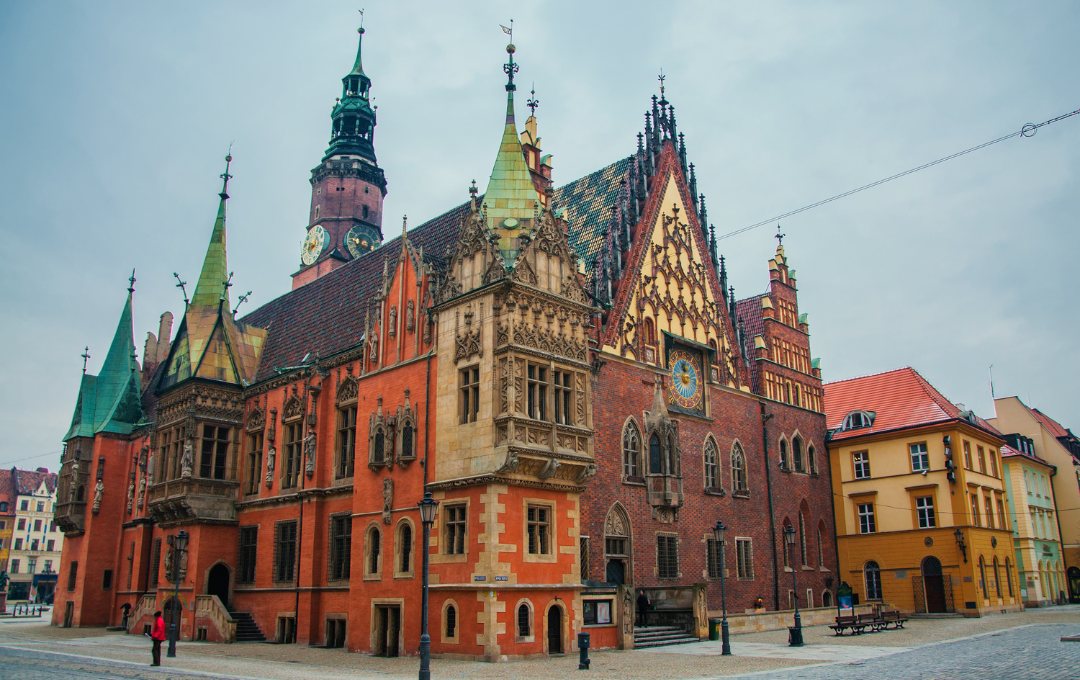
The centrepiece is the Old Town Hall — a Gothic building whose construction began in the late 13th century and continued for 250 years, resulting in the layered, ornament-covered structure you see today. Its tower stands 66 metres tall and bears five clock faces. Inside is the Museum of Burgher Art, worth half an hour of your time. In the basement, the Piwnica Swidnicka has been operating as a restaurant since 1273 — making it one of the oldest continuously operating restaurants in Europe, and a fact worth deploying at dinner.
In front of the Town Hall stands a stone pillory — a replica of the one used for public punishments from 1492 until well into the 18th century. Next to it, a small bronze bear on a tree stump has stood here since 1998, replacing one that was lost during the war. Both are smaller than the brochures make them sound, but no one comes to Wroclaw’s Market Square for the pillory.
The square is surrounded by 60 historic townhouses, each with a traditional name — Under the Griffins, Under the Blue Sun, Under the Golden Cup, Under the Old Gallows. The facades range from Gothic through Renaissance, Baroque, and Art Nouveau, reflecting how the city was rebuilt, modified, and refined across seven centuries. One exception stands at number 11 on the east side: a flat, modernist ten-storey block from 1931, a monument to the debate about what Wroclaw might have become had its historic centre been allowed to be modernised. It sits there like a warning.
Adjoining the main square on its western side is Plac Solny — the Salt Square — a smaller satellite square that was historically a market for salt, leather, and honey. Today it’s a 24-hour flower market. The stalls are there at midnight. They’re there at 6 AM. Fresh flowers surround you constantly in this corner of Wroclaw, which turns out to be one of the most unexpectedly pleasant things about the city.
Hansel and Gretel Houses
On the northern edge of the square, two small houses joined by a Gothic arch stand between the Town Hall and the Church of St. Elizabeth. These are the “Jas i Malgosia” houses — Hansel and Gretel — named not after the fairy tale but after the arch that connects them, which once served as the gateway to the churchyard of St. Elizabeth. They’re tiny, colourful, asymmetrical, and they photograph extraordinarily well. The Dwarves Museum — announced by a tiny plaque at knee height on the wall — is supposedly located here, though finding it is part of the game.
St. Elizabeth’s Church and the View From Its Tower
The Church of St. Elizabeth on the northern side of the Market Square is one of the largest Gothic churches in Poland, built between the 14th and 15th centuries with a tower rising 83 metres. It was Wroclaw’s primary Lutheran church for several centuries, then Catholic again, then damaged in a fire in 1976 that destroyed the original tower. The rebuilt tower is now open for visitors to climb — 302 steps to a viewing platform with one of the best panoramas of Wroclaw’s roofscape, the Oder River, and on clear days the distant Sudety Mountains.
Near St. Elizabeth’s stands the Church of St. Mary Magdalene, connected to a peculiar feature: the Bridge of Penitents — a narrow footbridge at 45 metres altitude linking the church’s two towers. It’s open to visitors and gives you a different kind of aerial perspective, looking down into the narrow streets of the old city. The combination of the bridge and the slightly vertiginous experience of being 15 floors up between two medieval towers is memorable.
The Bridges and the Oder
Wroclaw sits on the Oder River and its tributaries, distributed across a dozen small islands connected by over 100 bridges — more bridges per square kilometre than almost any other city in Europe. This geography defines the city’s character. You’re always crossing water, always moving between islands, always getting slightly disoriented in the best possible way.
The most romantic of the crossings is Most Tumski — Cathedral Bridge — the only pedestrian-only bridge in the Old Town, lined with lamp posts and connecting the main city to Cathedral Island (Ostrow Tumski). It’s famous for the padlocks that lovers attach to its railings, though a small sign nearby gently explains that a dwarf patrols the bridge, removing locks that threaten to weigh it down. At each end of the bridge stands one of the city’s bronze krasnale, keeping watch.
Cathedral Island itself is worth the short walk across. It’s the oldest part of Wroclaw — settled in the 10th century, the seat of one of Poland’s first bishoprics — and it feels genuinely ancient compared to the reconstructed grandeur of the Market Square. The Cathedral of St. John the Baptist has twin towers that are visible from across the city, and the island’s narrow lanes lined with church buildings and seminary walls have a hushed, medieval quality that persists even in summer.
The University Quarter
A short walk west from the Market Square along Swidnicka Street and then along the riverfront brings you to Wroclaw University — founded in 1702 by Emperor Leopold I and still one of the most impressive Baroque complexes in Central Europe. The centrepiece is the Aula Leopoldina, the university’s ceremonial hall, whose ceiling fresco, gilded columns, and carved wooden galleries represent Baroque decoration at its most concentrated. Tickets are available to visit the hall independently; it takes about 20 minutes but makes a substantial impression.
Adjacent to the Aula is the Mathematical Tower — an 18th-century astronomical observatory with a terrace at 42 metres that gives wide views over the Oder and Piasek Island (Sand Island). The university complex is ticketed as a combined museum; check the website for current prices and hours.
The Dwarfs: Where to Find Them
The dwarf information centre is at Rynek 14, next to the Town Hall, where you can buy a printed map for around 12 PLN showing the location of 100 of the most notable ones. There’s also an official app from the city’s tourism bureau that covers the full map, which is updated as new figures appear. An interactive online map is available at krasnale.pl.
The highest concentration is in and around the Market Square — look at ground level on steps, around corners, perched on windowsills. Some have been there long enough to acquire shiny noses or hats from being touched. Others are recent arrivals commissioned by businesses. A few have stories: the Deaf-Mute and Blind dwarfs on Swidnicka Street are part of the Wroclaw Without Barriers campaign. The dwarf standing guard on Cathedral Bridge removes love locks to stop the structure from collapsing under their weight. A dwarf representing a late owner of a beloved local snack bar was funded by crowdfunding within days of his death.
The best approach is to carry the map but not be enslaved by it. The ones you stumble across unexpectedly — crouched in a doorway, peering around a corner, fishing in a fountain — are the ones you remember.
Practical Tips for the Old Town
The Market Square, Cathedral Island, the university quarter, and the main churches can be covered in a half-day on foot. Give yourself a full day if you want to visit tower viewpoints, the Aula Leopoldina, and spend time wandering the side streets properly.
Wroclaw rewards slow walking. The streets between the Market Square and the river contain covered arcades, small courtyards, old bookshops, and coffee houses that don’t appear on any map. The Jatki passage near the Town Hall — a former medieval butchers’ arcade now lined with small bronze animal sculptures — is one of those corners that most visitors never find but always remember.
The city is at its most alive during the Christmas Market, held in the Market Square from late November through December. The Rynek fills with stalls, lanterns, and mulled wine, and the facades of the townhouses illuminate in the winter dark in a way that justifies an entire trip.
If you’re visiting in September, the International Dwarf Festival turns the whole city into a carnival of krasnale-hunting, parades, and family events. For the rest of the year, the dwarfs are simply there — on every corner, in every district, a city-wide joke that was once, quietly, one of the most effective acts of political resistance in the last century of European history.