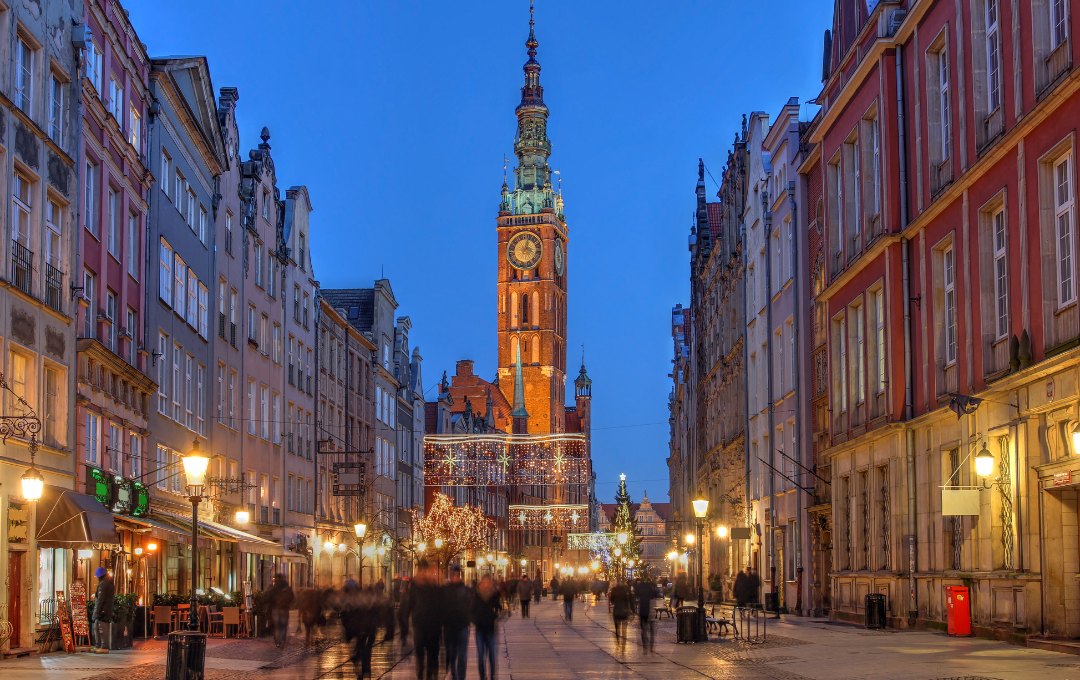
The first thing most people say when they arrive in Gdansk Old Town is that it looks like Amsterdam. The tall, narrow merchant houses with ornate stepped gables, the canals, the amber light on the facades in the evening — it does look like Amsterdam, or Bruges, or some idealised version of a northern European trading city that has been standing for centuries.
Then someone tells you the truth: almost none of it is more than 70 years old.
In March 1945, Soviet forces advancing on what was then the German city of Danzig shelled and burned the historic centre for days. By the time it was over, roughly 90% of the Main Town had been destroyed — over 1,000 houses, churches, granaries, and civic buildings reduced to rubble. The old districts contained more than 5,000 historically valuable structures before the war. Fewer than 40 residential buildings in the Main Town survived intact.
What you’re walking through today is a reconstruction — an extraordinary, decades-long act of collective will carried out by Polish architects, artisans, and ordinary workers who decided, amid the ruins of a devastated country, that this city was worth rebuilding. They did it deliberately, meticulously, emphasising the Flemish and Dutch Renaissance influences that defined the city’s mercantile golden age and consciously setting aside the later Prussian additions. The result is a city that looks historical because it chose to remember a specific history — and walks through it feel different once you know that.
Getting to Gdansk Old Town
Gdansk is well connected by train from Warsaw (around 3 hours on an express service), Krakow (around 5–6 hours), and Wroclaw (around 5 hours). The main train station, Gdansk Glowny, is about a 10–15 minute walk from the heart of the Old Town, or a short tram ride on lines 3, 6, or 9 to the Dlugi Targ stop.
From the station, the most natural approach to the Old Town is along ul. Heweliusza toward the Upland Gate — which puts you at the beginning of the Royal Way and lets you walk through the old city in its proper sequence, from west to east, ending at the river.
Gdansk also has its own airport, Lech Walesa Airport, located about 12 kilometres from the centre. A taxi or Uber to Old Town takes around 20–25 minutes and costs roughly 50–70 PLN.
The Royal Way: How to Walk the Old Town
The classic route through Gdansk Old Town follows the Royal Way — the ceremonial parade route that Polish monarchs took when they visited the city. It runs for about 500 metres from the Upland Gate in the west to the Green Gate on the Motlawa River in the east, passing through the most significant buildings and spaces in the city.
The sequence matters. Start at the Upland Gate (Brama Wyzynna), a late Renaissance structure that once marked the city’s western fortifications. Pass through it and you enter the narrow passage of the Torture House — now home to the Amber Museum — before reaching the Golden Gate, the most ornate of Gdansk’s old gateways. The gilded decoration and Dutch Renaissance stonework of the Golden Gate is genuinely spectacular, and it frames the view east along Dluga Street like a painting.
From here, ul. Dluga (Long Street) runs straight east, lined with restored merchant townhouses, cafés, and the famous Uphagen House at number 12 — a preserved 18th-century patrician interior, now a museum, that gives you a sense of how the city’s wealthy residents actually lived before it was all taken away.
At the end of Dluga Street the view opens into the Long Market — Dlugi Targ — the long rectangular square that is the centrepiece of the Old Town. The Main Town Hall stands here, its Gothic tower topped with a gilded figure of King Sigismund Augustus. The Neptune Fountain, cast in Augsburg in 1617 and restored after being hidden during the war, stands at the centre of the square. Artus Court, the grand meeting hall of Gdansk’s medieval merchants, fronts the square behind the fountain.
Walk to the far eastern end of Dlugi Targ and pass through the Green Gate to reach the Motlawa riverside. This is where the city’s identity shifts from civic grandeur to mercantile muscle.
The Main Town Hall and its Tower
The Town Hall is one of the few buildings in the Main City that survived the war with some original elements intact. It’s been rebuilt and restored, but the Gothic bones are genuine, and the tower — 80 metres high — offers the best panoramic view in Gdansk. Climb it. Most visitors go to St. Mary’s Church tower instead, but the Town Hall view is wider, includes the full length of Dlugi Targ below you, and involves fewer steps.
Inside the Town Hall is the Museum of Gdansk. The most impressive room is the Red Room, whose ceiling decorations from the early 17th century were restored after the war. If you have limited museum time in Gdansk, this room alone is worth the ticket.
Mariacka Street: The Best Street in the City
Running parallel to Dlugi Targ one block to the north, Mariacka Street is consistently described as the most beautiful street in Poland, and the description is not hyperbole. It runs from the north wall of St. Mary’s Basilica to Mariacka Gate on the river, roughly 200 metres of cobblestones flanked by restored houses with distinctive external staircases — a feature unique to Gdansk — and small stone terraces on each side.
During the day, Mariacka fills with amber sellers. The stalls and gallery windows lining both sides sell everything from raw Baltic amber to high-end jewellery, and the quality varies enormously. The street is famous enough that the sellers here have been curated over the years — you’re less likely to find outright fakes than in the market stalls, but the amber guide in the separate Gdansk activities article covers what to look for in more detail.
At dusk, when the tourists thin out and the light goes golden on the facades, Mariacka becomes genuinely cinematic. It’s the kind of street you come back to twice.
St. Mary’s Basilica
The largest brick church in the world. Construction began in 1343 and took 159 years to complete. The exterior is massive and severe — the sheer scale of dark brick against the sky is more impressive than beautiful. The interior, whitewashed after the war, is vast and pale and oddly peaceful because of it.
What most visitors don’t expect is the astronomical clock, dating to the 1460s — one of the largest medieval astronomical clocks in Europe. It shows the time, the day of the week, the phases of the moon, the positions of the sun and moon in the zodiac, and the calendar of saints. For centuries it was the most sophisticated mechanical object most people in this city would ever see.
The tower climb (409 steps) gives you a high vantage point over the rooftops of the Old Town, though as mentioned the Town Hall tower offers a broader view. If you’re going to climb one, the Town Hall. If you want both, allow half a day for this part of the city alone.
The Motlawa Waterfront and the Crane
The Green Gate opens onto the Motlawa River, and the waterfront — Dlugie Pobrzeze — runs north along the river past the old granary buildings, moored tourist boats, restaurant terraces, and eventually the city’s most recognisable single landmark: the Zuraw, or Great Crane.
The Great Crane was built in the mid-14th century and was, for centuries, the largest port crane in the world — capable of lifting loads of up to 4 tonnes using human-powered treadwheels operated by workers walking inside giant wooden wheels. It loaded cargo and stepped masts on ships. It was a technological marvel and the symbol of Gdansk’s status as the Baltic’s most important trading port. The Crane burned in 1945 and was reconstructed by 1962. It now houses a branch of the National Maritime Museum, and you can step inside and see the original treadwheel mechanisms.
Walk the full length of the waterfront north from the Green Gate to the Crane and back. It takes 20 minutes at a slow pace and gives you the best views of the Old Town from across the water — the facades of the granary buildings, the tower of the Main Town Hall, the stepped gables of the merchant houses reflected in the river. This is what Gdansk looks like in photographs and what it delivers in person.
Granary Island: Old Site, New Life
Directly across a narrow channel from the waterfront stands Wyspa Spichrzow — Granary Island. At its peak in the 17th century, this small island held 315 granaries capable of storing 250,000 tonnes of grain and servicing over 200 ships at a time. It was the physical engine of Gdansk’s wealth. The war destroyed almost everything. For 60 years the island sat derelict.
Since 2014, Granary Island has been rebuilt as a mixed-use neighbourhood of hotels, restaurants, apartments, and cultural spaces. The new buildings echo the old warehouse forms — tall, narrow, gabled — without pretending to be historic. It works well. The restaurant market at the Slony Spichlerz is worth crossing the bridge for, and the island’s position gives you the best possible views back across the water toward the Old Town facades.
Piwna Street and the Side Streets
One block north of Dluga Street runs ul. Piwna — Beer Street — a narrower, slightly less polished pedestrian lane lined with independent restaurants, craft beer bars, and more human-scale cafés than the main tourist drag. The name refers to the street’s long history as a centre of brewing, and the contemporary bar scene takes that heritage seriously. In the evenings this is where a quieter version of Gdansk nightlife happens — not clubs, but good beer, warm interiors, and conversation.
The streets between Dluga and Piwna, and the cross streets running north toward St. Mary’s, are where Gdansk rewards the people who leave the Royal Way and wander. The scale of the restored houses, the courtyards glimpsed through archways, the occasional fragment of genuine pre-war stonework embedded in a reconstructed wall — it’s a city that gives back to slow walkers.
Practical Tips
The Old Town is compact — the entire Royal Way from Upland Gate to the river is 500 metres. Allow half a day for the route itself with stops at the Town Hall and St. Mary’s, and a full day if you add the Crane, Granary Island, and time on Mariacka Street.
The city is busy with tourists from June to August, particularly around the St. Dominic’s Fair in late July and early August — one of the oldest and largest outdoor markets in Europe, held annually since the 13th century. If your trip overlaps with it, the fair is worth planning around rather than avoiding.
Getting around Gdansk is easy on foot within the Old Town. For trips to Westerplatte, the European Solidarity Centre, or day trips to Sopot and Gdynia, the local SKM commuter rail connects the main Gdansk Glowny station northward along the coast and is fast and cheap.
One last thing: look up at the facades of the buildings on Dlugi Targ and Dluga Street. The sculptural ornaments — allegorical figures, mythological scenes, heraldic animals — are all part of the reconstruction. Teams of craftspeople worked from historical photographs, old paintings, and surviving fragments to recreate each facade detail. Knowing that doesn’t diminish what you’re looking at. It makes it more remarkable.