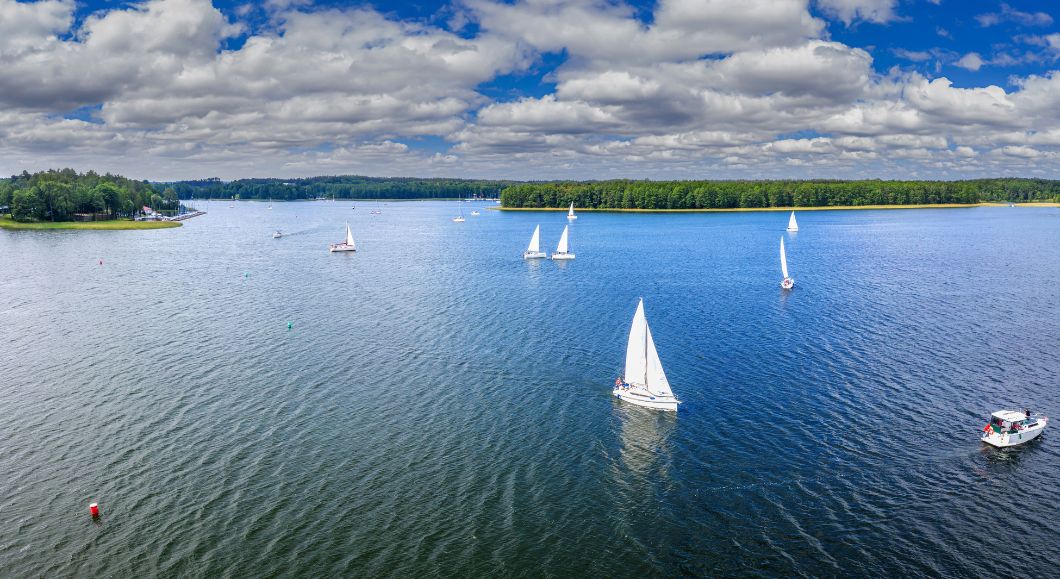
There is a part of Poland that most international visitors never reach, and the Poles who know it tend not to advertise the fact too loudly. The Masurian Lake District — Mazury in Polish — occupies the northeastern corner of the country in a vast sweep of forests, rivers, and interconnected lakes that covers an area larger than some small countries. The nickname “Land of a Thousand Lakes” is, if anything, an understatement: there are over 2,000 lakes here, ranging from small woodland ponds to bodies of water large enough to spend a week sailing without covering the same route twice.
This is where Polish families go for their summers. Sailboats and kayaks replace cars as the primary mode of transport. The pace of life slows to the speed of water. And in a country whose most visited attractions are rightly famous for their history and architecture, Mazury offers something completely different — a landscape of remarkable natural beauty where the main activity is simply being outside in it.
What Mazury actually looks like
The geography of the region was shaped by glaciers retreating at the end of the last ice age, which left behind a landscape of rolling hills, dense pine and mixed forests, and thousands of lake basins carved into the earth. The lakes are connected to each other by rivers and canals, creating a network of navigable waterways that runs for hundreds of kilometres without the need to go ashore.
The district is centred on Lake Sniardwy — Poland’s largest lake at 114 square kilometres — and Lake Mamry with its adjacent waters covering an additional 104 square kilometres. Over 15 percent of the entire area is covered by water and another 30 percent by forest. In between are small towns, farmsteads, nature reserves, and the occasional castle ruin — reminders that this landscape has been inhabited and contested for centuries.
The water is clean by any standard. Swimming in Masurian lakes is not the cautious dip of someone checking for pollution — it is the confident plunge of someone who knows the water is genuinely clear. Many lakes have sandy bottoms and gradual entry points, and the water temperature in July and August typically reaches 20 to 25 degrees Celsius, warm enough to spend real time in.
The Great Masurian Lakes Trail
The backbone of the region for anyone arriving by boat is the Great Masurian Lakes Trail — a continuous waterway of around 100 kilometres that links a chain of major lakes from Wiartel in the south to Wegorzewo in the north. The route passes through some of the most beautiful sailing waters in Central Europe, connecting lakes of different characters: the vast open stretches of Sniardwy and Mamry, the more intimate bays of Mikolajskie and Beldany, the forested shorelines of Nidzkie where the banks are almost entirely undeveloped.
Along the way, the engineering of the connections between lakes is itself worth noting. Canals, locks, and swing bridges link the individual bodies of water. In Gizycko, a swing bridge on the Luczanski Canal operates by human muscle, and in high season queues of vessels line up waiting to pass through it. The locks are social places during summer, where sailors from different boats find themselves waiting together and conversation starts naturally over the rails.
Sailing the full trail takes a week at a relaxed pace. Day sails, half-day excursions, and bareboat or skippered charters are all available from the main sailing ports, with Mikolajki and Gizycko offering the widest choice of rental boats and operators.
Mikolajki: the sailing capital
Mikolajki is the most important sailing port in Mazury and the town that most visitors use as their base for exploring the lakes. The town itself is small — a few streets of painted houses clustered around a narrow strait between two lakes — but its waterfront is lined with masts for much of the summer, and the atmosphere it generates is entirely out of proportion to its size. This is where the Polish sailing world converges in July and August, and the restaurants, bars, and jetties have a social energy that other towns in the region can’t quite replicate.
From Mikolajki you can rent sailboats, motorboats, kayaks, stand-up paddleboards, and pedal boats. Ferry services cruise between the surrounding lakes on fixed schedules and offer a way to see the water without any sailing experience required. The town beach is small but popular, and the walking route along the lakefront past the marina is the right way to start any day here.
The Luknajno Lake, a short drive from Mikolajki, is a UNESCO Biosphere Reserve and home to one of the largest wild mute swan populations in Europe. The viewing point above the lake offers sightings during the summer months that genuinely surprise people who weren’t expecting serious wildlife in this corner of Poland.
Kayaking the Krutynia River
If sailing is the quintessential Masurian experience for those who already know the region, kayaking the Krutynia River is the experience that converts everyone else. The Krutynia is a 100-kilometre river winding through the Piska Forest and the Mazury Landscape Park, moving slowly enough for beginners and children while passing through landscape of sufficient beauty to satisfy anyone.
The kayaking trail on the Krutynia is marked, the river’s current is slow, and the numerous meanders and interesting terrain make it one of the finest canoe routes in Europe. The most popular starting point is the village of Krutyn, where rental operations will set you up with a kayak and collect you at the end of the route. The full trail to Ukta takes around three to four hours at a comfortable pace, passing through forest, meadow, and small lakes without a road in sight for much of the way.
The river passes through several nature reserves and the birdlife along the banks — herons, kingfishers, ospreys, white-tailed eagles — is exceptional. Beaver dams appear periodically; the Piska Forest has one of the largest beaver populations in Poland. You can choose from one-day excursions or multi-day trips that camp along the riverbank, with rental operators handling logistics at both ends.
Gizycko and the Boyen Fortress
Among the larger towns in the region, Gizycko has the most to offer beyond the waterfront. The 19th-century Boyen Fortress — a Prussian star fort built in the 1840s to defend the strategic narrows between Lakes Niegocin and Kisajno — is one of the best-preserved fortifications of its type in Poland, and the walking route around and through its ramparts takes a couple of engaging hours. The town itself has a working harbour, a well-developed waterfront promenade, and the range of restaurants and provisions that make it a natural stop for sailors on the Great Lakes Trail.
The swing bridge on the Luczanski Canal is visible from the harbour and worth watching from the bank during busy periods — the operation of a bridge moved by human effort in an era of automated engineering has a slightly surreal quality that locals accept as entirely normal.
History in the landscape
Mazury’s natural beauty tends to dominate the conversation, but the landscape carries significant historical weight as well. The Teutonic Knights controlled this territory from the 13th century, and the ruins and reconstructed castles they left behind are scattered across the region — Ketrzyn, Reszel, Bartoszyce, and the castle at Ryn, now converted into a hotel, are all within reasonable range of the lake district.
Wolf’s Lair — Hitler’s wartime Eastern Front headquarters — lies in the forests near Ketrzyn, about 25 kilometres from Gizycko. Many visitors to Mazury combine a day on the lakes with a visit to the Wolf’s Lair site, which makes geographical sense and adds a layer of historical weight to what might otherwise be a purely nature-focused trip. We cover Wolf’s Lair in detail in a separate article on this blog.
The Warmia region to the west, technically distinct from Mazury but often grouped with it for tourism purposes, has its own historical texture — the Cathedral Hill in Frombork where Copernicus made his observations, the Gothic cathedral complex at Lidzbark Warminski, and the town of Olsztyn with its castle and Copernicus connections all reward a detour.
Getting there and getting around
Warsaw is the most natural starting point for a Masurian visit. The drive to Olsztyn, the regional capital, takes around two and a half hours; to Mikolajki or Gizycko, add another 45 minutes to an hour. Direct trains run from Warsaw to Olsztyn and to Elk, from where regional connections reach the main lake towns in around two and a half to three hours depending on the service.
The honest caveat is that Mazury rewards those with a car or a boat. The attractions of the region are spread over a large area and public transport, while adequate between the main towns in summer, misses the smaller villages, nature reserves, and lakeside spots that give the region its real character. If you’re coming for a week and planning to sail, the boat becomes your transport and the question of a car matters less. For a shorter visit from Warsaw, renting a car at the station in Olsztyn and driving into the lake district gives you the flexibility the landscape requires.
When to go
The main season runs from late May to August, with air temperatures reaching 25 to 28 degrees Celsius and the lakes at their warmest and most inviting. September is a quieter and often more pleasant alternative — the crowds thin significantly after the Polish school holidays end, accommodation becomes easier to find, and the early autumn colours in the forests add something the summer version of the landscape doesn’t have.
The peak weeks of July and early August bring significant crowds to Mikolajki and Gizycko in particular — accommodation books up months in advance and the popular sailing routes become busy with traffic. If you’re planning a summer visit, book early and consider basing yourself in a smaller town or village rather than the main centres.
Winter in Mazury is a different experience entirely — frozen lakes, empty forests, and a stillness that the summer version of the region doesn’t offer. A handful of operators run ice fishing trips and winter walking tours, and the agrotourism farms that stay open year-round offer a warmth of hospitality that compensates for the cold outside.
The one piece of advice that applies regardless of season: go further than you think you need to. The main towns are enjoyable but the real Mazury is in the quieter places — the unmarked lake you find through a forest track, the village of wooden houses where the only restaurant has been run by the same family for thirty years, the dawn on the water before anyone else is awake. That version of Poland is still here, and it is worth the effort to find it.