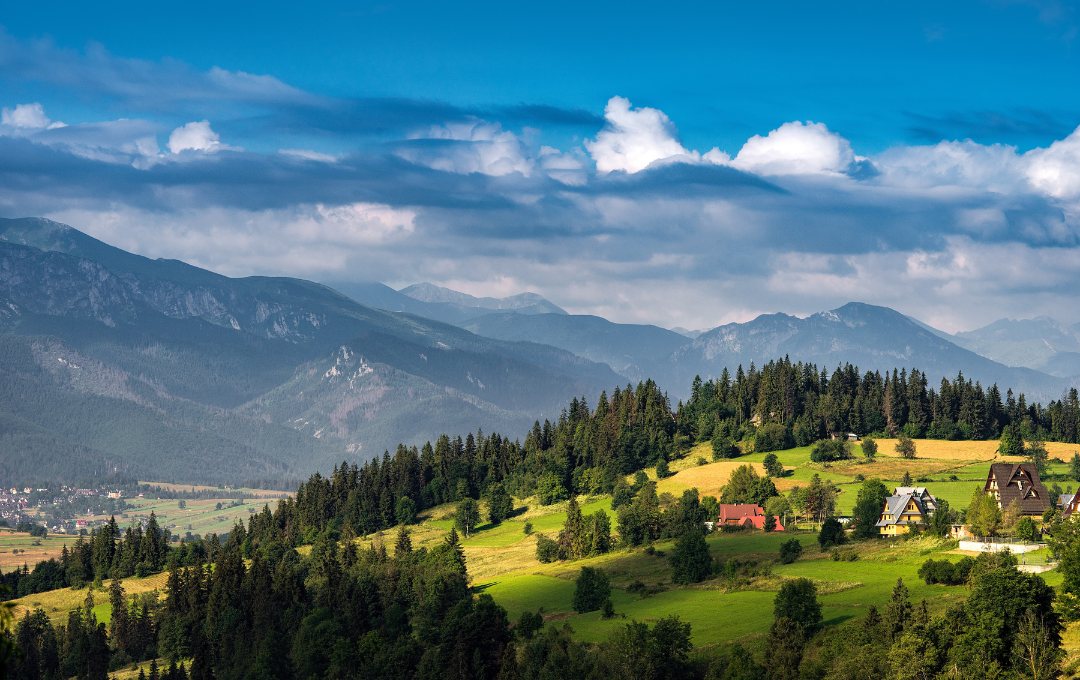
The Tatras are the only truly alpine mountains in Central Europe east of the Alps. That sentence sounds like something from a brochure, but it carries weight once you’re standing at a trailhead in Kuźnice looking up at granite peaks that rise to over 2,500 metres from a valley floor at 800 metres. The transition from forest to dwarf pine to exposed rock to ridge happens within a few hours of walking. Eagles soar above the upper valleys. Chamois pick their way across limestone faces that drop hundreds of metres on both sides. In the high zones there are plant species that exist nowhere else on earth.
All of this is accessible from a town of 27,000 people — Zakopane — which sits at the northern edge of the Tatra National Park and has been Poland’s mountain capital since the 19th century. Two million people visit the Polish Tatras each year. A million of them come in July and August alone. The mountains justify every one of those visits.
Getting to Zakopane
Zakopane is about 100 kilometres south of Krakow and is most easily reached from there. The journey by direct bus takes around 2 hours; buses run frequently from Krakow’s main bus station at Galeria Krakowska. The train takes slightly longer and requires a change. Many visitors make Zakopane a day trip from Krakow, though staying overnight gives you early morning access to the trails before the crowds arrive.
From Warsaw, the journey is around 5–6 hours by train or bus, usually with a connection in Krakow. There are no direct flight connections to Zakopane — the nearest airports are Krakow-Balice (around 2.5 hours away) and Katowice.
One practical note that almost every guide mentions and almost every visitor ignores: don’t bring a car. Zakopane’s single main road jams badly in summer and winter. Parking near popular trailheads fills by 7 AM on summer weekends. Public buses run from Zakopane to all the major valley access points, and using them is significantly faster and less stressful than driving. The bus to Morskie Oko costs around 15 PLN; the local bus to Kuźnice is around 5 PLN.
Zakopane Town: What to See Before You Hit the Trails
Most visitors use Zakopane primarily as a base and spend their days in the national park. The town itself rewards a slower look — particularly if you arrive the evening before and spend an hour walking before dinner.
Krupówki Street is the pedestrianised main street, running from the centre southward toward the mountains. It’s touristy in the expected ways — souvenir shops, restaurants with highlander-costumed staff, stalls selling oscypek cheese. But the wooden buildings lining it are genuine, the mountain backdrop at the far end is spectacular, and the energy of a mountain resort town in full season is infectious.
Zakopane Style architecture is what you’re actually looking at on Krupówki and throughout the older residential streets. In the 1890s, a painter and architect named Stanisław Witkiewicz arrived in Zakopane and decided that the traditional wooden houses of the Góral highlanders — with their carved decorations, steep shingled roofs, geometric motifs, and structural honesty — deserved to be elevated into a proper architectural movement. He designed Villa Koliba on Kościeliska Street (1892–1894) as his manifesto building. Subsequent villas, churches, and public buildings followed his principles: sturdy log construction, exposed wood, intricate carvings of Tatra flora and geometric Góral patterns, steep roofs capable of shedding heavy snow. Villa Koliba is now a museum open to visitors; it’s modest in scale but genuinely beautiful and takes about 30 minutes to walk through.
The Old Zakopane Cemetery on Pęksowy Brzyzek, a few minutes’ walk from the centre, contains the graves of the artists, writers, and mountaineers who made Zakopane famous in the late 19th century — including the physician Tytus Chałubiński, who first “discovered” the town for Polish intellectuals in the 1870s. The cemetery is enclosed by a wooden fence in the Zakopane style, the grave markers are intricately carved, and the mountains are visible over the treeline. It is quiet and genuinely moving.
The Tatra Museum on Chałubińskiego Street covers the natural history of the Tatras, the ethnography of the Góral highlanders, and the history of mountain exploration from its 19th-century beginnings to the present. The building itself is a Witkiewicz design. Allow 1–1.5 hours.
The Górale: The People of the Tatras
Before going into the mountains, it helps to understand who lives at their feet. The Górale are the highlanders of the Podhale region — ethnically and linguistically distinct from lowland Poles, with a dialect that mixes Polish with influences from the Vlach nomadic tradition and other mountain cultures. Their economy was historically based on sheep herding and transhumance (moving flocks between valley and alpine pastures with the seasons), supplemented by wood crafts and, over the last century, tourism.
The Górale culture is a living one, not a museum piece. Men still wear the traditional white wool trousers with black embroidery, leather moccasins (kierpce), and wide felt hats on feast days and weddings. Traditional music — lively, rhythmic violin-led pieces with unconventional harmonies — is played at restaurants throughout Zakopane and at the International Highlander Festival held every August. The zbójnicki dance, the “robbers’ dance,” reenacts highland outlaws and involves stamping, spinning, and increasingly athletic footwork as the evening progresses.
Oscypek — the smoked sheep’s milk cheese — is the region’s defining food product. It has protected designation of origin status in the EU, meaning authentic oscypek can only be produced in this region using methods passed down across generations. Buy it warm from the stalls on Krupówki, grilled and served with a spoonful of cranberry jam. It costs almost nothing and is one of the better things you’ll eat in Poland.
Tatra National Park: Entry and Essentials
The Tatra National Park — Tatrzański Park Narodowy — covers 21,197 hectares on the Polish side of the mountains, with the Slovak national park continuing seamlessly across the border. There is no physical border between the two; Poland and Slovakia are both in the Schengen Zone, and many trails cross between countries naturally.
Entry tickets are required for the national park. Adult tickets cost 55 PLN for a weekly pass (reduced to 27.50 PLN for children). Single-entry tickets are also available. Tickets can be bought at trailhead entry points, at the tourist information office at Chałubińskiego 44 in Zakopane (open daily 7:30–16:15), or via the SkyCash app.
Trails are open daily from April 1 to November 30 between dawn and dusk — camping overnight in the park is prohibited and enforced with fines. From December 1 to May 15, several high sections are closed due to avalanche risk, including the approach from the Valley of Five Polish Ponds to Morskie Oko via Świstówka Roztocka. Always check trail conditions on the park website or at the tourist information point before heading out.
The mountain rescue service — TOPR (Tatra Voluntary Rescue Service) — operates throughout the Polish Tatras. Their emergency number is 985 (or +48 18 206 34 44 for calls from abroad). Rescue is provided free of charge within the park.
Weather in the Tatras changes quickly and dramatically. A sunny morning can turn to afternoon storms with lightning at exposed ridges with almost no warning. Check the forecast at meteo.imgw.pl before any high-altitude hike and carry a waterproof layer regardless of conditions at the valley.
The Main Trailheads and What They Lead To
Kuźnice is the primary southern gateway to the High Tatras from Zakopane, reached by a short local bus from town or on foot in about 45 minutes. From Kuźnice the cable car runs to Kasprowy Wierch (1,987 metres) — the most popular single ascent in the Polish Tatras. The peak is accessible year-round; in winter it’s a ski mountain, in summer a ridge-walking starting point with views extending on clear days across the entire Tatra range and south into Slovakia. The cable car fills early on summer weekends; arrive before 8 AM or book online. Walking from Kuźnice to Kasprowy Wierch takes around 3–4 hours depending on the route.
Palenica Białczańska is the starting point for the trail to Morskie Oko, reached by bus from Zakopane in about 30 minutes. The trail to the lake is 9 kilometres each way along a paved forest road, mostly gradual, with a final steeper section near the lake. It takes 2–2.5 hours each way. The lake itself — Morskie Oko, the Eye of the Sea — is the largest in the Tatras at 34.5 hectares, set in a granite cirque at 1,395 metres with walls rising another 600 metres above it. There is a mountain hut at the lake serving hot food. The trail sees enormous visitor numbers; weekday mornings or early starts are strongly recommended.
Dolina Kościeliska (Kościeliska Valley) is the best introduction for visitors who want the atmosphere of the Tatras without committing to a strenuous climb. A wide, flat valley road runs for 5 kilometres through towering limestone walls, past rock gates, streams, and forests, to a series of mountain meadows. There are cave systems accessible from the valley — Mroźna Cave (open spring through autumn) offers a guided 20-minute walk through chambers decorated with stalactites. The valley is accessible by bus from Zakopane.
Dolina Chochołowska in the Western Tatras is similar in character to Kościeliska — a long, relatively gentle valley walk — but less visited and particularly spectacular in late April when the alpine crocuses bloom across the upper meadows. The Chochołowska mountain hut near the valley head is one of the largest in the park, with over 130 beds and a reliable kitchen.
What to See Without Hiking: Gubalówka and the Views
For visitors who want the mountain experience without a serious climb, the Gubalówka cable car offers the quickest access to a panoramic view. It runs from the northern end of Krupówki Street to the Gubalówka ridge at 1,120 metres — a 4-minute ride that costs around 25 PLN return. From the ridge you look south across all of Zakopane to the full sweep of the Tatra peaks. The Giewont massif — the three-peaked ridge with a steel cross at its summit, visible from the town — dominates the view. According to local legend, the sleeping shape of Giewont is a knight and his army in repose, who will awaken when Poland is in danger. In the early 20th century this felt less like legend and more like premonition.
The Gubalówka ridge also has a walking trail running west toward Butorowy Wierch, passing small inns, souvenir stalls, horse rides, and what feels like an entire parallel Zakopane spread along the hilltop. It’s perfectly pleasant for an hour’s amble.
Practical Tips
Bring cash. Public transport fares, national park entry, oscypek from the stalls, and many smaller restaurants and mountain huts operate cash only. ATMs exist in Zakopane town but may not be at trailheads.
Wear proper shoes. The number of people tackling Tatra trails in sandals or canvas sneakers is astounding and worrying. The rocky paths, particularly above the tree line, are uneven and can be slippery in rain. Proper hiking shoes with ankle support are not optional.
The high season runs July through August and during the winter ski season (December–February). If you’re visiting for hiking, late May through June or September through early October offer lower crowds, generally stable weather, and the advantage of seeing the park in transition — spring flowers or autumn colours depending on timing. September in particular is exceptional: clear days, golden larches, significantly fewer people.
Mountain huts (schroniska) within the park offer basic accommodation and hot meals. They book up weeks in advance in high season. The hut in the Valley of Five Polish Ponds is one of the highest in Poland and requires a full day’s hike to reach; staying there overnight and walking out the next morning is one of the definitive Tatra experiences.