In the summer of 1569, King Sigismund Augustus rode on horseback from Lublin Castle through the narrow streets of the Old Town to the Dominican Church, where a solemn Te Deum was being sung. The occasion was the signing of the Union of Lublin — the treaty that united the Kingdom of Poland and the Grand Duchy of Lithuania into a single Commonwealth that would, for a time, be the largest state in Europe. The Polish-Lithuanian Commonwealth that emerged from this moment was something genuinely novel: a multinational, multi-religious republic governed by elected kings, with remarkable legal protections for minority groups. Historians sometimes compare it to a 16th-century European Union.
All of this happened in Lublin. Not Warsaw, not Krakow — Lublin, a city on the trade route between those two capitals, sitting precisely halfway between them, which was exactly why it was chosen. The city that shaped the politics of central Europe for two centuries is now the city most Polish tourists skip on their way somewhere else.
That is a mistake. Lublin has one of the best-preserved Old Towns in Poland — over 110 monuments on less than a square kilometre, more than 70% of its original buildings intact — and a history layered with Catholic, Jewish, Orthodox, and Protestant cultures that met here for centuries before the war destroyed most of what had been built together. The Old Town was named a Historic Monument of Poland. It was awarded the title of European Capital of Culture for 2029. And on most weekdays in spring and autumn, you can walk its cobbled streets without fighting through a crowd.
Getting There
Lublin is around 170 kilometres southeast of Warsaw and is served by regular express trains and intercity buses from the capital. The train journey takes around 2–2.5 hours on a fast service; buses are slightly slower but run frequently. From Krakow the journey is around 3.5 hours by train. There is no direct intercity train connection from Gdansk or Wroclaw without a change.
Lublin’s main train station (Lublin Glowny) is about 1.5 kilometres from the Old Town — a 20-minute walk or a short bus ride (buses 1, 13, and 17 run from the station toward the centre). Taxis and Bolt/Uber take around five minutes.
The Cracow Gate: Start Here
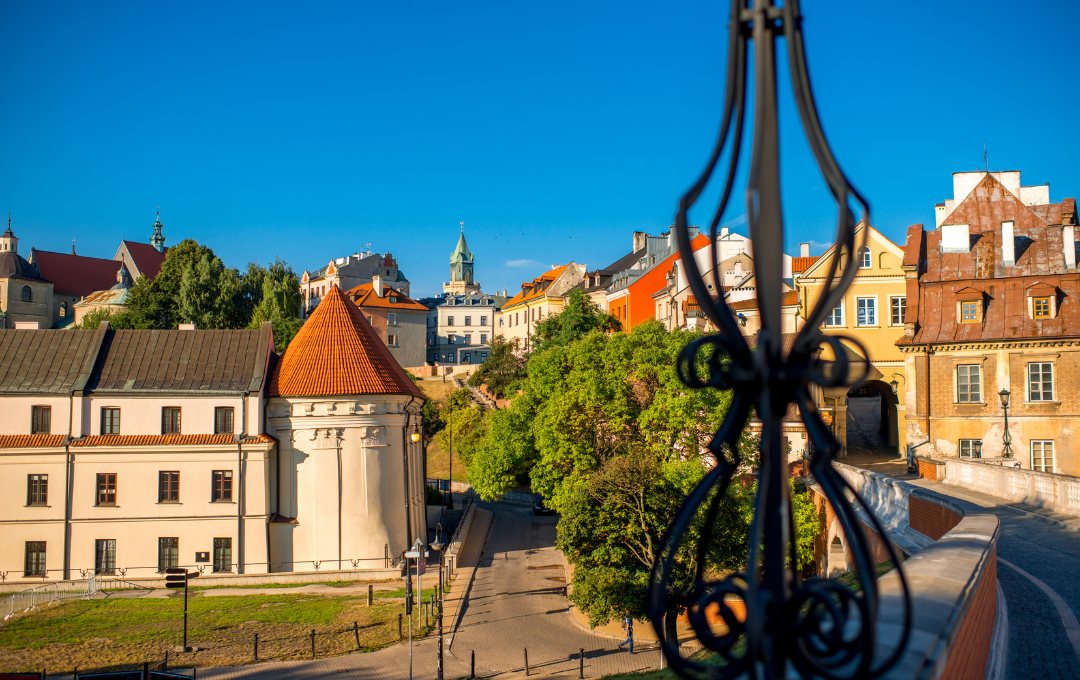
The natural entrance to the Old Town from the main city is the Cracow Gate — Brama Krakowska — a Gothic defensive tower that has stood at the western edge of the Old Town since the 14th century. It’s now the Museum of the History of the City of Lublin, and the tower’s fifth floor has one of the best viewpoints over the Old Town roofscape and the castle beyond.
Directly behind the gate, tucked into a small courtyard on the right, is a detail most visitors miss: a mural reproducing a print of the city as it appeared in 1618, taken from the Civitates Orbis Terrarum atlas, and the original Semicircular Tower — a surviving fragment of the medieval city walls, standing in the courtyard of a building that has grown up around it over four centuries.
The Market Square and the Crown Tribunal
Walk east from the Cracow Gate and you enter the Market Square — the Rynek — an oblong space with the Crown Tribunal building at its centre rather than a freestanding town hall. The Crown Tribunal was established in 1578 as the highest court of appeal for Lesser Poland, which made Lublin one of the legal capitals of the country. Important cases, appeals from across southern Poland, and the decisions of influential noble families were all argued out in this building. Today it houses the Lublin Underground Route, an atmospheric 280-metre walk through medieval and Renaissance cellars running up to 12 metres beneath the Market Square — one of the best underground experiences in Poland.
The surrounding townhouses are a textbook of what historians call Lublin Renaissance — a local style that emerged after a catastrophic fire in 1575 destroyed much of the earlier wooden city. When Lublin was rebuilt in stone, the local craftsmen developed an exuberant decorative approach that mixed Italian Renaissance proportions with native Polish ornamental sensibility. The result is facades covered with richly carved arcaded galleries, allegorical figures between windows, and graffito decoration that makes even fairly modest buildings look ceremonial. Look at the Klonowic Family Tenement House on the Market Square: between the first floor windows, carved portraits of poets who lived and worked in Lublin — including Jan Kochanowski, one of the greatest Polish Renaissance writers, who died in the city in 1584.
The Fortuna Cellar
A short walk from the Market Square, beneath a building that has been rebuilt and repurposed several times, is one of the most unexpected things in Lublin: a series of Renaissance wine cellars from the 16th century whose walls are covered in original frescoes. The Fortuna Cellar contains the most intact Renaissance wall paintings in Lublin, depicting allegorical scenes in vivid colours that have survived partly because the space was sealed off for centuries. The multimedia exhibition running alongside the frescoes explains the history of Lublin’s merchant trade and the role of wine imports from Hungary and the Balkans in the city’s commercial life. Admission is ticketed and inexpensive. It’s open most days but with varying seasonal hours — check the Grodzka Gate NN Theatre website before visiting.
The Grodzka Gate: The Threshold Between Two Worlds
At the eastern edge of the Old Town, the Grodzka Gate — Brama Grodzka — is a medieval passageway that for centuries stood as the physical boundary between the Christian town above and the Jewish quarter below. It was called the Jewish Gate informally, because it was through this arch that you passed from one world to the other.
Today it houses the Grodzka Gate – NN Theatre, a cultural institution whose work focuses on preserving the memory of Jewish Lublin. The exhibitions here are unlike anything else in Poland — part archive, part memorial, part reconstruction of a vanished world. Interactive displays allow visitors to explore the streets of the pre-war Jewish quarter as it existed in 1939. Photographs, documents, recorded testimonies, and virtual reconstructions build an image of a community of around 45,000 people — roughly a third of Lublin’s total population — that was almost entirely murdered during the Holocaust. The German authorities used Lublin as the headquarters for Operation Reinhardt, the operation to exterminate all Jews in occupied Poland.
Inside the gate itself, a small eternal flame burns — the Memory Lantern — commemorating those who passed through here for the last time. It is the simplest possible memorial and among the most affecting things in this city.
Allow at least an hour at the Grodzka Gate. It reframes everything you see in the Old Town above.
Lublin Castle and the Holy Trinity Chapel
A short walk from the Grodzka Gate brings you to Lublin Castle, perched on a hill with views over the city and the Bystrzyca valley beyond. The castle you see is mostly a 19th-century neo-Gothic construction built on the medieval foundations — it served as a prison until 1954 and the institutional character of its corridors is hard to shake. But two elements of the original medieval complex survive and are extraordinary.
The Donjon — a round defensive tower from the 13th century — is the oldest standing structure in Lublin. Walls up to 4 metres thick, an exhibition on castle history, and a viewpoint at the top from which you can see the full layout of the Old Town in relation to the castle hill.
The Holy Trinity Chapel is one of the most important medieval interiors in Poland and among the most visited sites in the city. From the outside it’s a modest Late Gothic structure. Inside, the entire surface — ceiling, arches, walls — is covered in Byzantine-Ruthenian frescoes painted in 1418 on the order of King Wladyslaw Jagiello, the ruler who had united Poland and Lithuania through his marriage to the Polish queen three decades earlier. The frescoes are in a style completely unlike anything else in Gothic Poland: gold halos, flat Slavic forms, vivid mineral colours, archangels and saints in poses drawn from Orthodox iconographic tradition rather than Western Gothic convention. A unique image of King Jagiello himself appears among the figures. The chapel has been given the European Heritage Label. Go slowly through it.
The castle also holds the National Museum in Lublin, with Jan Matejko’s monumental painting of the Union of Lublin, depicting the signing ceremony of 1569 with the figures of Polish and Lithuanian nobles gathered in the castle hall.
The Dominican Basilica
At the corner of the Market Square and Zlota Street stands the Dominican Basilica — the largest church in Lublin and one of the oldest, originally founded in the 14th century. The current building is the product of successive reconstruction after the 1575 fire and shows the full range of Lublin Renaissance decoration at its most confident. A thanksgiving mass was celebrated here on the day the Union of Lublin was signed, with King Sigismund Augustus himself attending.
The interior is layered with Gothic vaulting, Renaissance chapels, Baroque altars, and a sense of accumulated time that good old churches accumulate without quite meaning to. The medieval cloister is worth finding if you can get access. The Firlej Chapel, off the southern nave, has one of the best Renaissance vault decorations in the building.
Plac po Farze: A Square With a Ghost
A few steps from the Market Square, Plac po Farze is a square with nothing in it — or almost nothing. The foundations of the old Parish Church of St. Michael the Archangel are outlined in the ground, and a small model in the corner shows what the medieval church looked like before it was demolished in the 19th century because the building had fallen into too poor a condition to save. The church tower, once visible for kilometres in every direction, is gone. The foundations remain.
It’s a strange, contemplative space — a square defined by what’s no longer there. People sit on the low stone outlines. Children play. The castle is visible over the rooftops to the east. In the evening, when the square is quiet, it becomes one of those places where you think about impermanence without having to try.
Practical Tips
Lublin’s Old Town is compact enough to walk thoroughly in a half-day. A full day including the castle, the Grodzka Gate exhibitions, and the underground route is a comfortable pace. The Lublin Underground Route (Trasa Podziemna) requires a ticket and runs regular guided tours; book online or check times at the Crown Tribunal entrance on the Market Square.
The cebularz — a round flatbread with stewed onion and poppy seeds, baked in wood-fired ovens and sold throughout the city — is Lublin’s defining regional food. Buy one warm from a bakery near the Market Square and eat it on Plac po Farze. It costs almost nothing and tastes better outside.
The best time to visit is late May through June, or September. Summer brings festivals — the Festival of Jewish Culture in August, the Jagiellonian Fair in late August that turns the Old Town into a Renaissance market — but also more visitors. Autumn quiets the city down and the light on the Renaissance facades turns golden in a way that is very hard to photograph and very easy to remember.
Lublin was awarded European Capital of Culture for 2029, which means that through the late 2020s the city is investing heavily in its cultural infrastructure. The transformation is already visible, and the city’s self-confidence as a destination is growing. Come before the crowds catch on.