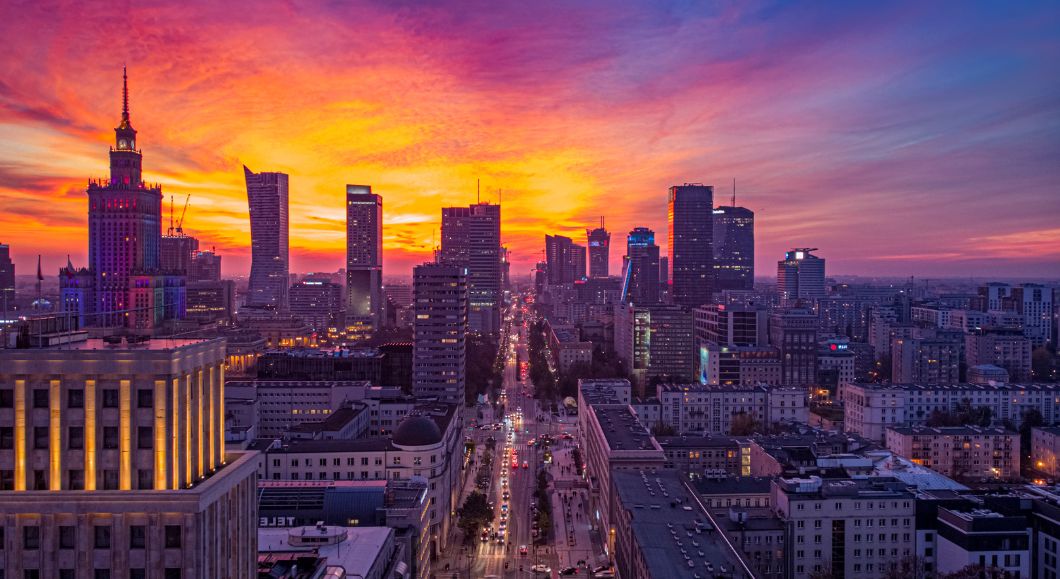
Warsaw has a nightlife problem, and the problem is that it’s genuinely good. Not good in the “for Eastern Europe” qualifier way that used to attach itself to anything east of Berlin, but good in an absolute sense — a city where you can spend an evening in a 25-bar courtyard labyrinth, follow it with an hour at a basement techno club with a world-class DJ, end up at a riverside bar watching the sun come up over the Vistula, and spend less on the whole night than you would on two drinks in London.
The city recovers quickly and builds on ruins. The nightlife that emerged after communism, after the grey economy of the 90s, after the rapid economic growth of the 2000s, is various and layered and still changing. Understanding it means understanding that Warsaw has several parallel nightlife scenes rather than one central one, and that which one you wander into depends on which street you start from and which direction you follow.
The Districts: How to Navigate Warsaw After Dark
Śródmieście (the city centre) is where the night most visibly happens for visitors. Nowy Świat — the Royal Route’s southern stretch — anchors the area: bars, cocktail lounges, and restaurants spilling onto the street from early evening. Mazowiecka Street, one block west, is the city’s main clubbing strip: high-energy clubs with dress codes, cover charges, and queues on weekends. If you want to dance to commercial house, top 40, or mainstream techno and don’t mind a tourist-facing environment, Mazowiecka delivers reliably.
Powiśle is the district that Varsovians are most proud of right now. Compressed between the Old Town and the Vistula, it has been transforming since the riverfront boulevards were rebuilt in 2015 — what was once an industrial afterthought is now one of the most pleasant stretches of city in Central Europe. In summer the riverside bars fill with locals from late afternoon until well after midnight. PKP Powiśle — a bar built into the shell of a former tram station under the Poniatowski Bridge — is one of the most iconic spots in the city: unpretentious, cheap, with occasional live music and a crowd that runs from students to architects to office workers who never quite went home. The Copernicus Science Centre next door and the rehabilitated Elektrownia Powiśle power station (now a mixed-use complex with good restaurants and bars) have cemented the area as a daytime-to-nighttime destination.
Praga is on the east bank of the Vistula, a neighbourhood that for decades had a reputation for being rough, cheap, and left out of Warsaw’s transformation. Artists and students moved in first, attracted by low rents and unpolished space. The vodka museum and the Koneser factory complex established a legitimate night-time destination. Ząbkowska Street has gone from gloomy to buzzing. What remains is a genuine alternative to the polished nightlife of the centre — smaller venues, more live music, more surprising encounters, a creative energy that isn’t self-conscious about it. Hydrozagadka — a club in a courtyard with a compound of smaller bars and a hostel attached — is the emblematic Praga venue: indie, alternative, genuinely local.
Plac Zbawiciela (Saviour Square) in the Śródmieście / Mokotów borderlands is where the neighbourhood-bar version of Warsaw’s nightlife concentrates. The square and its surrounding streets have a specific character: slightly older crowd than Mazowiecka, more interested in conversation than dancing, quieter but genuinely alive. This is where local professionals go for a drink after work and don’t leave until midnight.
The Bars
Pawilony — the word means “pavilions” — is Warsaw’s most distinctive drinking experience and one of the most distinctive in Central Europe. Behind the gate at Nowy Świat 24, a network of roughly 25 tiny bars fills a series of interconnected courtyards that once housed craftsmen’s workshops. Each bar has its own personality: some are no bigger than a large wardrobe, some have been there for 30 years in essentially unchanged form, some are newer and more styled. All are cheap. In summer, the courtyard fills with people standing with their drinks in the open air in a way that’s not quite legal and not quite enforced, which gives the whole place an atmosphere of managed anarchy. Open from midday, at their best between 8 PM and 2 AM.
Bar Wieczorny near Łazienki Park is exactly what the name suggests — an evening bar, cosy, cocktail-focused, with the slightly hushed quality of a neighbourhood place that doesn’t try too hard. Worth knowing if you’ve spent the afternoon in the park and want somewhere to transition into the evening without crossing back to the centre.
Woda Ognista (“Burning Water”) evokes pre-war Warsaw: the name, the design, and the intention are all about the city that existed before 1939 — Art Deco references, Polish spirits served with appropriate seriousness, a warmth that doesn’t tip into kitsch. It’s a legitimately good cocktail bar with an identity that goes beyond aesthetic.
PiwPaw Beer Heaven has more than 90 beers on tap — a number that takes a moment to absorb — across its locations on Mickiewicza and elsewhere. The crowd is mixed: beer enthusiasts, students, anyone who wants a great beer in a relaxed environment without the polish of a craft beer brand experience. The bar staff know what’s on tap and will help you navigate it.
Pijana Wiśnia (“Drunk Cherry”) is a Warsaw curiosity worth visiting at least once: a tiny bar that sells exactly one thing — alcoholic cherry drink, served hot or cold, in a setting designed around the single product. It’s Ukrainian in origin, now embedded in Warsaw’s bar scene as a peculiar institution. Go once.
The Clubs
Smolna (Smolna 38) is Warsaw’s most-mentioned techno club: basement location in an old building, serious sound system, regular international bookings, the kind of place where people travel from other cities specifically for the night. Not for the faint-hearted in terms of volume, commitment to electronic music, or hours (open until 6 AM or later). Entry around 40–60 PLN.
Level 27 takes a completely different approach: rooftop club on the 27th floor of the Millennium Plaza tower, panoramic views, smart-casual dress code, commercial house and EDM, the city’s skyline as wallpaper for your evening. It has won multiple TripAdvisor awards for rooftop bars and appears on European top-50 lists for the category. It is expensive by Warsaw standards and deliberately glamorous. Book a table in advance for weekends.
Hydrozagadka in Praga (11 Listopada 22) is the alternative counterpart: indie and experimental nights, live concerts, a courtyard compound with auxiliary bars and a hostel. The crowd is young, the music is varied and genuinely interesting, and the cover charge is low. The sound system is loud in a way that suggests it was built for music first and noise complaints second.
Kulturalna in the Palace of Culture and Science is unusual by virtue of its location: a bar and club in the ground floor of one of Warsaw’s most architecturally confrontational buildings. The retro feel is appropriate (the Palace was built in 1955 as a gift from Stalin to the Polish people), the crowd is arty, and there is live music on weekends.
The Vistula Riverfront: Summer Only
From May through September, Warsaw’s most distinctive and genuinely local nightlife happens along the Vistula. The left bank (the city side) has developed a string of bars, some on fixed terraces and some genuinely seasonal — built, operated, and dismantled with the weather. The right bank (east side, below Praga) has a sandy beach, Plaża Praga, where beach bars and food trucks set up in summer. La Playa, the seasonal bar and club below the Old Town on the left bank, has been operating for years and gets busy from late afternoon on warm days.
These riverside spots are where Varsovians relax in a way that the rest of the city’s nightlife doesn’t quite capture: families early in the evening, young people from around 9 PM, everyone watching the sun set behind the city across the water. The evenings have a loose, uncommitted character — you go without a plan and stay longer than intended.
Practical Information
Drinks prices: Beer 8–18 PLN in most bars; cocktails 25–45 PLN; expensive cocktail bars 50–70 PLN. Warsaw is significantly cheaper than any Western European capital.
Hours: Bars open from midday or late afternoon; clubs typically from 10 PM. Clubs in Warsaw operate late by European standards — many stay open until 5 or 6 AM. Cover charges on weekends at clubs: 20–60 PLN depending on the event.
Getting around at night: The night tram and bus network runs through the night on weekends. Bolt and Uber both operate efficiently at all hours and are cheap by Western standards. There is no need to drink and drive; taxis are fast and affordable.
Safety: Warsaw is among the safer major European cities. The standard urban precautions apply: keep track of your belongings in crowded clubs, stick to well-lit routes late at night, don’t leave drinks unattended. The Praga district, often given a rougher reputation in older guides, is genuinely fine for visitors; the reputation dates from the 1990s.
Dress code: Varies widely. Mazowiecka clubs expect smart-casual. Pawilony doesn’t care what you’re wearing. Praga venues lean heavily casual. Level 27 has the most formal expectations of any regularly-mentioned Warsaw venue.
The honest summary of Warsaw nightlife is that it rewards curiosity over planning. The city is too large and too layered for any single itinerary to capture it, and the most memorable evenings here tend to be the ones where you followed one place to the next without knowing quite where you’d end up.