There is no way to prepare fully for what you will see at Auschwitz-Birkenau. Every article that attempts to describe it encounters the same limit: language isn’t adequate to the scale of what happened here. Between 1940 and 1945, Nazi Germany operated in this place the largest concentration and extermination camp in history. Over 1.1 million people — the overwhelming majority of them Jews — were murdered here. The physical evidence of that crime is preserved and open to visitors, because the survivors who returned after the war decided it should be.
Going is not an obligation, but for many people who come to Poland, it becomes one. If you decide to go, this guide covers everything you need to know to make the visit as meaningful as possible.
What Auschwitz-Birkenau Actually Is
The memorial and museum encompasses two main sites, located about 3 kilometres apart:
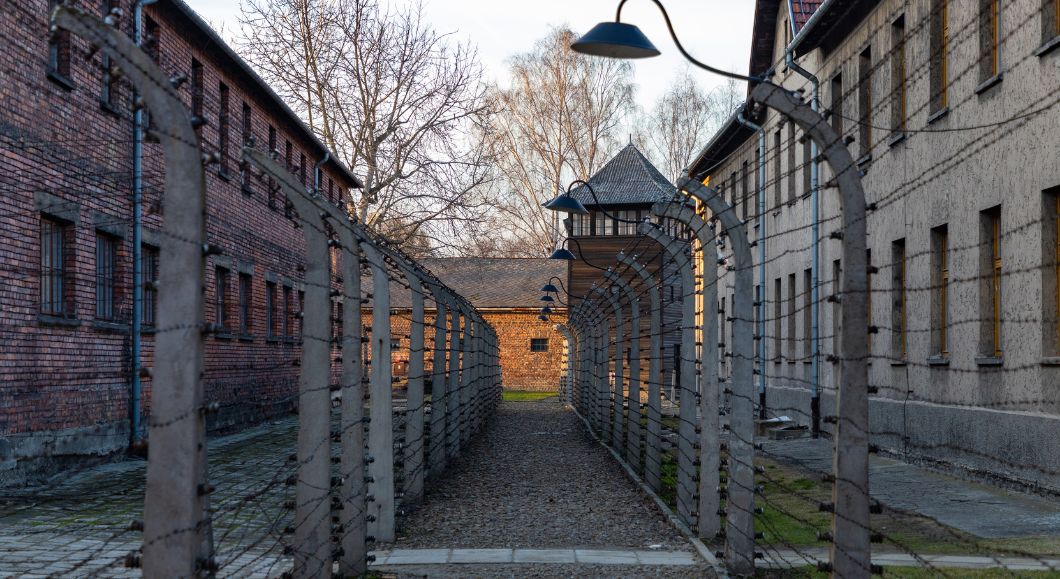
Auschwitz I — the original camp, opened in 1940, initially for Polish political prisoners. The brick barracks here have been converted into permanent exhibitions. The “Arbeit Macht Frei” gate above the main entrance — the lie that greeted prisoners on arrival — is still in place. The exhibitions document the camp’s history, the systematic process of persecution and murder, and the individual stories of those who were brought here. One building contains rooms of evidence recovered from the site after liberation: mountains of shoes, glasses, suitcases, prosthetic limbs, hair. The scale of these rooms — what they represent — is the point at which many visitors reach a different understanding of what they are seeing.
Auschwitz II-Birkenau — the extermination camp, vastly larger than Auschwitz I. The railway tracks run directly to the selection platform where arriving transports were met. Those deemed unfit for forced labour — the majority, typically the elderly, children, and their mothers — were directed immediately to the gas chambers. The crematoria were blown up by the SS before they retreated; the ruins remain. The scale of Birkenau — rows of barracks extending to the horizon, the vastness of the death architecture — is something photographs cannot communicate. You have to stand there.
A free shuttle bus connects the two sites. The visit to both requires a minimum of three hours; more is better. Most guided tours run 3–3.5 hours and cover the essential elements of both camps.
Booking Your Entry: What You Need to Know
All visitors must pre-book a personalised entry pass through the official website: visit.auschwitz.org. There are no tickets available at the entrance on the day. This is not a technicality — the system genuinely sells out, sometimes weeks in advance during peak season (April through October).
Options for individual visitors:
- Guided tour with a Museum educator (3.5 hours, conducted in groups of up to 35): the recommended option for most visitors. The fee is charged for the guide, not for entry. Guides are licensed by the Museum and are knowledgeable about the history in depth. Tours run in English, German, French, Polish, Hebrew, Italian, Russian, Spanish, Czech, Slovak, Hungarian, and many other languages. Book at least one month in advance during summer.
- Self-guided visit (without an educator): possible during certain hours, using free entry passes from the booking system. Only recommended for visitors who have already prepared themselves deeply with reading and who understand the site’s history. Without context, the visit risks becoming a walk through old buildings.
Children: Visits by children under 14 are not recommended by the Memorial itself. The exhibitions contain graphic evidence of murder on an industrial scale.
Practical booking steps: Go to visit.auschwitz.org, select “Visit for individuals,” choose your date and language, select a time slot, register each visitor’s name (names cannot be changed after booking), and pay the guide fee. Bring ID — you will need to present it at the entrance. Entry passes are non-refundable.
Getting There from Krakow
Auschwitz-Birkenau is located near the town of Oświęcim, 66 kilometres west of Krakow. Getting there independently is straightforward:
By bus: Direct buses run from Krakow’s main bus station (MDA) to Oświęcim approximately every 30–60 minutes. Journey time is around 1.5 hours. From Oświęcim bus station it’s a short walk or local bus to the Memorial entrance.
By train: Trains run from Krakow Główny to Oświęcim in around 1.5 hours, with onward local transport to the Memorial.
By organised tour from Krakow: The most practical option for most visitors, particularly those who want the guided tour handled end-to-end without navigating logistics on what can be an emotionally demanding day. Tour operators handle transport, the booking of the Museum-licensed guided tour, and return transfer.
Poland Travel Tours runs well-organised guided day trips to Auschwitz-Birkenau from Krakow, with English-speaking guides and comfortable transport. Their tours are structured around the Museum’s official guided route and include both Auschwitz I and Birkenau. For visitors coming from Warsaw, they also offer an Auschwitz day trip via train to Krakow. Booking in advance is essential, as their tours are popular and slots fill quickly during high season.
What to Expect on the Day
Arrive early. The Museum requests arrival at least 30 minutes before your tour start time for security checks. The security screening is thorough — bags are X-rayed and you pass through metal detectors. Large bags are not permitted inside the exhibitions and must be left in vehicles or in the small-fee lockers near the entrance.
The guided tour begins at Auschwitz I. You will walk through the barracks, through the exhibitions documenting the persecution and murder of Jews across occupied Europe, through the block where medical experiments were conducted on prisoners, past the execution wall between Block 10 and Block 11, into the gas chamber and crematorium of Auschwitz I — the only one not destroyed by the SS, preserved as it was found in 1945.
Transfer to Birkenau. The free shuttle takes about 10 minutes. At Birkenau the scale becomes apparent immediately: 171 hectares, the original guardhouse and main gate, the railway tracks running straight to the selection platform, the reconstructed and original barracks, the ruins of the four main crematoria where the majority of murders took place, the memorial at the far end of the camp near the ruins of Crematoria II and III.
After the guided tour ends, individual visitors may continue walking the Birkenau grounds independently for as long as they wish during opening hours. Many people use this time to walk in quiet, to sit near the memorial, to absorb what they have seen.
Opening Hours
The Memorial is open seven days a week, year-round, except January 1st, December 25th, and Easter Sunday. Hours vary by season:
- December: 7:30 AM – 2:00 PM
- January and November: 7:30 AM – 3:00 PM
- February: 7:30 AM – 4:00 PM
- March and October: 7:30 AM – 5:00 PM
- April, May, September: 7:30 AM – 6:00 PM
- June, July, August: 7:30 AM – 7:00 PM
The early morning time slots are the quietest. Afternoons, particularly in summer, see the highest visitor numbers. A weekday morning visit in April, May, September, or October represents the best combination of reasonable crowds, decent weather, and sufficient daylight.
What to Wear and Bring
Dress respectfully — this is a place of mass murder and the dress code should reflect that. The Memorial explicitly asks that visitors dress in a manner befitting the nature of the site. Shorts and sleeveless tops are considered inappropriate.
Comfortable walking shoes are essential. The total walking distance across both sites is several kilometres, including uneven ground at Birkenau.
Water and a light snack are advisable. There is a restaurant and café at the Visitor Service Centre near the main entrance, but given the nature of the visit, many people find they have little appetite during the visit itself.
A light jacket or layer is sensible even in summer — the underground spaces in the former gas chamber are cool, and Birkenau is exposed to wind.
Photography is permitted throughout the grounds and exhibitions, with restrictions in specific areas marked on site. The Memorial asks that photography be conducted with appropriate sensitivity — this is a burial ground as well as a museum.
How to Prepare
Go informed. Reading about the history of Auschwitz before your visit significantly deepens the experience. The Memorial’s own website (auschwitz.org) has extensive historical resources. For a longer background read, Laurence Rees’s Auschwitz: The Nazis and the Final Solution or Primo Levi’s If This Is a Man (written by a survivor of Auschwitz) provide essential context.
Go emotionally prepared. Most people find the visit more affecting than they anticipated. Build time after the visit to process quietly — do not schedule a busy afternoon of sightseeing immediately afterwards. Many visitors need an hour or two of quiet before they’re ready to re-engage with ordinary daily life.
Go ready to listen. The guided tour provides historical context that transforms what you are seeing from architecture into testimony. Without a guide, the buildings are old and damaged. With a guide, they become what they actually are.
The visit is not an easy thing. It is a necessary one.